A Small Piece of Crabapple Cove
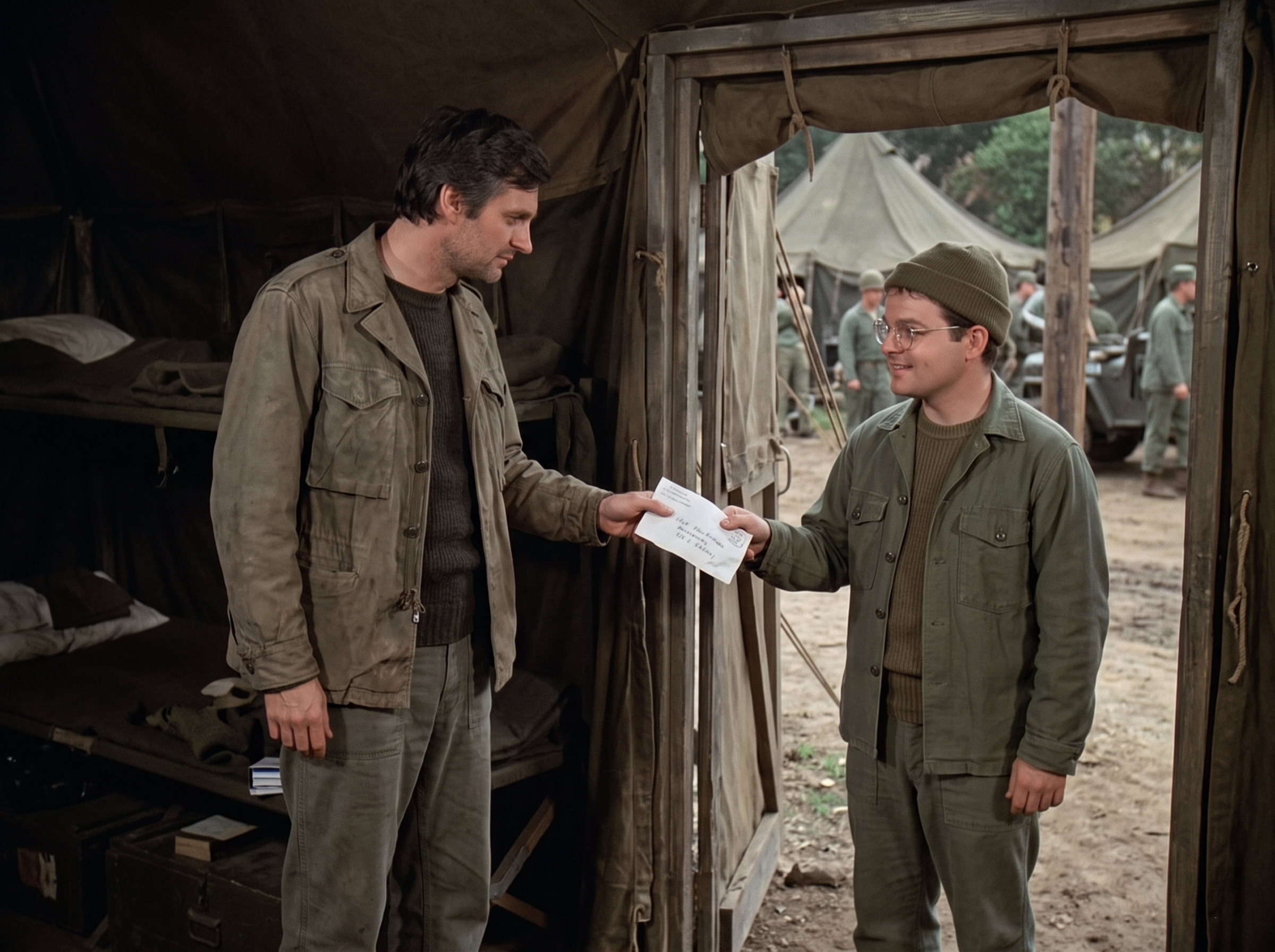
The Swamp was rarely quiet, but when it was, the silence felt heavier than the stifling Korean summer heat. It was a thick, stagnant quiet that settled over the dusty canvas and the unmade cots after a marathon session in the operating room.
Hawkeye Pierce was sprawled on his bunk, still wearing his faded green fatigues. He was staring blankly at the tent ceiling, trying desperately not to see the faces of the kids he had just spent three days patching together.
His body was a map of utter exhaustion. Every muscle ached, and his eyes felt like they were full of sand. He was trapped in that dangerous, hollow place between bone-deep fatigue and the sheer inability to sleep, where the mind just spins its wheels in the mud.
He was just reaching for a witty, cynical thought to keep the darkness at bay when a shadow fell across the sunlit doorway.
It was Radar.
The young company clerk didn’t barge in with his usual clipboard or a frantic message from Colonel Potter. Instead, he lingered gently at the threshold, holding the canvas flap back with one hand.
The bright, dusty dirt path of the compound stretched out behind him, framing him perfectly in the afternoon light. He stood half in the shadow of the tent, wearing his lived-in, modest olive drab.
Hawkeye pushed himself up, instantly preparing his usual defensive shield of jokes. “Unless you’ve found a way to distill gin from canvas, Radar, the doctor is officially out of business.”
But the joke died in his throat.
Radar wasn’t looking for a laugh. He was standing there with a shy, incredibly sincere smile on his face. It was the kind of gentle, unassuming expression that was altogether too rare at the 4077th.
In his other hand, held out with quiet reverence, was a single white envelope.
“Mail call was three hours ago, Hawk,” Radar said softly. “But I was sorting through a stray canvas bag that got routed to the 8063rd by mistake. I found this at the very bottom.”
Hawkeye swung his legs over the side of the cot and stood up. He moved toward the doorway, his eyes fixed entirely on the letter.
He didn’t need to see the return address. He recognized the familiar blue and red airmail border. More importantly, he recognized the slanted, slightly hurried handwriting of Dr. Daniel Pierce.
It was a letter from his father.
Hawkeye stopped just inside the tent. As he reached his hand out toward the envelope, his usual mask of playful deflection simply vanished.
There was no wisecrack. There was no theatrical sigh or rapid-fire punchline.
Instead, his face softened into a quiet, profoundly vulnerable expression. The witty, cynical army surgeon disappeared in an instant, replaced by a desperately homesick son.
His hand hovered just inches from the paper, his fingers trembling a fraction, frozen for a split second by a sudden wave of emotion so thick it threatened to pull him under.
Hawkeye’s fingers finally brushed the edge of the envelope.
The paper felt impossibly thin, fragile enough to tear in a stiff breeze, yet it seemed to carry the entire, monumental weight of the state of Maine.
He took it from Radar’s outstretched hand with a gentleness he usually reserved for tying off tiny, delicate arteries in the OR.
“Thanks, Radar,” Hawkeye murmured. His voice was stripped bare, completely devoid of its usual sarcastic edge. It was just a quiet, gravelly whisper of genuine gratitude.
Radar nodded, his shy smile remaining steady and warm. He didn’t step fully into the Swamp, intuitively understanding that this was private territory.
“He says the tomatoes are doing real well this year,” Radar offered quietly, shifting his weight in his dusty boots.
Hawkeye looked up from the envelope, a flicker of genuine surprise breaking through his emotional fog. “You read my mail, O’Reilly?”
Radar’s ears turned a faint shade of pink, but he didn’t look away. “Oh, no, sir! Never. It’s just… your dad wrote a little note on the back flap. Right over the seal. He said, ‘If the company clerk sees this, tell him my boy owes him a drink for the good care he takes of him.'”
Hawkeye let out a heavy breath that caught halfway in his chest, turning into a sound that was suspended right between a laugh and a sob.
“Of course he did,” Hawkeye whispered, a sudden shine appearing in his tired, dark eyes. “The man is a shameless politician.”
Radar slowly began to let the canvas flap fall. He was deeply innocent in many ways, but he possessed a profound, quiet wisdom when it came to the hearts of the people he served with.
He knew exactly when a man needed to be left alone with three thousand miles of distance.
“I’ll let you read, Hawk,” Radar said softly, his figure fading back into the bright Korean afternoon. “Just… thought you wouldn’t want to wait.”
“You thought right,” Hawkeye replied to the empty doorway.
Alone again in the quiet heat of the Swamp, Hawkeye didn’t rush. He stood in the center of the messy tent, simply holding the letter.
He ran his thumb over the postmark. Crabapple Cove. The ink was slightly smudged, but to Hawkeye, it was the most beautiful piece of art he had seen in months.
He sat back down on his cot, the springs groaning in familiar protest. Carefully, painstakingly, he slid his thumb under the flap and opened the envelope.
When he unfolded the pages, the scent of the paper seemed to waft up and hit him squarely in the chest. It didn’t smell like iodine, or wet canvas, or the diesel fumes of the motor pool.
In his mind, it smelled exactly like his father’s study. It smelled like old hardcover medical journals, cherry pipe tobacco, and the crisp, salty air of the Atlantic Ocean blowing through a screen door.
He began to read.
The words weren’t dramatic. There were no grand philosophical statements about the war or the state of the world. It was simply a chronicle of home.
His father wrote about Mrs. Halvorsen’s stubborn arthritis. He wrote about a leak in the roof over the back porch that finally got patched. He complained affectionately about the local hardware store running out of the right size nails.
He wrote that the weather was turning, the mornings getting that sharp, familiar bite that meant autumn was right around the corner.
And at the very bottom, in handwriting that looked a little more deliberate, a little more pressed into the paper: I’m keeping the light on, son. Come home safe.
For fifteen minutes, the 4077th ceased to exist.
There were no choppers roaring over the hills. There was no distant thud of artillery. There was no endless, bloody parade of wounded boys waiting in pre-op.
For fifteen minutes, Hawkeye Pierce wasn’t a drafted captain in a muddy triage unit. He was just a boy sitting on his front porch, listening to the tide roll in, safe in the knowledge that his father was in the next room.
It was a temporary peace, a fragile illusion made of ink and paper, but it was exactly what he needed.
Hawkeye read the letter three times, savoring every mundane detail, letting the normalcy of it wash over his battered spirit.
Finally, he carefully folded the pages along their original creases. He slipped the letter back into its envelope and tucked it securely into the left breast pocket of his fatigue shirt, right over his heart.
He patted the pocket once, a small, grounding gesture.
He took a deep breath, letting the stale, hot air of the tent fill his lungs. The Swamp came back into sharp focus. The war was still here. The exhaustion was still heavy in his bones.
But as he lay back down on his cot and closed his eyes, his jaw wasn’t clenched quite as tight. He was still in Korea, but a small piece of him had just spent the afternoon in Maine.
Sometimes, the most life-saving medicine at the 4077th didn’t come in a bottle, but in a small, white envelope from home.