The Substitute for Martini Fixings at Rosie’s
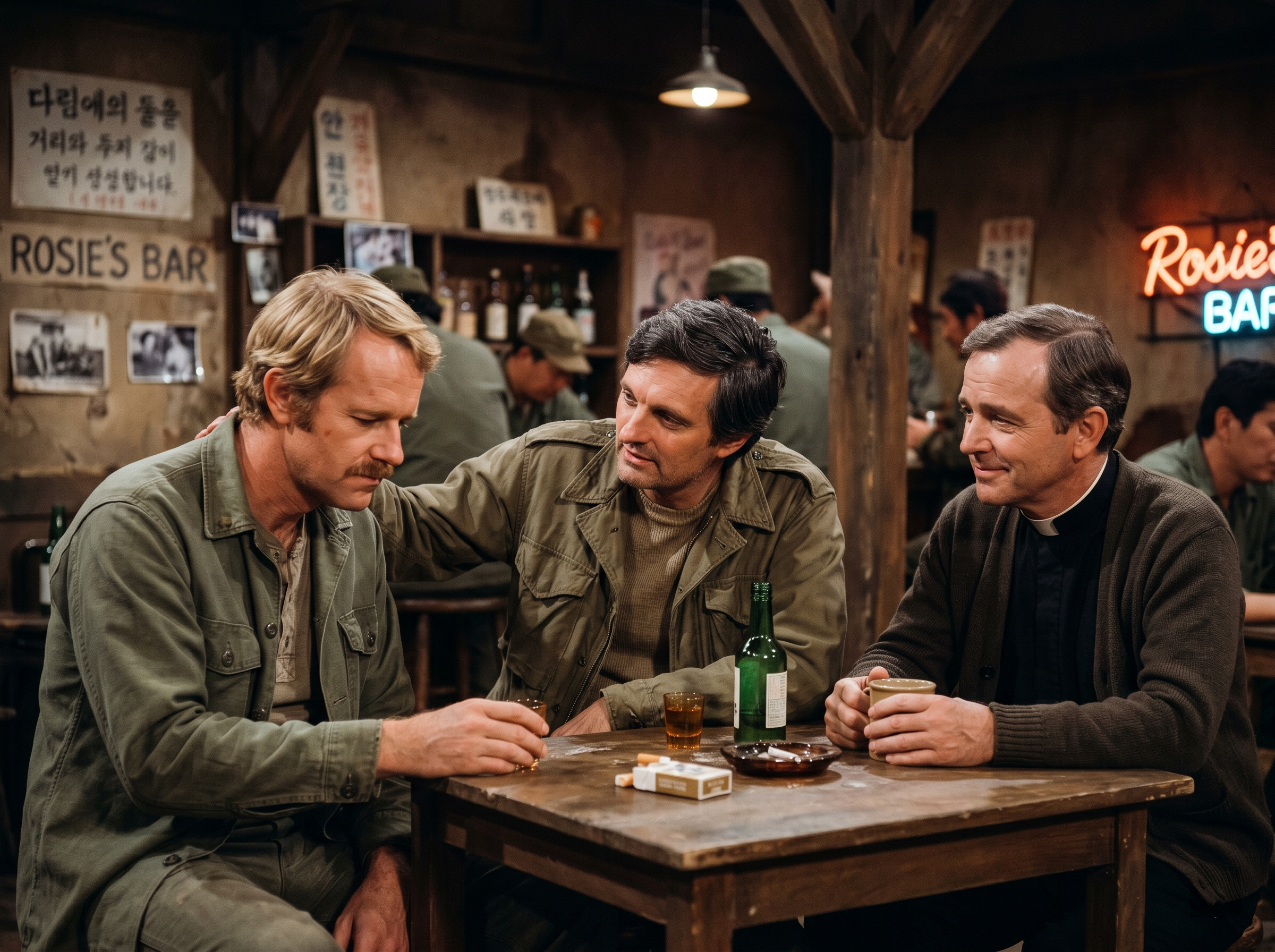
The dimly lit interior of Rosie’s Bar was a sanctuary on nights when the quiet at the 4077th felt too heavy.
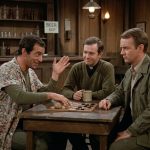
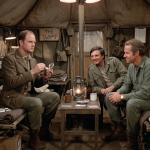
Three men sat at a corner table, the only light provided by a low-hanging bulb and a struggling neon sign outside.
Captain B.J. Hunnicutt stared down at the small amber liquid in his soju glass, his blonde hair dusted with the day’s grime, his mustache slightly dampened.
His posture was slumped, eyes closed, a weary sadness that went beyond physical exhaustion etching his features.
Hawkeye Pierce sat close, leaning in, his hand resting gently and reassuringly on B.J.’s shoulder.
His dark hair was messy, and his expression, while searching B.J.’s face, held that distinct mix of dry wit and deep empathy that defined him.
Across from them, Father Mulcahy held his own mug with both hands, his gentle face and clerical collar a calm, patient contrast.
He watched the two surgeons, his silent presence offering a stable anchor in the tired human moment.
The air smelled of stale beer, fermented rice wine, and the faint, ever-present scent of tobacco from the scattered cigarette packs and the used ashtray.
Rosie’s was a place where rank mattered less than the shared reality of displacement and exhaustion.
Earlier that day, the mail call had happened. Thin bags, fewer letters than expected. B.J. had received none from Peg.
For a man who lived and breathed for his family, that silence was a profound weight.
Hawkeye knew this. He had seen B.J. retreat into himself like a turtle, retreating into the memory of a distant home.
He had tried his usual barrage of jokes, of course. “Look at this, Beej, I think Rosie is using diesel fuel again, it really enhances the floral notes of the soju.”
B.J. hadn’t even smirked. He had just taken another long, silent pull from his glass.
Hawkeye, for the first time in an hour, was quiet, respecting the profound isolation he knew was overtaking his friend.
Father Mulcahy finally broke the silence. “Gentlemen, it is quiet tonight. Perhaps the war is just resting?“
His smile was soft, hopeful, but B.J. didn’t lift his eyes. A micro-tremor ran through his shoulder under Hawkeye’s hand.
It was the first sign of crack in B.J.’s stoic shell. Hawkeye’s gaze deepened. He was about to make his move. He took a slow breath. “You know, Beej…“
The tremor on B.J.’s shoulder was faint, almost imperceptible, but Hawkeye felt it as clearly as a pulse. He didn’t let go. He didn’t speak immediately.
He waited for B.J. to set down his empty glass, a small clink on the rough wood.
Finally, Hawkeye spoke, his voice unusually low, lacking its typical comedic intensity.
“You know, I once wrote my father a letter where I described the martini fixings at Rosie’s. He wrote back and asked if we had tried using it as antiseptic.”
B.J. opened his eyes. They were wet. He looked at Hawkeye. “Did he now?” His voice was hoarse.
Hawkeye gave a small, genuine smile. “Yeah. He said it was important to be resourceful.”
A slow, tired chuckle escaped B.J., a sound both sad and relieved. “Antiseptic, huh?”
Father Mulcahy nodded in silent approval. “Laughter, Captains, can also be a antiseptic for the spirit.“
B.J. turned his head slightly to look at the Father, then back to Hawkeye. The intensity from Hawkeye’s gaze hadn’t wavered. It was solid. Unyielding.
“Thanks, Hawk,” B.J. said quietly. “He’s right. Sometimes you just need to laugh at the substitute for gin.”
Hawkeye gave a slight squeeze to his friend’s shoulder. “Exactly. And when you run out of substitute gin, you still have me, Beej. A considerably less tasty, but arguably more reliable, source of comfort.”
Another soft laugh. This one truer. B.J. picked up his glass again, signaling for a refill.
“And,” Father Mulcahy added, “a slightly less potent antiseptic than what the locals are serving.“
They raised their small glasses. A quiet ritual.
They didn’t speak of letters, or home, or the people they missed. They spoke of the absurdities.
They spoke about the time Klinger tried to hide in a medical supply crate, and Winchester got caught inside it for three hours.
They spoke about Radar’s strange affinity for the camp’s small animal population.
They found the common ground of shared human silliness. They forged a different kind of memory.
The dimly lit room didn’t feel as desolate anymore. The neon sign outside pulsed. Inside, they held their own small lights.
It wasn’t a martini, and it wasn’t a letter from home, but it was real. And on some nights, that was exactly what mattered most.
The quiet understanding at the table was louder than any operating room drama. They wouldn’t forget this simple act of solidarity. It was a shared defense against the vast, lonely void.
Some nights, the strongest antidote to the war is just the sound of friends holding each other steady.