The Small, Silver Beacon
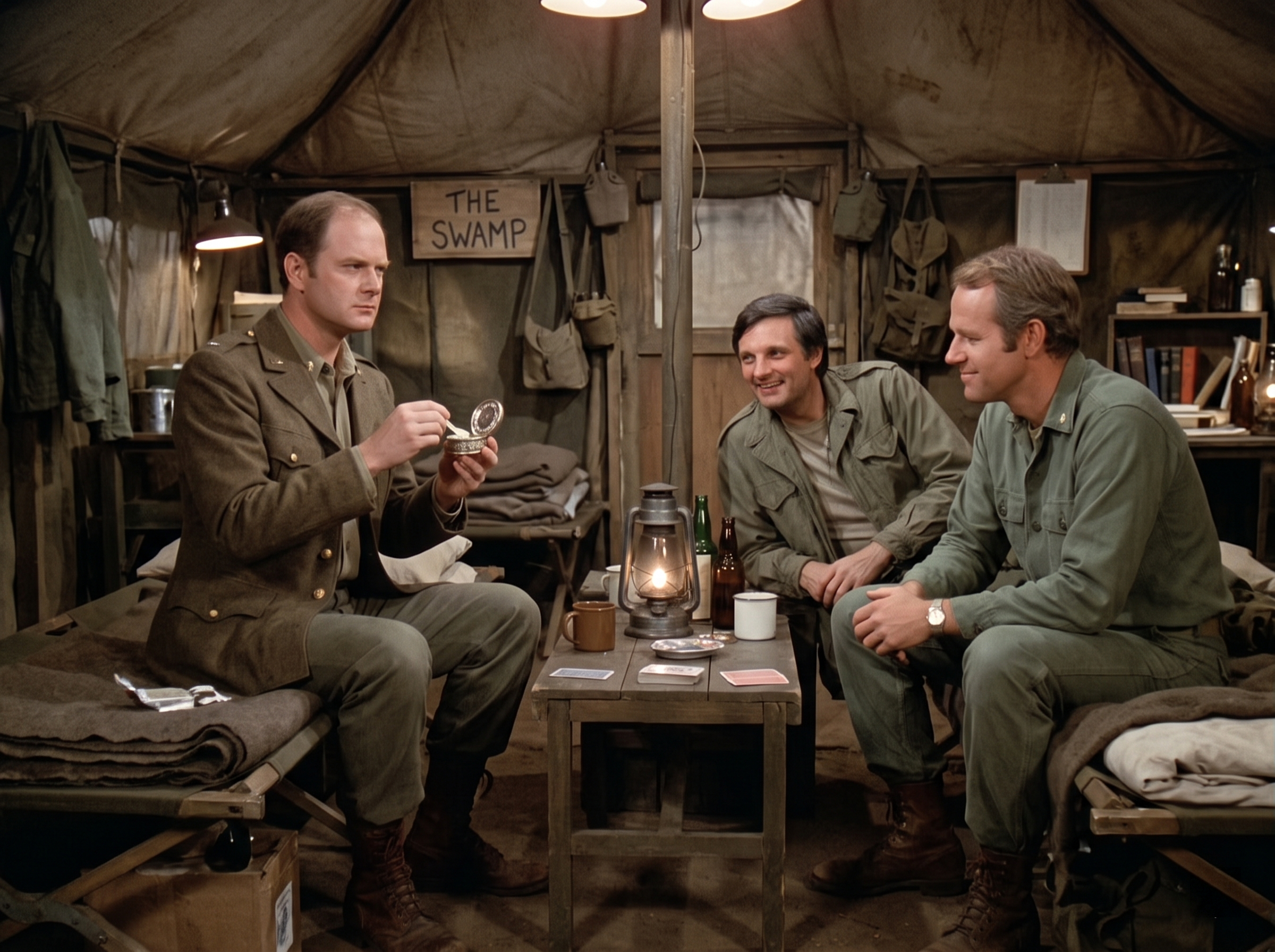
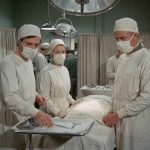
You could always tell when the shift in the Operating Room was truly over. It wasn’t when the last surgical drape was lifted, or when the final chart was signed off. It was the moment you finally sat down in The Swamp.
That’s where the stillness found you.
Outside, the generators hummed, the distant rumble of trucks vibrated the packed earth, and maybe you heard a dog bark or a helicopter rotor slowly bleeding off momentum. But inside the canvas walls, marked by that fading, hand-painted sign, the world was small and golden.
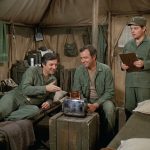
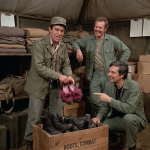
It was a quiet night, following two days of grueling, relentless arrivals. Major Charles Emerson Winchester III, usually a symphony of controlled contempt for his surroundings, was the first to return, settling onto his cot. Captains Pierce and Hunnicutt followed, too tired even for sarcasm, seeking only the comforting, smoky embrace of the central lantern’s light.
The air smelled of kerosene, old wool, and the subtle metallic tang of surgical soap that lingered like a ghost on everyone’s skin. The small table, a makeshift altar to temporary peace, held a few forgotten beer bottles and a deck of playing cards, seemingly frozen mid-shuffle.
The tired routine was shattered by a surprise.
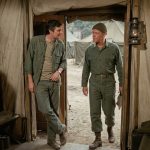
Radar, that nervous, magical sprite of the 4077th, had slipped into the tent. He was silent, just a ghost with big eyes, but in his hands, he carried a single, battered care package. It was address to Charles.
Charles, whose mail was typically a parade of refined Bostonian correspondence and expensive periodicals, accepted it with unusual grace, merely nodding as the diminutive corporal melted back into the darkness.
He didn’t tear the paper. He didn’t rush. He used a precise, controlled motion to open the box, as if opening a patient.
From the depths of cardboard and packing straw, he retrieved a single, minuscule, highly polished silver tin. It gleamed, a tiny, absurd beacon against the mud and olive drab. He then produced a miniature spoon, an elegant, delicate utensil that looked utterly lost in the rugged environment.
Charles sat up, maintaining a posture that was less ‘military’ and more ‘aristocratic.‘ He seemed to enter a delicate, private ritual.
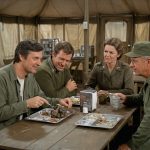
On the cot across the small table, Hawkeye Pierce watched, his head slightly tilted. A smirk, the classic mask for his exhaustion and deep empathy, began to bloom. It was a teasing smile, but it was soft. It wasn’t the jagged edge he typically used on Charles. He leaned back slightly, purely amused by the absurdity of it.
Beside Hawkeye, B.J. Hunnicutt leaned forward. His smile was different—a quiet, warm knowing smile that spoke of shared burdens and the understanding of small comforts. He saw not the caviar, but the man needing a connection to home.
Charles, holding the minuscule spoon above the polished silver tin, paused. He looked down at the tiny, exquisite item with a complex emotion: part dry superiority (this is what is owed a Winchester) and part wounded pride (this is all I have left). He was utterly focused, his face a careful mask of refinement while the muddy boots of his companions framed the table.
The silence grew heavy, the golden lantern light illuminating three men suspended in a perfect moment of weary human connection.
Hawkeye opened his mouth, and the air held its breath. Everyone waited for the perfect, scathing line that would pop the tiny silver bubble.
“Well, Major,” Hawkeye began, his voice surprisingly gentle, barely above a whisper. He leaned forward, matching Charles’s intensity with mock reverence. “Is that… a sample of the actual Moon, or just another one of your small, silver, highly polished mirrors for checking your own ego?“
Charles froze. He did not look up from the tin. A muscle in his jaw clenched, and for a second, the dry wit that sustained him looked like it might shatter into raw, vulnerable homesickness.
He dipped the tiny, elegant spoon into the black gems inside the tin. The silver tool looked alien in the context of the rugged tent.
“This, Pierce,” Charles said, his voice quiet, controlled, yet entirely deficient of its usual bite, “is Beluga caviar. Sent by my sister, Honoria, on the occasion of our graduation anniversary from… proper schools.“
He paused, holding the spoonful delicately. “She understands that even in the midst of this… profound, muddy uncivilization, one must maintain some semblance of… us.“
The word ‘us’ hung in the air, heavy and true. It didn’t mean ‘us, the elite of Boston.‘ It meant ‘us, the human beings we were before the war erased everyone.‘
Hawkeye didn’t snap back with a joke about chopped liver. He looked at B.J. B.J.’s soft smile deepened, a silent validation of Charles’s need.
B.J. nodded slowly. “Your sister… she sounds very perceptive, Charles.“
“Indeed,” Charles murmured. He finally brought the spoon to his lips. It was a singular, almost sacred indulgence. He tasted the fleeting salinity of home, the cool luxury of a memory that was rapidly fading. For five seconds, he was back in a wood-paneled library, not a canvas tent in Korea.
When he finished, he didn’t boast. He didn’t offer a commentary on the flavor. He set the spoon down, the soft clink on the polished tin loud in the silence.
“It is… precisely as I remember,” he said, his expression settling into a look of quiet, internal peace.
Hawkeye watched him. The smirk was gone. In its place was a look of tired, bone-deep respect. “Well, that settles it,” Hawkeye declared, sitting up and reaching for his own lukewarm, green beer bottle. “If Charles can find elegance in a tiny tin of salty fish eggs, then the rest of us… we can at least try to find sanity in… whatever the hell this beer is.“
He held up his bottle. “To Honoria, for understanding the importance of small, silver things.“
B.J. smiled, lifting his own mug. “To small comforts, wherever we can find them.“
Charles did not smile, exactly. The mask of controlled dignity never fully slipped. But as he capped the polished silver tin and gently polished it with a handkerchief, the cold arrogance seemed less rigid. He nodded—just once, a almost imperceptible acknowledgement of their shared understanding.
“To civilization,” Charles muttered softly, almost to himself. “Long may she hold her ground.“
The quiet returned, but it was lighter now. The lantern light seemed slightly warmer. The tension of the battlefield, the residue of the OR, and even the natural friction between the surgeons had eased, replaced by a simple, profound truth.
They were three tired men, stuck in a terrible place, holding onto a small, shared moment of sanity, illuminated by a tiny silver tin and the warmth of found-family loyalty.
Hawkeye leaned back, the smirk returning, but softer. “So, Major,” he said, nudging B.J., “Now that we’ve confirmed you are indeed a sophisticated caviar thief, who’s winning this poker game, anyway?“
Charles let out a dry, almost impossible-to-detect chuckle. “I believe the cards, like the caviar, require a level of tactical refinement utterly beyond your comprehension, Captain. Your move.“
The conversation resumed, the cards were shuffled, and the routine returned. But the small, polished silver tin remained visible on the table, a tiny beacon of humanity they all silently protected, until the next shift, the next helicopter, and the next moment they needed to remember what they were fighting for.
In the mud of Korea, sometimes the greatest act of bravery was simply finding the tiny, private light of home.