A Torn Ticket to Toledo
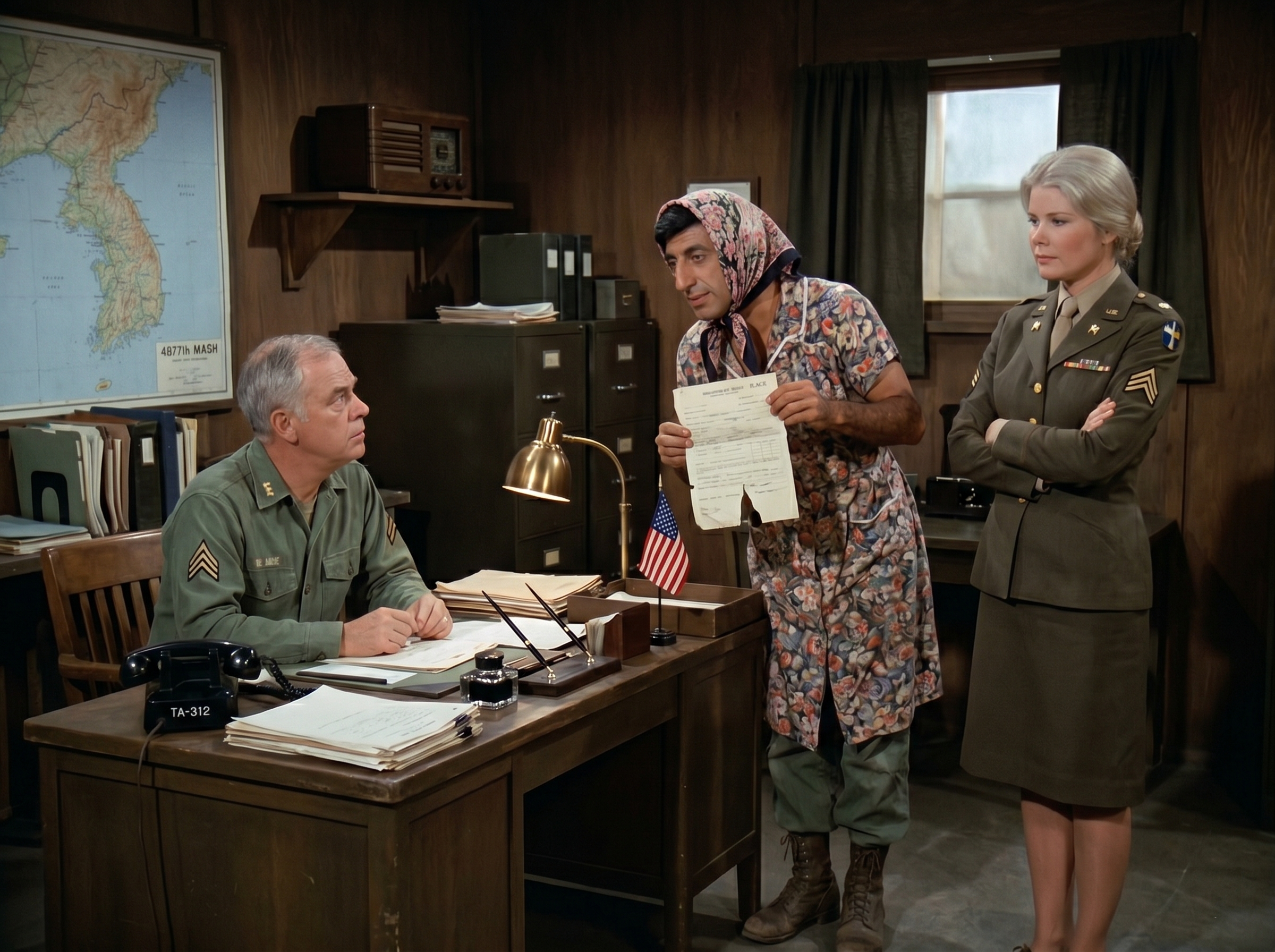
The 4077th Mobile Army Surgical Hospital ran on black coffee, dark humor, and an endless, exhausting mountain of military paperwork.
By four o’clock in the afternoon, the canvas walls of the compound baked in the Korean sun, trapping the stifling heat and the lingering smell of dust. Inside the Commanding Officer’s quarters, however, the atmosphere was a different kind of suffocating.
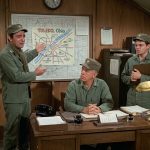
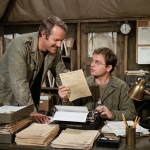
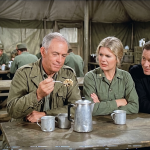
Colonel Sherman Potter sat grounded behind his heavy wooden desk. The small, brass desk lamp radiated a soft, practical light across his workspace, casting long shadows over neat stacks of reports, an inkwell, and the heavy black receiver of the TA-312 field phone.
Potter rested his hands quietly on the desk. His silver hair caught the dim light, and his face was drawn into a mask of fatherly exasperation. He looked exactly like a man who had survived two world wars, only to find himself defeated by a corporal in a floral print.
Standing front and center, dominating the small office with sheer theatrical willpower, was Corporal Maxwell Q. Klinger.
Klinger was dressed in a surprisingly pristine, light-colored dress covered in a vibrant pattern of blooming roses. A matching floral headscarf was tied securely under his chin, framing a face locked in a grand, dramatic posture of slyly hopeful pleading. Below the delicate hem of the dress, his hairy legs ended abruptly in a pair of scuffed, thoroughly lived-in combat boots.
In his hands, held up as if it were the Magna Carta itself, was a piece of typed paper. The bottom third of the document was violently, jaggedly torn away.
Standing rigidly to the right of the desk was Major Margaret Houlihan.
Margaret was a picture of absolute military bearing. Her blonde hair was swept back flawlessly. Her olive-drab officer’s uniform was crisp, the gold buttons gleaming, the insignia perfectly aligned. She stood with her arms tightly folded across her chest.
Her composed face was a masterclass in controlled frustration. She was trying desperately to maintain her dignity, and the dignity of the United States Army, in the face of absolute absurdity.
“I am telling you, Colonel,” Klinger declared, his voice trembling with manufactured emotion. “This is the final, irrefutable proof. The golden ticket. My undisputed passage back to the glorious paved streets of Toledo, Ohio.”
Potter didn’t blink. He just stared at the ragged piece of paper. “Klinger, that piece of paper looks like it was chewed on by a disgruntled mule.”
“Exactly, sir!” Klinger leaned in, his eyes widening. “It is a metaphor for my shattered psyche! But more importantly, it is a certified, notarized letter from my family physician, Dr. Habibi, declaring me entirely unfit for military service!”
Margaret’s jaw tightened. “Corporal, that paper is an insult to the uniform.”
“Major, please,” Klinger said, not breaking eye contact with Potter. “The tragic tearing of the document occurred during a sudden, violent psychological episode. A fugue state! I blacked out, and when I awoke, the bottom half of my salvation was gone. But the top half remains! And it clearly states I am legally insane.”
Potter let out a slow, heavy breath that seemed to carry the weight of the entire war.
He leaned forward slightly, resting his arms on the paperwork covering his desk. The silence in the small wooden office stretched out, thick and heavy.
Margaret’s fingers dug slightly into her sleeves, her patience hanging by a microscopic thread. Klinger held the torn paper higher, his eccentric, hopeful expression faltering just a fraction as he waited for the Colonel’s judgment.
The air in the room pulled tight, snapping with the comic tension of a man about to burst a very delicate, very desperate bubble.
The silence held for another long, agonizing second.
Then, Colonel Potter slowly reached out his hand. Klinger surrendered the torn document, stepping back with a rigid, theatrical salute that looked ridiculous paired with the floral sleeves.
Potter adjusted his posture, bringing the paper under the warm light of the desk lamp. He adjusted his invisible reading glasses, his eyes scanning the remaining typed words.
Margaret shifted her weight, clearly hoping the Colonel would finally throw the book, the desk, and possibly the field phone at the Corporal.
“Well, Klinger,” Potter began, his voice gravelly, calm, and utterly devoid of anger. “This is certainly a fascinating document.”
“Thank you, sir! I knew you’d see the medical validity of—”
“It is,” Potter interrupted smoothly, “a standard Army requisition form for three dozen cases of canned creamed corn.”
Klinger’s dramatic posture deflated by a fraction of an inch. “Sir?”
“Furthermore,” Potter continued, tapping the paper with a heavy, tired finger, “the torn section at the bottom appears to be where the quartermaster’s signature should be. You haven’t proven you’re crazy, son. You’ve just delayed tomorrow’s breakfast.”
Klinger didn’t break character, but the sly hope in his eyes vanished, replaced by a deep, familiar exhaustion. His shoulders slumped beneath the delicate fabric of the dress.
“Colonel,” Klinger pleaded softly, dropping the theatrical bravado. “I’m tired, sir. I’m just so tired.”
The room changed instantly. The comedy evaporated, leaving behind the raw, aching reality of the 4077th.
Potter looked up. He didn’t see a clown in a dress. He saw a scared, exhausted kid from Ohio who was thousands of miles from home, surrounded by blood and mud, desperately trying to construct a raft out of sheer nonsense to float away from the madness.
The fatherly exasperation on Potter’s face melted into patient, weary wisdom.
“I know you are, son,” Potter said quietly. His voice was incredibly gentle. “We all are. The whole camp is tired. The war is tired.”
Margaret, who had been holding her breath, slowly let it out. She unfolded her arms.
The strict, uncompromising Major Houlihan looked at Klinger. She saw the mud on his boots and the desperate, homesick fatigue etched into the lines around his eyes. Her strict military bearing softened. The armor she wore to survive the camp cracked just enough to let the humanity shine through.
“Corporal,” Margaret said, her voice lacking its usual sharp edge.
Klinger looked at her, expecting a reprimand about military decorum.
“If you are going to present a fraudulent document to the commanding officer,” Margaret said calmly, her eyes betraying a quiet, secret tenderness, “at least make sure your hemline is straight. You’re completely uneven on the left side.”
Klinger blinked, genuinely surprised. A tiny, grateful smile tugged at the corner of his mouth. “Yes, Major. Thank you, Major.”
Potter slid the torn requisition form into a file folder on his desk and closed it with a soft thud.
“Get back to your duties, Klinger,” Potter said softly. “And Corporal?”
“Yes, sir?”
“Find a new doctor. Habibi’s handwriting is terrible.”
Klinger drew himself up. He snapped a surprisingly sharp, dignified salute. The resilience flooded back into him, patching the holes the war kept tearing open.
“Right away, Colonel,” Klinger said. He executed a perfect about-face, the floral skirt swirling around his muddy combat boots, and marched out of the office, his theatrical dignity completely restored.
The wooden door clicked shut behind him.
The office returned to its quiet, muted stillness. The hum of the camp generators drifted in through the window.
Potter sighed, picking up his pen and pulling a fresh stack of reports toward him. He looked over at Margaret. She had folded her arms again, but the tension was gone. She looked composed, steady, and entirely human.
“He’s a good man, Margaret,” Potter murmured, not looking up from his paperwork.
“He’s a menace to the dress code, Colonel,” Margaret replied smoothly. But she was smiling, just a little, as she walked toward the door. “Good afternoon, sir.”
Potter watched her leave, then looked around his small, wood-paneled office. It was a million miles from anywhere that made sense, filled with broken people trying to put each other back together with laughter, thread, and sheer stubbornness.
He dipped his pen in the inkwell, the warm light of the desk lamp pushing back against the shadows of the fading afternoon.
In a place surrounded by madness, sometimes the craziest thing a person could do was simply care.