The Size of Mercy
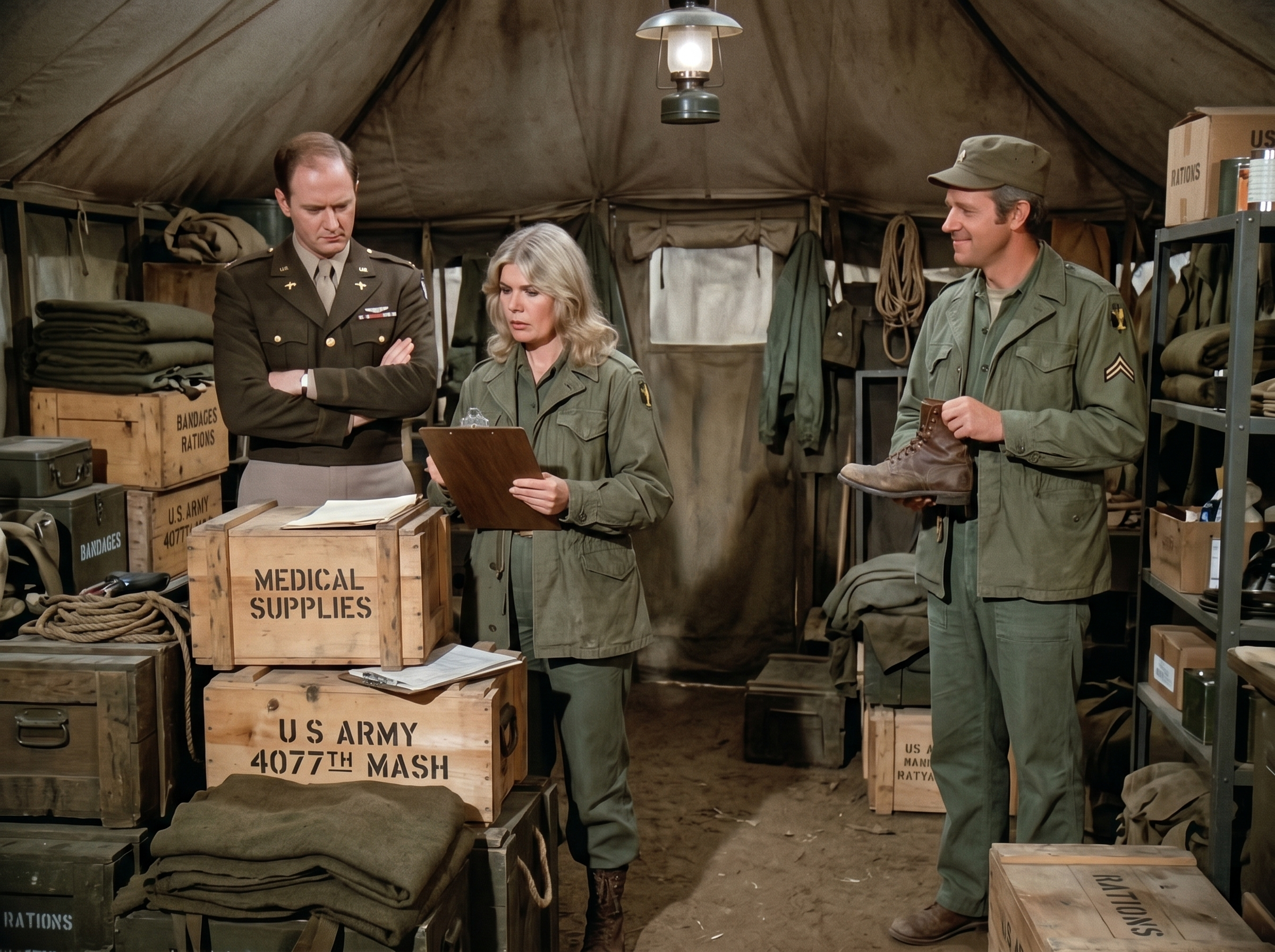
If the 4077th MASH had a pulse, it was usually beating two beats too fast in the O.R. or fluttering weakly with exhaustion in Post-Op. But the place that truly measured the heart of the camp was the supply tent. It was a cathedral of cardboard and canvas, a monument to bureaucratic hope and logistical despair. The air always smelled like wet wool, stale coffee, and the metallic dust of a thousand boxes that had traveled too far.
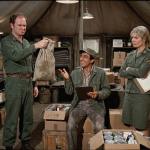
Major Margaret Houlihan was trying, with characteristic meticulous precision, to maintain the fiction that this chaos obeyed orders. She stood before a stack of wooden crates, her clipboard held tight against her chest like a shield. She wore her standard utility jacket, a pencil poised over a supply manifest that was, at best, a list of polite suggestions. She was focused, she was determined, and deep in the pit of her professional soul, she was incredibly frustrated. A critical delivery of X-ray film was missing, and the charts from Tokyo said they had it; the charts in the supply tent said they had absolutely nothing of the sort.
To her left, standing with the rigid, suffering dignity of a duke waiting in a provincial bus station, was Major Charles Emerson Winchester III. He was, inexplicably and entirely to his own dismay, dressed in his Class A jacket and tie. He had come looking for Captain Hunnicutt regarding a slight matter of stolen wine, only to find himself marooned in this dusty purgatory, waiting for B.J. to finish some mysterious errand. Charles had his arms crossed, his mouth set in a thin, aristocratic line of profound disgust as he surveyed the labeled mess. He refused to even lean against a crate, lest he contaminate his fine worsted wool with plebeian dust.
“Inventory, Major,” Margaret snapped at no one in particular, her pencil tapping an impatient rhythm. “Inventory is the spine of command, and this spine is distinctly lacking calcium. Winchester, if you’re just going to pose as a statue of ‘Condescension’s Triumph,‘ at least stand somewhere useful.” Charles merely snorted, a refined, dismissive sound. He eyed a crate labeled ‘RATIONS’ and closed his eyes briefly, praying for deliverance from this unsophisticated misery.
Captain B.J. Hunnicutt, however, was having a completely different relationship with the supply chaos. He had arrived minutes earlier, casually wandering in from a conversation with Klinger regarding the shortage of silk, and now stood near the main supply shelf. He looked relaxed, his cap tilted back, his mustache curled slightly as he found something fascinating. While Margaret stared at the numbers that weren’t there, B.J. found an object that was there.
It was an old, battered, muddy combat boot.
Not just old, mind you. This boot had lived a thousand lives. The leather was scuffed to a pale, dry white; the sole was separating at the toe like a hungry mouth; and it was coated in the distinct, clingy mud of three different front-line engagements. B.J. picked it up and held it aloft, examining it with the careful scrutiny a surgeon gives a rare specimen. He smiled, a dry, quiet smile that was entirely B.J.
“Margaret, Charles,” B.J. said, his voice mild and amused as he interrupted the tension. He held the boot toward them. “You are missing the forest for the inventory list. Look at this magnificent creature. I think it has more character than most of the people Klinger tries to sell watches to.“
Margaret didn’t look up from her clipboard. “Captain Hunnicutt, unless that boot is secretly hiding a case of penicillin, it is not helping me find my X-ray film.“
Charles, finally opening his eyes, gave a genuine shudder. “Hunnicutt, for the love of everything civilised, drop that repulsive object. It’s filthy. It is actually sweating dust.” He recoiled further, offended by the juxtaposition of his dress uniform and this muddy relic. “I cannot believe I am trapped in a supply tent with a man who finds amusement in footwear decomposition. Where are your priorities, B.J.?“
B.J. didn’t put the boot down. He looked at Charles’s pristine, tailored uniform and then back at the dusty, muddy, broken boot, his smile widening slightly. He knew Charles wouldn’t understand. The contrast was too high. That boot was the reality of Korea. It was raw, tired, broken, but still somehow present. And in this moment, held up against the rigid dignity of Winchester and the professional frustration of Houlihan, it felt like the perfect, quiet punchline to their entire absurd existence.
Just then, the tent flap opened, and a young Private, his face streaked with dust and his own fatigue, stumbled in, gripping his only possession: a single, equally muddy combat boot. He stopped, looking at B.J. holding up the first boot. “Begging the Captain’s pardon, sir,” the soldier croaked, his eyes wide with a combination of hope and fear. “Klinger said you might know where I could… where I could trade my only decent boot for a matching set. My other one… it didn’t survive the last shift.“
The simple, humble question hung in the air, instantly shifting the mood of the tent. B.J.’s amused smile faltered. He looked at the ruined boot he held, then at the exhausted soldier, and finally at the soldier’s remaining boot. It was the same size 9E. A single, tired pair of boots, separated by the random cruelty of supply shortages and mud. The joke B.J. had been making—the quiet humor of seeing something broken held up against self-importance—suddenly evaporated, replaced by the weight of genuine need.
For a long moment, nobody spoke. The tent was silent, filled only with the faint sound of the wind snapping against the canvas. The soldier, Private Miller, shifted uncomfortably, clutching his single boot tightly. He had expected laughter, or worse, to be dismissed. The MASH units were hospitals, not quartermaster depots. Klinger had sent him on a fool’s errand, he was sure.
B.J. slowly lowered the boot. He looked at Private Miller, then he looked at the boot, and then, slowly, he turned his gaze toward Margaret. The humor was gone from B.J.’s eyes, replaced by a quiet, warm steadiness that only his closest friends ever saw. B.J. wasn’t a man who made grand speeches, but in that moment, his simple, steady look was more eloquent than anything he could have said. It was a request, a question, and an act of faith, all rolled into one. He doesn’t need much, Margaret. He needs a matching pair of boots.
Margaret was already there. She hadn’t looked at B.J., she was staring at Private Miller. Her clipboard was lowered. The numbers on the charts didn’t matter anymore. The missing X-ray film could wait. In its place, she saw something concrete. She saw a tired soldier with tender feet, facing a winter without boots. Her expression softened, the hard lines of professional command smoothing out into something tender and fiercely maternal. This wasn’t inventory; this was care.
She turned back to the stack of crates she had been inventorying, her clipboard useless. She began sorting through them again, but this time, with an entirely different purpose. She wasn’t looking for film; she was looking for opportunity. “Major Winchester,” she said, her voice quiet but filled with an steel authority that came from a deeper place than her rank. “While you are occupying that uniform, you will assist Major Houlihan.” She pointed to the soldier. “Private Miller, wait outside. We will find a solution. No more trading required.“
Charles looked genuinely alarmed. “Major Houlihan, I assure you, my assistance in finding common footwear for a… Private… is entirely inappropriate, and quite frankly, the mere idea of touching these dusty crates has given me palpitations. Besides, my own boots—my fine Italian boots—require my attention.“
Margaret just stared at him. She didn’t argue. She just looked at him, with a fierce conviction in her eyes that even Charles Winchester couldn’t sneer at. It was the look that had commanded the nurses through dozens of horrific shifts. It was the look that said, We are the 4077th, and we take care of our own.
Charles sighed, a long, weary, dramatic sound. He looked at his beautiful Class A uniform, then at B.J., and then, reluctantly, at Margaret. He knew defeat when he saw it, especially defeat wrapped in that particular brand of female resolve. He uncrossed his arms. “Very well, Major,” he muttered, his refined voice laced with resignation. “But I must insist you keep that… thing… away from me. Hunnicutt, find something less offensive to handle than decomposition.“
The three Majors began their new inventory. The previous tenseness of B.J.’s humor and Charles’s disgust was replaced by a different kind of energy. It was a shared mission, born in the mud and the scarcity of war. B.J. didn’t smile again, not that amused, dry smile. But as he began gently testing the leather of another box, he met Margaret’s eyes again. A quick, warm, silent understanding passed between them. A silent ‘thank you.‘ And a silent ‘of course.‘
B.J. worked the new crate, Margaret moved boxes, and Charles, with extreme, fastidious care, lifted single items, treating each bandage pack or ration box with the delicate touch of a jewel thief. He would never admit it, not even to himself, but as he worked, the dusty reality of the supply tent began to feel less like a purgatory and more like a necessary challenge.
For an hour, they searched. They found boxes of rations, bandages, blankets, an entire crate filled with nothing but left gloves, and, frustratingly, the missing X-ray film. But no boots. No size 9E boots. Private Miller sat patiently outside on a ration crate, holding his one boot, waiting in the gathering dusk.
Finally, they opened a small, unassuming crate that Klinger had likely marked as “UNKNOWN SURPLUS” during a previous raid. B.J. carefully pulled back the heavy wax paper that sealed the top. He looked inside and his breath caught. “Margaret,” he said softly. He reached in and pulled out a perfect, pristine pair of combat boots. Not muddy, not scuffed, not separated at the sole. Just clean, sturdy leather, in a matching set. B.J. lifted them up and smiled, but this smile was different. It wasn’t dry or humorous. It was warm, nostalgic, and filled with quiet joy.
Margaret and Charles joined him. They looked at the boots. And then, at the same moment, they all looked out the open tent flap to where Private Miller sat. B.J. simply lifted the new pair of boots, offering them into the dim light. He held them high, not like a punchline, but like a prize.
“Winchester, Houlihan,” B.J. said quietly, his dry humor returning only slightly. “I believe your spine of command has found its Calcium. These boots are just the right size.” Private Miller, hearing his name and seeing B.J., looked up, his eyes widening. He saw the new boots. He saw B.J.’s steady, kind smile, and Margaret’s warm, professional, tender expression. Even Charles, looking at his dusty uniform and then at the boots, let out a small, satisfied sigh. The boots weren’t sophisticated, they weren’t Italian, but they were whole. And they would keep Private Miller warm.
It was a small victory. One private got a pair of boots. Thousands of others were still walking in the mud. The war was still going. The supply tent was still chaos. But in that dusty, dimly lit tent, three officers, bound by the strange, beautiful, exhausted friendship of the 4077th, had shared a moment of perfect human connection. They had seen a need, and in the resourcefulness born of their found family, they had solved it. It wasn’t O.R., it wasn’t medicine, but it was healing. And as the night set in, that small act of mercy, pulled from a muddy, chaotic supply tent, was the only thing that mattered.
They had come for wine, inventory, and reasons to be disgusted, but what they found, stashed away with the bandages and rations, was the simple, beautiful fact that humanity could be found just about anywhere if you knew how to look.