The Compass to Toledo
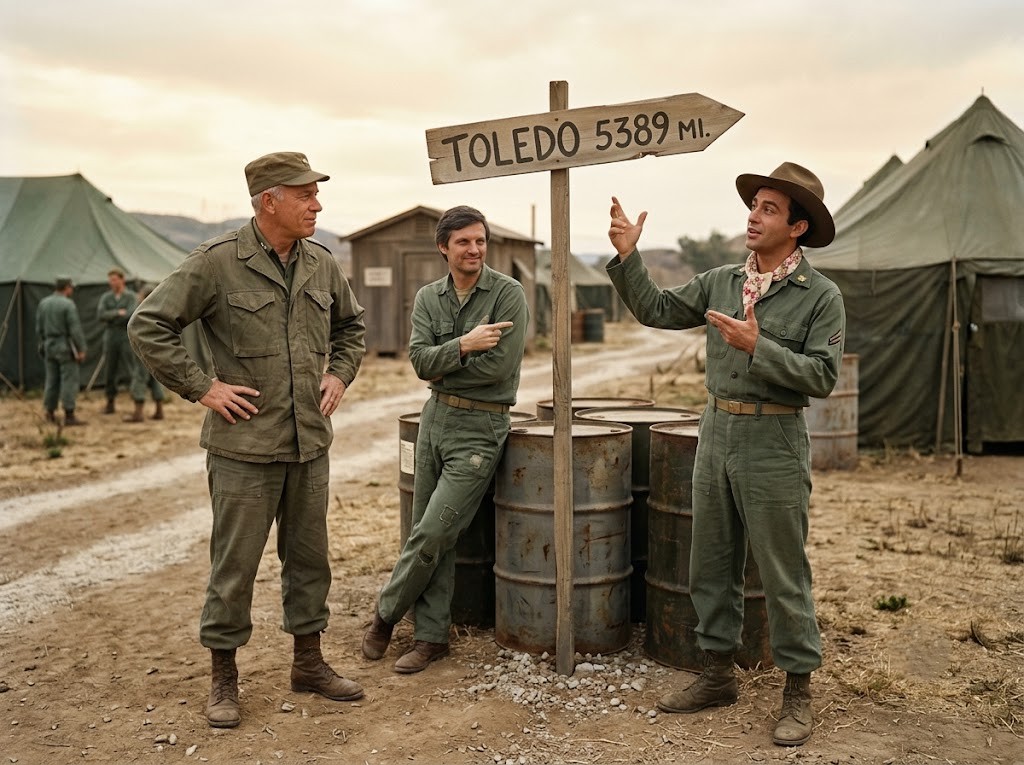
The mud in Uijeongbu always found a way into your socks, no matter how tightly you laced your boots, but today nobody was looking at the ground.
Under an autumn sky that couldn’t decide whether to rain or bleed into twilight, a small crowd had gathered near the center of the 4077th.
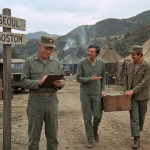
There stood a freshly painted wooden signpost, pointing its arrow resolutely toward the jagged horizon: TOLEDO 5389 MI.
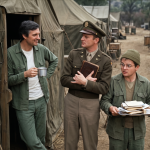
Colonel Sherman Potter stood with his hands firmly on his hips, his faded green cap tilted just enough to shield his eyes from the low-hanging sun. His jaw was set in that familiar, unyielding line, a stark contrast to the sheer, theatrical energy radiating from the man standing next to the sign.
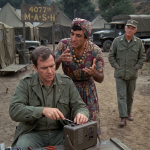
Corporal Max Klinger, sporting a neatly knotted pink-and-white patterned scarf around his neck and his favorite wide-brimmed campaign hat, had one hand raised to the sky like a sidewalk prophet. With his other hand, he gestured proudly toward the hand-carved letters as if he had just discovered a new continent.
“Fifty-three hundred and eighty-nine miles, Colonel!” Klinger announced, his voice carrying across the compound, vibrating with a desperate kind of hope. “Give or take a few yards to the front door of Tony Packo’s. If I start walking right now, I could be biting into a hot dog with mustard and chili before the snow hits the Ohio River!”
Leaning casually against a stack of rusted oil drums just behind the post was Captain Hawkeye Pierce. His fatigue shirt was wrinkled, a patch roughly sewn onto the right knee of his trousers, and his hands were loosely folded as he pointed a mock-serious finger toward the wooden arrow.
Hawkeye’s face wore that characteristic, bittersweet smirk—the kind he wore when the OR was finally empty but the smell of ether was still trapped in his nostrils. He looked at Klinger, then at the old Colonel, his eyes glittering with a mix of genuine amusement and the profound exhaustion that never truly left any of them.
“Careful, Klinger,” Hawkeye chimed in, his tone dripping with dry, affectionate sarcasm. “If you start walking east, you’ll hit the Sea of Japan in about sixty miles. I know you’re desperate to see the Mud Hens play, but I don’t think your stamina covers a cross-continental swim.”
Colonel Potter didn’t laugh; he just let out a slow, heavy breath through his nose, his eyes fixed on the word *Toledo*.
For months, the camp had been running on fumes, enduring three straight days of incoming choppers from a forgotten ridge to the north. They were all bruised, tired, and desperately homesick, clinging to whatever anchors they could find to remind them that a world outside this valley actually existed.
Klinger’s face softened slightly, his dramatic posture faltering just a fraction as he looked at his commanding officer. “It’s accurate, sir. I spent three nights with a stolen map and a broken ruler making sure the mileage was exact. It’s a direct line home.”
Potter finally stepped forward, his heavy leather boots crunching against the gravelly dirt, his shadow stretching out toward the tents. He reached out a weathered hand, touching the rough edge of the wooden arrow, his thumb tracing the painted numbers.
For a long moment, the entire compound seemed to fall completely silent—the distant rumble of a generator, the faint clinking of metal from the post-op tent, all of it fading into the background.
“Five thousand, three hundred and eighty-nine miles,” Potter muttered, his voice dropping into a quiet, gravelly register that made Hawkeye stop smiling. The Colonel looked up, his eyes suddenly looking much older than his rank. “Klinger… you got it wrong.”
The words hung in the cool air, heavy and unexpected, throwing a sudden blanket of tension over the three men.
Klinger blinked, his chest falling as his hands dropped to his sides. “Wrong, sir? But I checked the coordinates twice. I even asked Radar to double-check the logistics with a supply clerk in Seoul.”
Hawkeye straightened up from the oil drums, his smirk vanishing, replaced by a quiet, protective concern as he stepped closer to the sign. He looked from Klinger’s crestfallen face to the Colonel’s unreadable expression, sensing the sudden shift in the wind.
“Come on, Sherman,” Hawkeye said softly, using the Colonel’s first name the way he only did when the barriers of military rank needed to give way to human comfort. “Cut the kid some loose rope. Even if he’s off by a mile or two, it’s the prettiest piece of architecture this swamp has seen since we built the latrine.”
Colonel Potter didn’t look at Hawkeye; he kept his gaze locked on the horizon, past the olive-drab tents, past the barbed wire, toward the distant, hazy mountains that trapped them in this valley.
“I’m not talking about the math, Pierce,” Potter said, his voice steady but laced with a profound, fatherly tenderness. He turned to face Klinger, placing a heavy, reassuring hand on the Corporal’s shoulder. “I’m talking about the direction.”
Klinger frowned, looking up at the arrow. “Sir?”
“You’re pointing it toward the ocean, thinking about the distance between your body and your front porch,” Potter said gently, his eyes softening as he looked at the young man who spent every day trying to escape, yet worked himself to the bone to keep the camp running. “But home isn’t just a spot on a map you can walk to, Corporal. When you’re in a place like this, home is whatever keeps you from falling apart.”
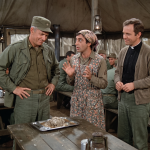
Potter looked around the camp—toward the mess tent where Father Mulcahy was helping wash trays, toward the swamp where B.J. was likely writing a letter to Pegasus, and back at Hawkeye, whose eyes were now shining with understanding.
“Right now, Toledo isn’t across the sea,” Potter continued, his voice thick with a quiet warmth. “It’s right here. It’s in the fact that you spent three nights carving a piece of wood just to make these miserable bastards smile. It’s in the way Pierce here keeps people breathing when the world is trying to stop them. We’re each other’s home until Uncle Sam decides we’ve had enough.”
Klinger swallowed hard, his throat moving as he looked down at his own mud-splattered boots, then back up at the signpost. The theatrical defiance was entirely gone, replaced by the raw, earnest boy from Ohio who just wanted to feel safe. He managed a small, watery smile, nodding his head. “Yes, sir. I suppose it is.”
Hawkeye let out a breath that was half-sigh, half-laugh, stepping up and clapping Klinger on the opposite shoulder. “See? The Colonel just saved you a very long, very wet walk. Besides, if you left, who would I argue with about the quality of the powdered eggs?”
“You’d find someone, Captain,” Klinger murmured, his voice thick but lighter now, the tension completely draining out of the afternoon. “You always do.”
The sun finally dipped below the ridge, casting long, golden-orange streaks across the dirt road. A cool breeze swept through the compound, rustling the canvas of the tents and making the wooden sign creak gently on its post.
Colonel Potter gave Klinger’s shoulder one final, affectionate squeeze before turning back toward his office, his posture as straight and steady as ever. “Carry on, Klinger. And leave the sign up. It reminds me that even if the mileage is long, the company isn’t half bad.”
Hawkeye watched the old man walk away, then looked back at the signpost, his hand resting briefly against the rough wood. For the first time in days, the weight in his chest felt just a little bit lighter.
They were still thousands of miles from the lives they had left behind, surrounded by the quiet hum of a war that wouldn’t end today, but under that wooden arrow, the valley didn’t feel quite so lonely anymore.
Sometimes home isn’t a place you go back to, but the people who keep you alive until you get there.