The Paper War of the 4077th
The war in Korea was fought on two entirely different fronts.
There was the literal front, which brought the mud, the blood, and the terrifying roar of the choppers into the operating room.
And then there was the second front: the soul-crushing, never-ending avalanche of carbon copy paper in the commanding officer’s tent.
Right now, in the stifling afternoon heat of the 4077th, Lieutenant Colonel Henry Blake was losing the second war.
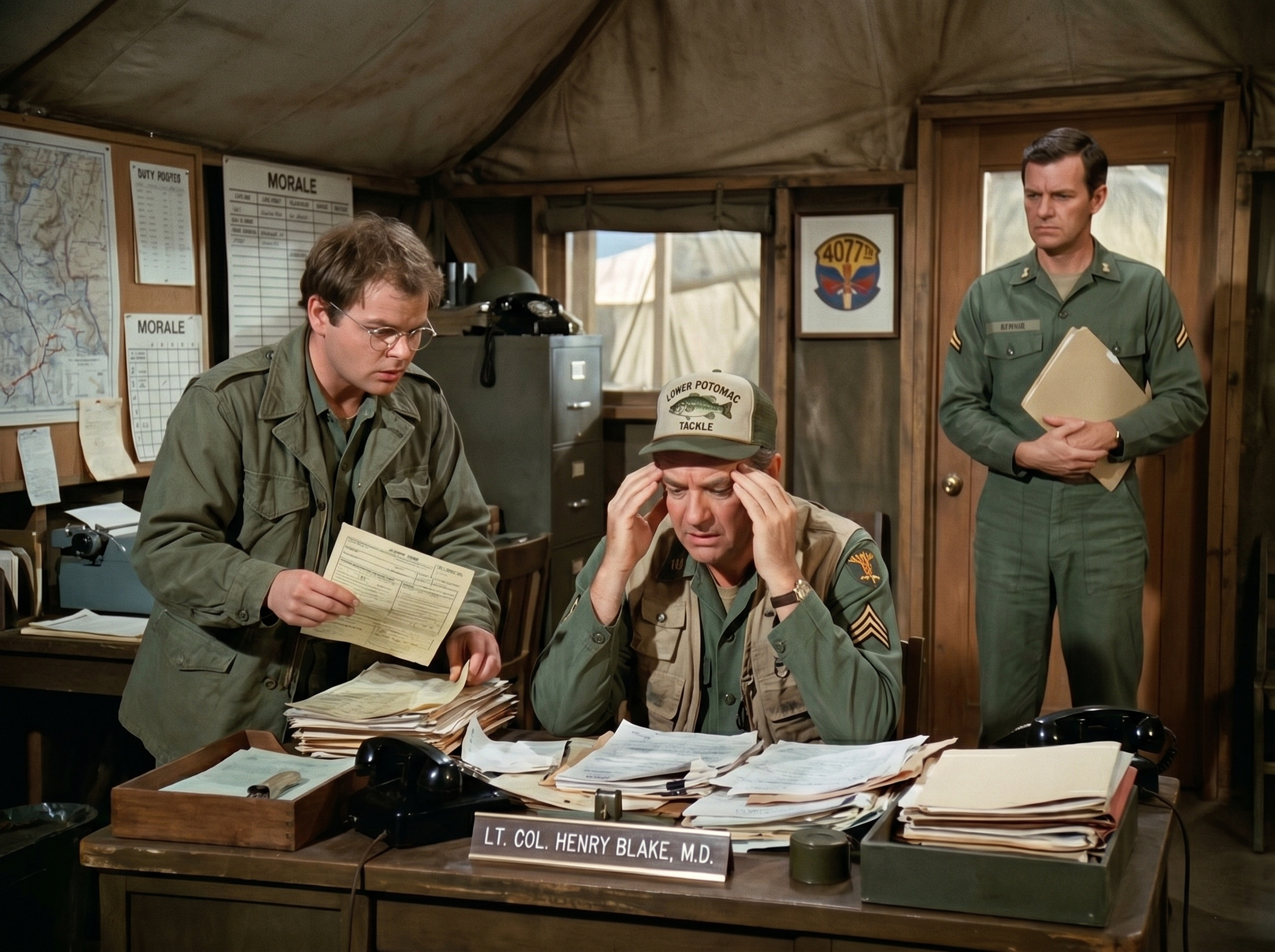
The desk in the center of his office was no longer a piece of furniture. It was a topographic map of administrative misery. Stacks of manila files, loose requisition forms, and half-finished reports buried the wooden surface. The paperwork was so high it threatened to swallow his “LT. COL. HENRY BLAKE, M.D.” nameplate whole.
Henry sat dead center in the chaos, looking like a man who had entirely given up. He wore his favorite battered baseball cap—the one proudly advertising “LUBER POTOMAC TACKLE”—and a worn, pocket-heavy canvas fishing vest over his standard issue fatigues.
But he wasn’t thinking about casting a line into a quiet Illinois lake.
He was pressing the heels of both hands so hard into his temples that it looked like he was trying to keep his skull from physically cracking open.
“It has to be here, Radar,” Henry muttered. His voice was muffled by his own hands, thick with absolute exhaustion. “A piece of paper doesn’t just pack up its bags, go AWOL, and hitch a ride to Seoul.”
Beside him, Corporal Radar O’Reilly hovered like an anxious, olive-drab sparrow.
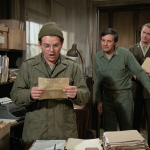
Radar wore his oversized field jacket, the collar turned up, making him look even younger than he was. His round, wire-rimmed glasses slipped slightly down his nose as he frantically tried to navigate the mess.
Radar clutched a single, yellowing document in his hands. His face was a perfect, frantic mixture of urgent panic and sympathetic confusion.
He leaned in, trying to slide the specific paper into Henry’s line of sight. But the Colonel was entirely blind to the world outside his own pounding migraine.
“Sir,” Radar started gently, waving the paper an inch from Henry’s elbow. “If you’d just look at this for one second—”
“Not now, Radar,” Henry groaned aloud. He let his hands fall, staring blankly at the hopeless mountain of ink and red tape. “If I don’t find Form 339-J, Division is going to reroute our entire month’s supply of surgical gauze to a motor pool in Okinawa.”
To make matters infinitely worse, they weren’t alone in the stifling little office.
Standing rigidly near the wooden doorframe was Major Frank Burns.
Frank stood at strict, overly-pressed attention. His spotless, sharply creased uniform was a stark, almost insulting contrast to Henry’s lived-in, modest, fishing-gear attire.
Frank held a manila folder tight against his chest, clutching it like a shield of absolute moral superiority. His lips were pursed into a tight, deeply disapproving line.
He glared down his nose at Henry and Radar, radiating an aura of self-righteous disgust.
Frank didn’t offer to help sort the mess. He didn’t offer to search for the vital gauze requisition.
He simply stood there, stiff as a board, waiting for the perfect moment to deliver a condescending lecture on Army discipline and proper military filing procedures.
“A real commander,” Frank sneered, his reedy voice breaking the heavy silence, “knows the exact location of every single memorandum in his unit. This desk is a disgrace to the uniform, Colonel.”
Henry slowly raised his head.
His eyes were red-rimmed, heavy-bagged, and utterly exhausted. The air in the small, canvas-walled office grew suddenly, dangerously thick.
Radar swallowed hard. He stepped back a fraction of an inch, recognizing the rare, dark storm brewing in his usually easygoing commanding officer’s eyes.
The silence that followed Frank’s smug remark was heavier than a winter snowstorm in Uijeongbu.
Henry didn’t yell. He didn’t throw a stapler. He didn’t even raise his voice.
He just stared at Frank with a look of profound, bone-deep fatigue that no amount of sleep could ever cure. It was the haunted look of a doctor who had spent twelve straight hours pulling shrapnel out of kids, only to be told he was failing the war effort because his desk was messy.
“Frank,” Henry said softly. His voice was terrifyingly calm and quiet. “If you don’t take your perfectly pressed fatigues and that folder, and step out of my office in the next three seconds…”
Henry paused, leaning slightly over the mountain of paper.
“…I am going to have you transferred to an infantry unit where the only filing you’ll do is digging foxholes with your bare hands.”
Frank’s rigid, superior posture instantly faltered. His mouth opened to protest, his eyes darting toward the “MORALE” board on the wall as if desperately looking for backup.
“But sir, the Army regulations clearly state—”
“One,” Henry counted, not breaking eye contact.
“It’s just that Major Houlihan and I feel—”
“Two,” Henry said, his voice dropping an octave.
Frank didn’t wait for three. He spun sharply on his heel, his glossy combat boots clicking loudly against the wooden floorboards. He practically fled out the door and into the compound, muttering bitterly to himself about disrespect, insubordination, and lack of military bearing.
Once the door swung shut, the terrible tension in the room instantly deflated.
All that was left behind was the crushing weight of the administrative disaster.
Henry slumped forward, burying his face in his hands once again. The brim of his Potomac Tackle cap dipped forward, hiding his eyes.
“It’s hopeless, Radar,” he whispered. He sounded more like a defeated, homesick man than a commanding officer. “It’s really hopeless. They want us to save lives, but they want it done in triplicate.”
He rubbed his eyes aggressively. “I can’t find the gauze requisition. I just can’t find it. We’re going to be sewing kids up with bedsheets.”
Radar stood perfectly still by the desk. He didn’t fidget. He didn’t offer a nervous, folksy anecdote about a three-legged pig back in Iowa.
He just gently tapped the single piece of paper he had been holding the entire time against the edge of the mahogany desk.
Tap. Tap.
Henry slowly peeked out from between his fingers.
“What is that, Radar?” he asked tiredly.
“It’s Form 339-J, sir,” Radar said softly, pushing his glasses back up his nose. “The requisition for emergency surgical gauze.”
Henry stared at the single sheet of paper. He blinked once. Twice. He looked up at Radar’s earnest, unblinking face, then back down at the form.
“Where did you find it?” Henry asked, his voice entirely hollow.
“It was under the Form 112 for the powdered eggs, sir,” Radar explained patiently, his voice steady. “Which was hiding under the memo about the new latrine regulations, which was stuck to the back of the letter from your wife, Lorraine.”
Henry slowly reached out and took the paper.
He stared at it like it was a winning lottery ticket. Or better yet, a first-class train ticket back to Bloomington, Illinois.
A slow, weary smile began to tug at the corners of Henry’s mouth. The deep, heavy lines of stress on his forehead finally started to soften.
“Radar,” Henry said, his voice thick with a sudden, overwhelming rush of genuine emotion. “Have I ever told you that you are the only reason this entire hospital hasn’t completely collapsed into the Sea of Japan?”
“You mentioned it last Tuesday, sir,” Radar replied earnestly. “When I found the spark plugs for the backup generator in the mess tent.”
“Well, I’m saying it again.”
Henry grabbed a pen from the clutter, practically tearing the cap off. He signed his name at the bottom of the form with a heavy flourish, the ink scratching loudly in the quiet, canvas tent.
He handed the life-saving form back to his clerk.
Radar took it delicately, holding it like a fragile treasure. “I’ll get this out on the very next chopper to Seoul, Colonel. We’ll have the gauze by morning.”
“You do that, son,” Henry sighed deeply.
He leaned back in his creaky wooden chair, the tension finally leaving his shoulders. He adjusted his fishing cap, suddenly looking a little more like the good-hearted doctor he was supposed to be, and a little less like a beaten Army bureaucrat.
Radar turned to leave, his oversized jacket swallowing his small frame. But he paused at the door, glancing back at the mountain of paperwork that still consumed the desk.
“Sir?” Radar asked quietly, his brow furrowing with genuine concern. “Do you want me to help you sort the rest of that out before dinner?”
Henry looked at the disaster zone in front of him.
He looked at the stacks of useless complaints, the endless, redundant memos, and the cheap carbon paper that always stained his fingers blue.
Then he looked out the small screen window of his tent.
The sun was beginning to set over the Korean hills, casting a warm, deceptive, golden glow over the compound. For a brief, shining moment, there were no choppers incoming. There were no sirens wailing. The war was holding its breath.
“No, Radar,” Henry said softly, a gentle smile touching his eyes. “Let it sit. It’s just paper. It’ll still be there tomorrow.”
“Yes, sir,” Radar smiled back. It was a small, knowing expression that made the young Corporal look far older, and far wiser, than his years.
Radar slipped out the door, the screen shutting quietly behind him.
Henry reached into the pocket of his fishing vest and pulled out a small, tarnished silver lure. He held it up to the fading light of the window, turning it slowly between his fingers.
The real war would be waiting for them in the morning.
The casualties would inevitably come, the OR would smell heavily of ether and blood, and Major Burns would undoubtedly find something brand new to complain about.
But for tonight, in this tiny corner of the 4077th, the paper war was over. And they had survived.
Henry kicked his boots up onto the only clear corner of his desk, closed his tired eyes, and listened to the quiet hum of the camp, imagining the gentle ripples of a lake back home.
In a place where nothing made sense, the only real compass they had was each other.