The Day the Wind Stole Tomorrow
The mud at the 4077th had a memory, but the wind was entirely forgetful.
It blew down from the barren hills of Uijeongbu, carrying the scent of diesel, old canvas, and the faint, metallic tang of the operating room. It was a restless, impatient wind that didn’t care about the exhaustion lining the faces of the people trapped below it.
On days like this, the camp felt less like a military unit and more like a fragile raft tossed about on a sea of brown earth.
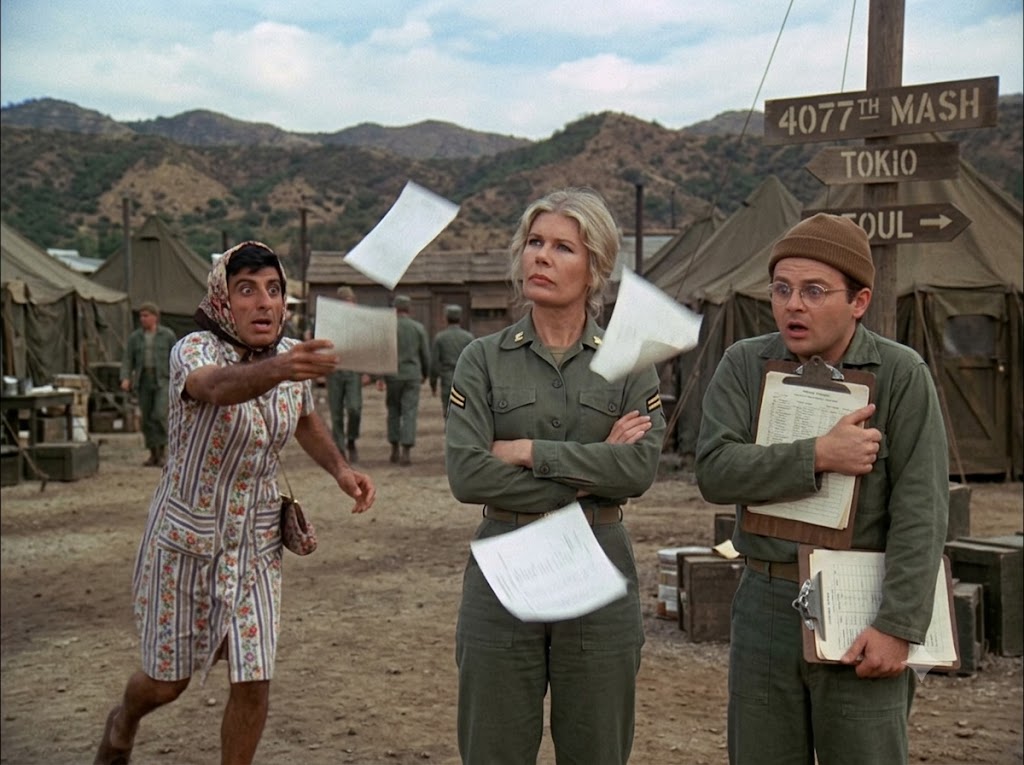
Corporal Radar O’Reilly stood near the signpost, his boots sinking two inches into the dirt.
His oversized glasses were fogged slightly at the edges, and his knit cap was pulled low over his ears. Under his arms, he clutched two oversized clipboards like they were shields protecting him from the harsh reality of another endless month in Korea.
Next to him, Major Margaret Houlihan stood with her arms tightly crossed over her olive-drab fatigues.
Her blonde hair was pinned up perfectly, a defiance against the chaos around them, but her face was a mask of cold, unyielding frustration. She wasn’t just looking at the camp; she was looking through it, staring toward the horizon where the artillery rumbled like a distant, angry heart.
Then there was Klinger.
He didn’t just walk into a scene; he erupted into it. Today’s ensemble was a floral-patterned sundress paired with a matching headscarf, a wardrobe choice meant to convince the bureaucracy that he belonged anywhere else but here.
In his outstretched hand, he held a stack of papers, his dark eyes wide with a mixture of panic and desperate hope.
“Radar! Major! Look at this!” Klinger shouted, his voice cracking as he sprinted across the compound. “It’s the new manifest! The supply sergeant in Seoul finally approved the reassignment orders for the spring rotation!”
Margaret didn’t move an inch, her arms remaining locked. “Corporal, if those are more requests for silk stockings, I will personally see to it that you spend the next week scrubbing the latrines with a toothbrush.”
“No, Major, you don’t understand!” Klinger panted, reaching them. “These aren’t just my papers. These are the transfer requests, the hardship leaves, the letters from home that got mixed up in the supply depot! This is everything we’ve been waiting for!”
Radar’s eyes widened behind his lenses. “The April mail sack? The one that got lost during the mortar attack on the crossroads?”
“The very same!” Klinger cried triumphantly.
For a split second, the heavy, exhausting weight of the war seemed to lift from the three of them.
In Klinger’s hand was a treasure trove of ordinary life—news from spouses, confirmation of leaves, words from a world where people didn’t wear dog tags. Even Margaret’s rigid posture softened, just a fraction, her eyes dropping to the white sheets of paper.
But the wind, as always, had the final say.
A sudden, violent gust roared between the tents, whipping up a miniature tornado of dust and gravel.
It caught Klinger entirely off guard. The papers, loosely held in his frantic grip, were instantly ripped from his fingers.
“No!” Klinger shrieked.
The white sheets caught the thermal updraft, scattering into the air like a flock of frightened birds. They danced above their heads, spinning wildly against the backdrop of the bleak Korean mountains and the signpost pointing toward a home that felt thousands of miles away.
Margaret looked up, her face frozen in sudden shock as a page fluttered right past her nose.
Radar gasped, clutching his clipboards tighter to his chest as if his own life depended on keeping his own paperwork secure, his mouth catching a gust of dusty air.
The papers soared higher, drifting toward the burning exhaust pipes and the deep, muddy trenches where they would be lost forever.
—
Time seemed to stop at the 4077th as the papers danced in the sky.
“My discharge!” Klinger wailed, lunging into the air like a clumsy ballerina in a floral dress, his purse swinging wildly against his hip. “My section eight! My ticket out of this sandbox!”
“Grab them!” Margaret ordered, her military composure instantly shattering into pure, human desperation. “Don’t just stand there, O’Reilly! Move!”
But Radar was paralyzed, his eyes tracking a single piece of paper that was spinning toward the grease pit. He knew what those papers meant. He knew that on one of those sheets was a letter for a boy from Iowa whose mother was struggling with the harvest.
From the doorway of the Swamp, Hawkeye Pierce and B.J. Hunnicutt emerged, coffee mugs in hand, their faces pale from a fourteen-hour shift in surgery.
“Look at that,” Hawkeye muttered, squinting through the dust. “Klinger’s finally molting. I knew that dress was too aerodynamic.”
“Hawkeye, look closer,” B.J. said, his voice dropping its usual playful tone. “Those are the lost mail manifests from the southern depot.”
The humor vanished from Hawkeye’s eyes.
Without a word, both doctors dropped their mugs into the dirt and sprinted into the compound.
Colonel Potter stepped out of his office, his brow furrowed as he took in the chaotic sight. “What in the name of General Custer is going on out here?”
“The mail, Colonel!” Radar yelled, finally breaking out of his trance. “The wind’s got the mail!”
Potter didn’t hesitate. “All hands! Secure those papers! That’s an order!”
Within seconds, the camp became a theater of the absurd and the beautiful.
Father Mulcahy came rushing from the chapel tent, his robes flapping as he tackled a flying sheet of paper against the side of an ambulance. Major Charles Winchester III, holding a pristine leather-bound book, used it like a tennis racket to swat a drifting page out of the air, cursing in high-society Bostonian prose as his boots splashed into a puddle of mud.
Klinger was a whirlwind of floral fabric, leaping over crates, his headscarf slipping as he grabbed pages from the air.
Margaret forgot all about protocol. She scrambled up the hood of a parked jeep, her hands reaching high, her fingers locking around a sheet just before the wind could carry it over the perimeter fence.
Hawkeye and B.J. worked as a team, B.J. hoisting Hawkeye up by the waist so the taller doctor could snatch a page stuck to the high canvas of the mess tent.
For five frantic minutes, the war didn’t exist. There were no casualties, no incoming choppers, no political lines drawn on a map. There were only thirty human beings fighting a desperate battle against the wind to save a few scraps of words.
Slowly, the wind died down, leaving the camp breathless and bruised.
One by one, they gathered back near the signpost, panting, covered in dust and fresh mud.
Margaret climbed down from the jeep, her uniform stained, but she held three pages tightly against her chest. Her hair was a mess, yet she looked more magnificent than she ever had in a dress uniform.
Klinger sat on an overturned crate, his sundress torn at the hem, carefully smoothing out a wrinkled page on his knee. His chest heaved as he checked the names.
“Did we get them?” Radar asked quietly, his voice trembling as he looked around the circle of tired faces.
Hawkeye walked over, dropping a small stack of retrieved pages onto Radar’s clipboard. He patted the young corporal on the shoulder, his fingers lingering for a reassuring second. “We got most of them, son. We got the important ones.”
Colonel Potter walked through the group, looking at his people. He saw Winchester quietly wiping mud off a letter before handing it to a passing private. He saw Father Mulcahy offering a silent prayer over a torn corner of paper.
“Good job, people,” Potter said, his voice soft but thick with pride. “Take the rest of the afternoon to sort through these. Dismissed.”
As the crowd dispersed, Margaret remained standing by the signpost for a moment longer.
She looked down at the top page in her hand. It wasn’t an official document. It was a handwritten letter from a family member of a patient they had saved three weeks ago, thanking the nursing staff for their tenderness.
A small, sad, beautiful smile touched her lips.
Hawkeye and B.J. walked back toward the Swamp, their arms flung over each other’s shoulders, their boots dragging in the heavy mud.
“You know,” Hawkeye said, looking back at Klinger, who was now proudly wearing his ruined dress like a badge of honor, “if we ever get out of here, no one is going to believe a word of this.”
“They don’t have to,” B.J. replied softly, looking at the distant mountains. “We were here. We know.”
The afternoon sun began to dip behind the peaks, casting long, golden shadows across the tents of the 4077th. The wind was gone, leaving behind a quiet camp, a pile of wrinkled papers, and the undeniable warmth of a family found in the middle of nowhere.
In a place where tomorrow was never promised, they held onto every piece of yesterday they could find.