The Feathers and the Folly
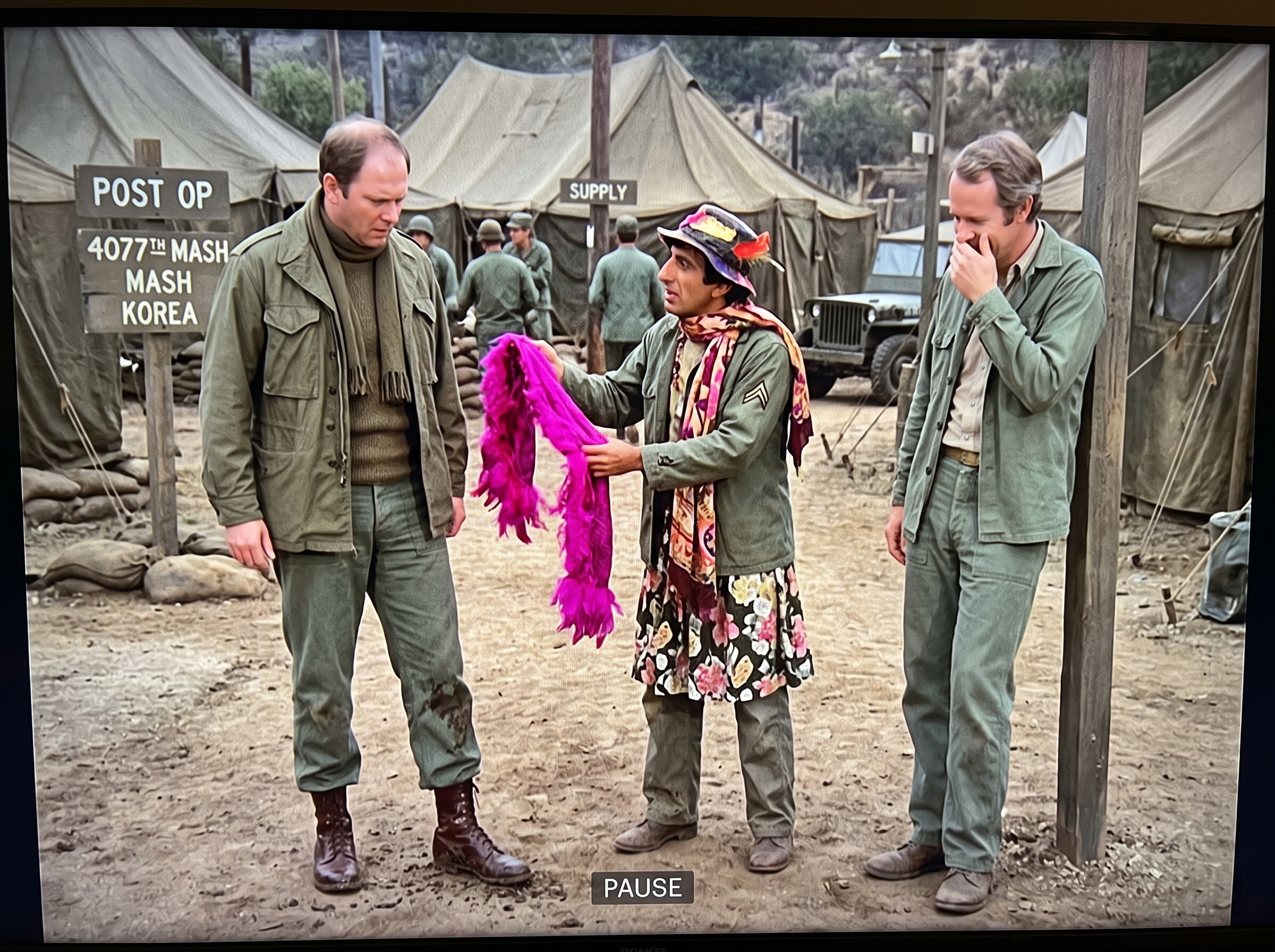
If there was one constant in the 4077th, more durable than the canvas tents or the mud that coated everything, it was the crushing, quiet exhaustion. We had just finished another “meat run” of casualties, the operating room a blur of suture wire, fatigue, and shared panic. Now, the dust was settling, and the camp was exhaling, if only for a few precious hours. The Post-Op sign was visible through the haze, a stark reminder of the work we’d just done and the fragile lives we were now babysitting.
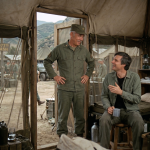
This afternoon, the Outdoor Compound was a quiet stage. The tired earth crunched underfoot. A few shadows stretched across the dirt towards the supply tent. In the middle of it all stood Major Charles Emerson Winchester III, a bastion of refinement seemingly dropped onto a different planet. His Bostonian accent usually arrived seconds before the rest of him, but right now, he was entirely, and shockingly, silent. He stood rooted, looking not at us, not at the camp, but downward, his face a perfect sculpture of existential horror.
We all followed his gaze. A dark, gloopy blob of mud, a remnant of the last monsoon, had seemingly gained sentience and launched itself directly onto the toe of his impeccably shined leather boot. To Charles, this was more than a splash of dirt; it was a personal affront from the universe, a violation of his sanctity, a cracking of his aristocratic armor in this barbaric wasteland. He didn’t just look disgusted; he looked defeated, as if the entire weight of his Boston lineage was pressing down on that single, muddy boot.
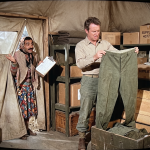
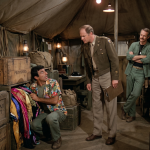
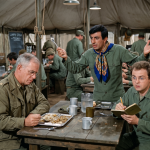
Before Charles could find his voice to properly damn the mud, and perhaps the entire Korean Peninsula, Corporal Max Klinger appeared. Klinger didn’t just walk; he made an entrance. Having just come from his latest, desperate Section 8 attempt involving a “performance art piece” near Colonel Potter’s quarters, he was still fully costumed: a colorful floral skirt, a textured green jacket with a patterned scarf, and a hat that featured at least three distinct types of feathers. He looked like an explosive accident at a costume shop.
Klinger, in his infinite, theatrical compassion, saw the Major’s suffering and immediately stepped in. He didn’t just offer a rag. He wouldn’t dream of something so pedestrian. Instead, Klinger reached deep into his colorful repertoire and whipped out a brilliant, shocking pink feather boa. It was a spectacular, vibrant weapon of assistance, its feathers dancing in the slight afternoon breeze. “Major, darling!” Klinger exclaimed with dramatic flair, striking a pose of heartfelt distress. “Do not weep! Your savior has arrived. With this delicate touch, we shall banish the beast and restore you to your former, pristine glory!“
Major Winchester looked at the shocking pink feathers, then back at his mud-coated soul. And for the first time in his life, Charles Emerson Winchester III was speechless. Not angry. Not offended. Just… broken. And it wasn’t clear if he would ever recover.
The silence that followed was heavy, filled only by the wind whistling against the canvas. In that quietness, the utter absurdity of the moment became deafening. Major Charles Emerson Winchester III, whose standards of perfection were so high they often gave him altitude sickness, stood confronted by his greatest nightmare—the mud of Korea—and his only proffered solution was a neon pink feather boa held by a man wearing a dress. It was a test of sanity that even Charles’s legendary refinement was struggling to survive.
Just behind him, Captain B.J. Hunnicutt, standing against a worn wooden post, began to lose his internal battle. B.J. was the anchor, the grounded one, the man who quietly absorbed the absurdity of this place and processed it with dry humor. But even he had limits. He turned his head slightly, as if to hide, but the movement only signaled his complete surrender. He pressed his hand over his mouth, desperately stifling a laugh that was already vibrating up through his chest. It was a rich, full, knowing laugh, the kind you save for when a disaster is so complete, so perfect, that it ceases to be a tragedy and becomes a masterpiece.
Klinger, oblivious to B.J.’s internal collapse, pressed on. “It’s soft as a baby’s whisper, Major! Not a scratch on your precious leather. Tell me you accept!” He stood poised, his face a caricature of earnest dedication, the magenta boa dangling between them like a challenge from the god of comedy. He truly believed in his cure; to Klinger, the boa was a source of light and beauty, and right now, Charles needed both. He saw not an aristocrat and a misfit, but a comrade in distress who needed his boots tended.
We held our breath. Would Charles finally snap? Would he turn on Klinger and deliver a monologue that would leave scorch marks on the dirt? Would he just drop to his knees and succumb to the inevitable mud? For several agonizing seconds, his face was unreadable, a war-torn map of disgust, shock, and an unprecedented, terrified confusion. He looked at the pink feathers, then at Klinger’s sincere, mascaraed eyes. He saw the genuine care masked by the comedy. He saw the exhaustion they all shared, the shared survival mechanism of finding light in the darkest corners.
His refined armor cracked, but not with anger. A slow, weary, very human sigh escaped his lips. The kind of sigh that says, “I surrender, I cannot win against this madness.” He did something unexpected. Charles slowly, deliberately, reached out. His fingers, which usually handled sterling silver and delicate classical records, now grasped the end of the ridiculous pink boa. B.J. stopped laughing. He leaned forward, watching, his amusement replaced by a sudden, quiet respect.
Charles began to work. Gently. Not aggressively, not like he was fighting the mud, but almost reverently, as if accepting the impossibility of his situation. He dabbed and stroked the muddy boot with the pink feathers. The vibrant feathers mixed with the wet, brown earth. It was grotesque, it was comedic, it was tragic, it was MAS*H. Pink feathers and mud, dancing in the dust. Klinger beamed with pride, a doctor seeing his eccentric cure take effect. B.J. watched them both, a warm, soft smile spreading across his face.
The Routine continued around them. Soldiers walked past, their expressions a mix of confusion and “seen it all.” The Jeeps rumbled. The Post-Op sign stood firm. In that moment, as the afternoon sun hit the dirt, they weren’t surgeons, or corporals, or aristocrats; they were just three tired men, found family in a place designed to break them, momentarily linked by a muddy boot and a pair of neon feathers. And for the first time in a very long while, we knew we’d all be okay.
We were just three tired men, grateful for the feathers that could momentarily pause the war.