The Color of Dust and Wildflowers
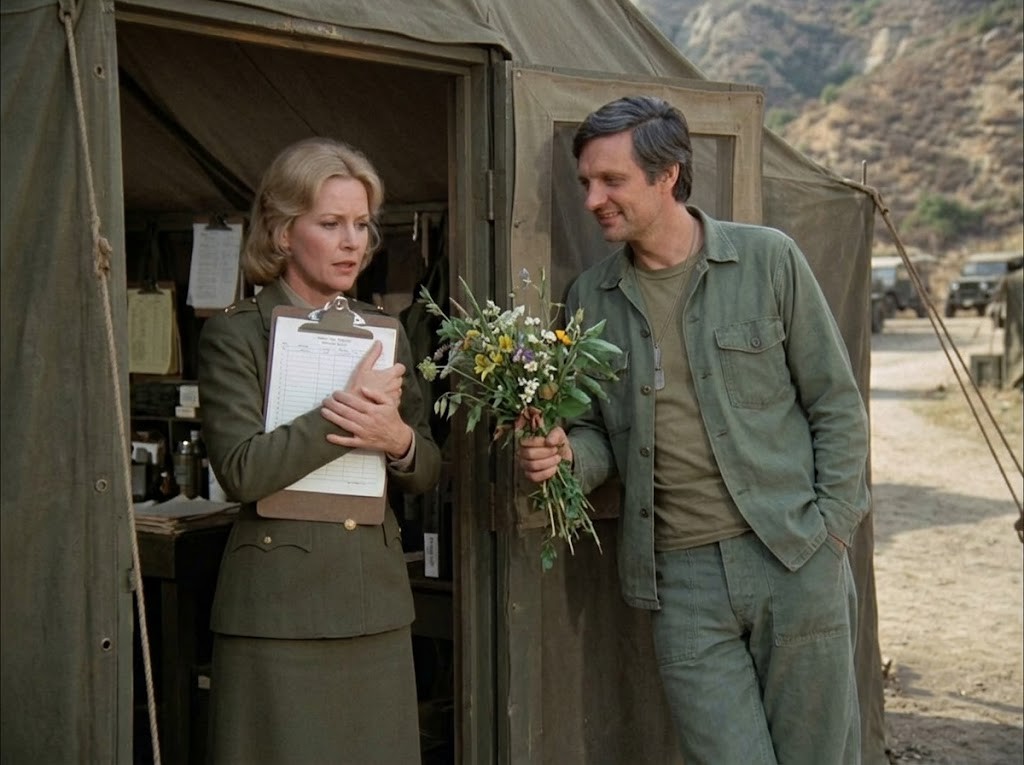
The dust of Uijeongbu had a way of settling into everything, turning the whole world a monotonous, weary gray. It coated the canvas tents, lined the inside of the surgical gowns, and left a permanent grit between your teeth that no amount of swamp juice could ever quite wash away. After thirty-six continuous hours in the operating room, the gray didn’t just cover the camp; it felt like it had settled deep into the bones of everyone trapped inside the perimeter of the 4077th.
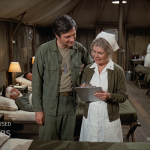
Major Margaret Houlihan stood just outside the administrative tent, her posture rigidly upright despite the crushing weight of the fatigue pulling at her shoulders. She held her clipboard tightly against her chest, arms crossed over it like a shield against the rest of the world. On that clipboard were the latest supply discrepancies—missing penicillin, delayed shipments of clean linen, and a list of requisitions that Seoul had ignored for the third time this month. To anyone else, it was just paperwork, but to Margaret, every missing sheet was a standard slipping, a crack in the armor she fought so hard to maintain.
Her eyes were heavy, burning from the harsh glare of the O.R. lamps and the lack of sleep. She stared down at the columns of numbers, trying to focus, but the figures kept blurring together into a meaningless jumble of ink. She felt entirely alone in her responsibility, marooned in a sea of mud, noise, and men who seemed to treat the war like a bad joke.
A shadow fell across her clipboard, breaking the afternoon glare.
Margaret didn’t look up immediately, her jaw tightening in anticipation of another complaint, another joke, or another problem she would have to fix. Instead, the faint, unmistakable scent of crushed stems and damp earth cut through the pervasive smell of diesel exhaust and boiled cabbage. It was a clean, green smell that didn’t belong anywhere near a combat zone.
“You know, Major, if you stare at that paperwork any harder, you’re going to burn a hole right through the carbon copy,” a familiar, raspy voice said.
She glanced up to see Captain Hawkeye Pierce leaning casually against the wooden frame of the tent door. His olive-drab fatigue jacket was unbuttoned, his dog tags dangling loosely over a faded t-shirt, and his hands were tucked into his pockets. He looked just as exhausted as she felt, the dark circles under his eyes resembling bruises in the harsh sunlight. But his expression lacked its usual sharp, cynical edge.
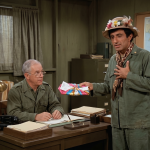
Slowly, Hawkeye pulled his right hand from his pocket, revealing a small, messy bundle of wildflowers. They were a chaotic mix of pale yellows, deep blues, and wild whites, completely unarranged and tangled with bits of long grass. He held them out toward her with a quiet, tentative smile, his head tilted slightly to the side.
Margaret froze, her fingers tightening around the edges of her clipboard until her knuckles turned white. In a place where everything was sterile, broken, or covered in mud, the vibrant colors of the flowers looked almost shocking. For a second, the professional mask she wore so fiercely began to slip, leaving her completely exposed to the one man who knew exactly how to find the cracks in her walls.
—
For a long moment, neither of them said a word. The distant rumble of artillery echoed over the hills, a reminder of the reality waiting just beyond the valley, but inside the small square of space between them, the world seemed to slow down.
Margaret looked from the flowers up to Hawkeye’s eyes. She expected a punchline, a sarcastic comment about her disposition, or a theatrical bow. She braced herself for the defense mechanism they both used so often to survive the place. But the joke never came.
“Where did you get these, Pierce?” she asked, her voice lower and softer than usual, lacking its sharp military authority.
“They were growing right by the edge of the chopper pad, down in the ditch where the water collects,” Hawkeye said, his voice equally quiet. “I was watching the last evacuation bus pull out, and I saw a splash of yellow in the weeds. I figured they deserved a better home than a ditch next to a helipad. And honestly, I thought of you.”
Margaret swallowed hard, looking back down at the clipboard pressed against her ribs. “I don’t have time for flowers, Captain. I have three missing crates of surgical gauze to track down, and the morning shift schedules are completely disorganized.”
“The gauze can wait ten minutes, Margaret. The war isn’t going anywhere,” Hawkeye said gently, shifting his weight against the doorframe. He didn’t push the bouquet into her hands; he simply kept it there, an open offer. “Take them. No strings attached. No smart-aleck remarks from the peanut gallery. Just a few colors that aren’t olive drab.”
A faint, tired smile touched the corner of Margaret’s lips, though she tried quickly to hide it. She looked at the delicate petals, noticing how fragile they were against the heavy, coarse fabric of their uniforms. It was a stark reminder that life could still find a way to grow in the middle of a wasteland.
“You’re a very frustrating man, Pierce,” she murmured, finally letting her arms relax. She slowly lowered the clipboard from her chest, holding it in one hand at her side.
“It’s my finest quality,” Hawkeye replied, his smile widening just a bit, the familiar glint of dry humor returning to his eyes. “Just ask the Colonel. Or better yet, ask Charles. He’s currently writing a three-page manifesto to his uncle about my lack of decorum.”
Margaret reached out and took the wildflowers from his hand. Her fingers brushed against his for a brief second, a warm, human touch that felt grounding after the cold steel of the surgical instruments they had handled all night. She brought the small bouquet close, taking a quiet breath of the fresh, wild scent.
“They really are beautiful,” she admitted softly, her shoulders dropping as she finally allowed herself to let go of the tension she had been carrying since yesterday’s triage. “Thank you, Hawkeye.”
Hearing her use his nickname without a trace of anger or irony made Hawkeye pause. The exhaustion in his own face seemed to lift for a brief moment, replaced by a deep, genuine warmth. He nodded once, a gesture of quiet respect between two people who had seen the worst of humanity and were still trying to hold onto the best of it.
“Anytime, Major,” Hawkeye said, pushing himself off the tent frame and taking a step backward into the compound. “Just put them in an old penicillin jar with some water. They don’t last long out here, but while they’re here, they do a pretty good job of reminding us that there’s a world outside this valley.”
Margaret watched him walk away, his lanky frame moving with that familiar, loose-jointed stride across the dusty compound toward the Swamp. He called out a quick, teasing greeting to Radar, who was rushing past with a stack of official forms, and just like that, the rhythm of the 4077th resumed its frantic pace.
Turning back toward her tent, Margaret looked down at the flowers in her hand and then at the clipboard in the other. The numbers and the missing supply crates didn’t seem quite as overwhelming anymore. She stepped inside the cool shade of her quarters, looking for an empty glass jar, feeling a little less alone in the gray.
Sometimes, the greatest victories at the 4077th weren’t won in the O.R., but in the quiet moments where we reminded each other that we were still human.