The Six-Hour Standoff on Boardwalk
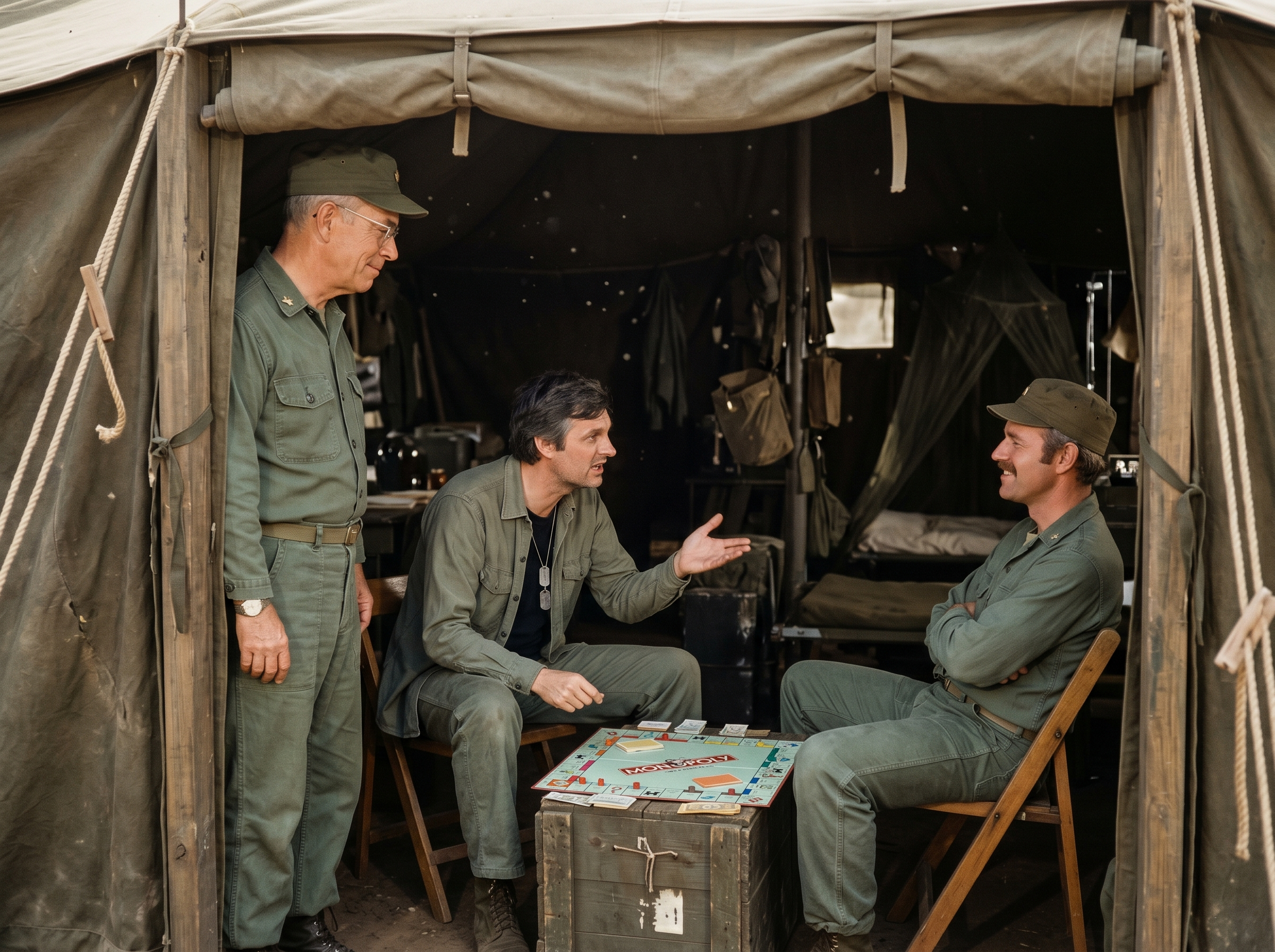
The mud of Korea had a way of clinging to everything, but it couldn’t quite touch the fragile, cardboard sanctuary of a Monopoly board.
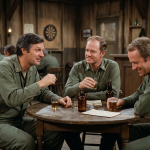
Inside the tent, the air was thick with the scent of damp canvas and stale coffee, a familiar cocktail that smelled like home to those of us far away from it. Hawkeye was leaning forward, his eyes narrowed with the calculated intensity of a surgeon diagnosing a terminal patient. He was in the middle of a frantic, one-sided debate, his hand gesturing toward the properties as if he were trying to talk a reluctant patient into surgery.
“You’re telling me, B.J. Hunnicutt, that you refuse to sell the B&O Railroad? You’re acting like a landlord with a heart of gold, which we both know is a medical impossibility,” Hawkeye quipped, his voice dancing between genuine frustration and his signature, restless humor.
Opposite him, B.J. sat with his arms crossed, a knowing, infuriatingly calm smirk playing on his lips. He wasn’t even looking at the board; he was watching Hawkeye, enjoying the spectacle of his friend’s unraveling.
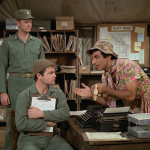
Standing near the tent flap, Colonel Potter watched the scene with his hands on his hips, his posture weary but his eyes softening with that familiar, grandfatherly patience. He sighed, a sound that carried the weight of a long week, and rubbed the back of his neck beneath his cap. He had walked in looking for a quiet moment away from the command tent, hoping for a distraction, but he had walked into a war zone of a different kind.
Hawkeye suddenly slammed his hand down near the center of the board, his playfulness evaporating into a sharp, sudden edge of exhaustion. “For heaven’s sake, BJ, it’s just a game! Can’t you see I’m trying to hold onto something here? Anything that feels like I’m still the one in control?”
The silence that followed was heavy, stifling the banter and turning the air cold.
B.J.’s smirk vanished instantly. He uncrossed his arms, the playful challenge replaced by a quiet, searching gaze. He knew, as only a best friend could, that Hawkeye wasn’t talking about railroads or plastic houses. He was talking about the last forty-eight hours of choppers, the endless flow of wounded, and the way the world felt like it was slipping through their fingers.
Colonel Potter didn’t move, but his expression shifted from amused observer to something deeply tender. He stepped forward, the floorboards creaking under his boots. He didn’t offer a lecture or a command; he just reached out and gently moved one of the little metal tokens, a top hat, onto a space Hawkeye had been eyeing.
“You know, Hawk,” Potter said, his voice gravelly and low, “back in Hannibal, a man could go broke and still be rich in company. This game, it’s just paper and paint. But that chair you’re sitting in? That’s yours. And those boots? Those are yours too.”
B.J. leaned forward, his hands resting on the edge of the wooden crate that served as their table. “I’m not holding out, Hawkeye. I’m just trying to make sure you have someone to play with until the next siren goes off.”
The tension in Hawkeye’s shoulders finally dropped. He let out a long, shaky breath, the fire in his eyes dimming into something warmer, more human. He looked at the board, then at B.J., and finally at the Colonel, seeing the genuine care behind their tired smiles. The absurdity of the situation—three grown men sitting in the middle of a war zone, arguing over make-believe money—hit them all at once.
Hawkeye let out a soft, self-deprecating chuckle, rubbing his tired eyes. “I suppose I’m bankrupting myself over a few imaginary hotels while the real world is doing a fine job of tearing down the ones we’ve got.”
B.J. laughed, a genuine, hearty sound that filled the tent and pushed back the encroaching gloom. He reached out and knocked over his own pieces in a theatrical gesture of surrender. “Alright, you win. Take the railroad. Take the whole town. I surrender unconditionally.”
Potter let out a soft huff of a laugh, patting Hawkeye on the shoulder as he turned toward the tent entrance. “Good. Now that the war is over, maybe we can find some real coffee. The kind that doesn’t taste like it was strained through a combat boot.”
They sat there for a few minutes longer, the game forgotten, just listening to the distant, rhythmic hum of the camp settling down for the night. The war was still out there, the wounded would come again, and the fatigue was a permanent resident in their bones. But for this one, small moment, in a tent that smelled of rain and friendship, they were just three tired men holding onto the only thing that mattered: each other.
It’s not the game that keeps us going, but the people sitting across from us when the pieces finally fall.