Points for a Lost Star
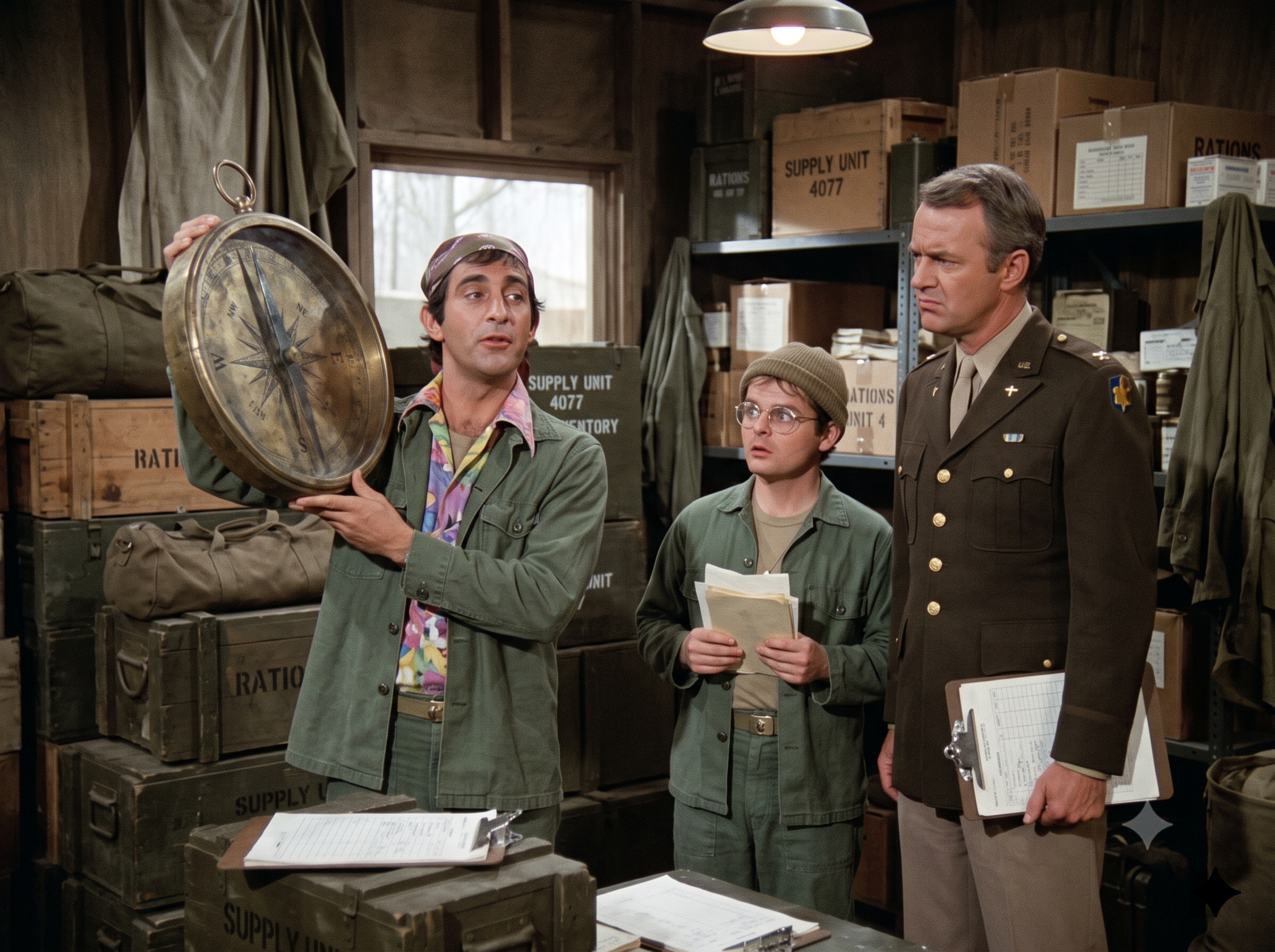
Sometimes, the loudest battles at the 4077th weren’t in OR, but right here in the Supply Hut. This particular Tuesday, the air was thick with something heavier than usual: the unmistakable, quiet panic of a missing compass.
Actually, to be precise, it was the largest brass-plated, nautical-grade compass in the history of the Korean theater. Klinger was displaying it now, lifting the heavy disc like a trophy, though his face carried an unfamiliar gravity beneath his bandana. “Found it!” he declared, and for a second, the hut fell silent.
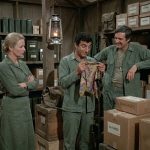
Radar stopped rustling his endless paperwork. Father Mulcahy, clipboard in hand, just stared at the massive compass with a mixture of confusion and relief that mirrored his standard Sunday sermon expression. It wasn’t just *any* piece of surplus. This compass had a destination.
It was intended as a quiet retirement gift for an old infantry buddy of Colonel Potter’s—a man who, and I can say this without exaggeration, spent his entire thirty-year career getting hopelessly lost. Even within a hospital, he required a map.
When the crates for the 4077th arrived two days prior, this gift—a private request from the Colonel, personally stashed in his footlocker by Klinger—was gone. Lost. Stolen. It didn’t matter; its absence felt like a gut punch in a camp where small kindnesses were everything.
They’d torn the camp apart searching. Hawkeye had made several cracks about Klinger trading it for a lifetime supply of satin, but the humor felt forced. The missing compass had become a symbol of something bigger—a missing sense of hope, a map to *nothing*.
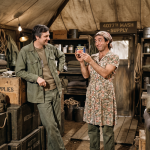
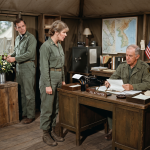
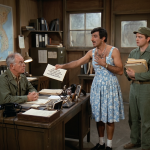
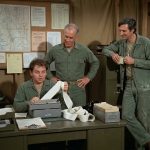
Now, Klinger stood in image_0.png, raising the polished compass. “Sir,” he said, directing his words to Colonel Potter (though the old man was likely in his office, and Klinger was addressing Father Mulcahy as the nearest available authority), “she was hiding behind the box of surgical gloves we ordered for Nurse Kelley. Someone must have… displaced her.” He winked at Father Mulcahy.
Radar looked skeptical. He knew *exactly* where every box of gloves was. “Wait,” the corporal squinted, adjusting his glasses. “The surgical gloves were… adjacent to the mess tent, for months.”
Father Mulcahy looked between Klinger’s smooth grin and the genuine concern on Radar’s face. The compass, heavy and solid, pointed firmly North. He took the clipboard, feeling the weight of the moment. The tension in the dusty room began to climb. Klinger’s “finding” seemed a little *too* convenient, especially on the same day the replacement request form was scheduled for authorization by I-Corps.
Father Mulcahy cleared his throat, his usual gentleness warring with practical suspicion. He could feel Radar vibrating next to him. Klinger just held the compass, looking as innocent as a Lebanese saint, his colorful scarf slightly askew. The smell of dust, sweat, and cheap perfume filled the small space.
“Klinger,” Mulcahy began softly, placing his pen down. “I must ask. This compass… it’s quite large. You say it was behind the gloves? We’ve looked everywhere, multiple times.”
Radar pointed a shaking finger. “Sir, Klinger… he helped unload the *new* supply crates this morning. The ones marked ‘MEDICAL SUPPLIES – DO NOT OPEN.’ They were sealed.”
“Yes, but my dear corporal, that’s precisely why no one *checked* behind them!” Klinger argued, a little too quickly. “The box *of* surgical gloves was empty! I mean, I *checked* behind the *empty* box! It had been moved! Yes, moved!”
He raised the compass higher, the needle steady as a heartbeat. “But look, Father! It points North! And South! It’s magnificent! Let’s get it to the Colonel! Why split hairs over logistics when the point—the *point*—is that the gift is found!”
Mulcahy stared into Klinger’s earnest, theatrical eyes. He saw the sheer panic of a man who’d just realized his original “found” story was implausible to anyone with half a brain—or Radar’s brain. But he also saw the genuine desire to fix a problem, to heal a broken link, to restore faith in *something*.
He knew—and Klinger knew—that Klinger had probably ‘requisitioned’ this identical compass (at significant personal cost, perhaps trading his beloved pink satin gown) from an unsuspecting Navy supply sergeant in Seoul just this morning. He hadn’t *found* the original compass. He had replaced it, using the chaos of the supply delivery as cover, determined not to let the Colonel down.
And the Colonel… he would know. Potter wasn’t a man easily fooled. He’d see the shine on the “found” compass was a little too bright. He’d read between the lines. He’d recognize the lie, and he’d recognize the deep, desperate loyalty behind it.
The tension broke, not with an argument, but with the quiet sound of a sigh. Mulcahy gently took the compass from Klinger’s hands. Radar looked confused, looking between the priest and the supply clerk.
“I will personally deliver this to the Colonel, Klinger,” Mulcahy said, his voice quiet. He didn’t smile, but his eyes were soft. “You did… a remarkable thing, ensuring it was located amidst the confusion of the delivery.”
Klinger’s theatricality dropped for a split second. A small, genuine, tired smile touched his lips. “It’s important, Father. Everyone needs a compass.”
As the Father walked out of the Supply Hut, the heavy compass held close to his vestments, the afternoon sun caught the brass, sending a single point of light dancing across the dusty ground. Back in the hut, Klinger turned to Radar, a mischievous glint back in his eyes.
“And you, corporal,” Klinger said, gesturing to the stack of crates. “I think those surgical gloves need checking *again*. Who knows what other vital medical supplies might be ‘displaced’ by the mess tent? Get Hawkeye, will you? He’s always complaining about missing gin.”
A short while later, inside his quiet office, Colonel Potter held the massive compass. He ran his calloused thumb over the clean engraving. He looked up at Father Mulcahy, who waited silently.
“It’s heavier than I remember,” Potter said softly. He didn’t need to say anything else. They both knew the weight wasn’t just the brass. It was the weight of memory, the weight of loyalty, and the quiet understanding that out here, in this impossible place, finding your way home—however it happened—was all that truly mattered. He smiled, a dry, fatherly expression. “Good job, Mulcahy.” He paused. “And the clerk, too.”
Finding your way home sometimes means building a new map with the people standing right beside you.