The Scarf from Toledo
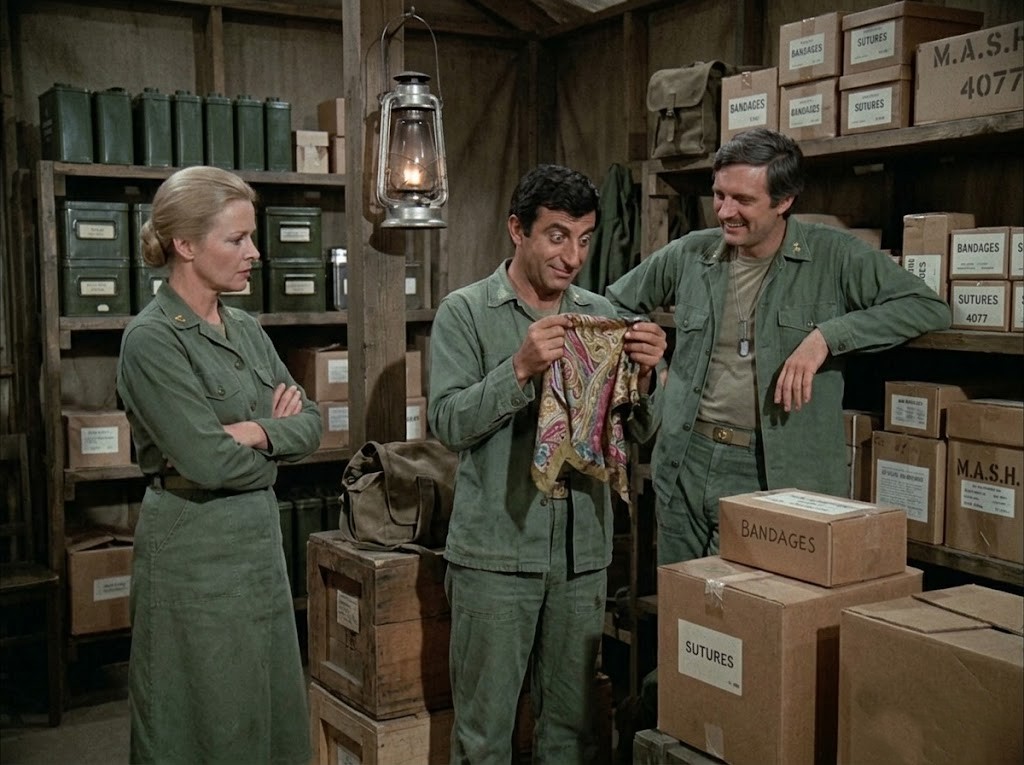
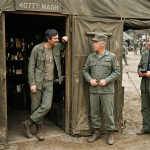
The supply tent always smelled of cardboard, damp canvas, and the sharp, antiseptic sting of rubbing alcohol. It was a quiet kind of refuge, tucked away from the roar of the incoming choppers and the relentless glare of the OR lights. For a few minutes at a time, it was a place where you could simply stand still and remember that a world existed beyond the muddy perimeter of the 4077th.
On this particular afternoon, the air was heavy with the exhaustion of a thirty-six-hour shift. The meatball surgery was over, the wounded were resting in post-op, and the swamp of fatigue had settled deep into everyone’s bones.
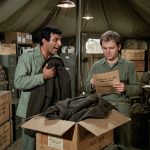
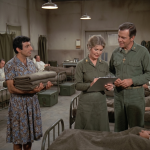
Hawkeye Pierce leaned heavily against a stack of crates labeled *BANDAGES*, his hands tucked loosely into his pockets, his posture loose but wired with tired energy. A faint, knowing smile tugged at the corner of his mouth as he watched Klinger carefully unfold a crumpled piece of silk.
Beside them stood Margaret Houlihan, her arms crossed tightly over her olive-drab shirt. Her jaw was set in its usual line of strict military discipline, her eyes tracking Klinger’s movements with a mixture of professional skepticism and a quiet, deeply hidden curiosity.
Between them, Klinger held the fabric aloft like a priest handling a sacred relic. It was a paisley scarf, woven with rich, faded purples, deep golds, and earthy greens—a startling explosion of color in a world that had turned entirely olive-drab. The lantern hanging from the central wooden post caught the sheen of the silk, casting a warm, amber glow over his face.
“It’s not just a scarf, Pierce,” Klinger murmured, his voice uncharacteristically soft, devoid of his usual theatrical flair. “My Aunt Alberta wore this to every Sunday service at St. Hedwig’s in Toledo. She said whenever the winter wind blew off Lake Erie, this silk felt like a warm hand on her neck.”
Hawkeye tilted his head, his eyes softening as he looked from the vibrant fabric to the absolute earnestness on his friend’s face. “And she sent it all the way to Korea? To keep her favorite nephew warm during the night shift?”
“She sent it because she heard the Mud 207th was short on blankets,” Klinger said, looking up, his dark eyes wide and suddenly shining with something heavy. “She doesn’t know about the casualties, Hawkeye. She thinks I’m just sitting in an office typing forms. She doesn’t know what we do in that tent.”
Margaret took a step forward, her arms still crossed, but her shoulders dropped an inch. The rigid exterior she wore like armor seemed to fray just a little at the edges. “Corporal, that is civilian property. It has no place in a medical supply depot.”
Klinger didn’t snap back with a sarcastic quip. He just held the scarf closer to his chest, his knuckles whitening against the silk. “I know, Major. But holding it… it’s the first time in six months I can actually smell home. It smells like her kitchen. Like baked bread and garlic.”
The silence that followed was dense, filled only with the distant hum of a generator and the soft crackle of the lantern. For a brief second, the war seemed to stop outside the canvas walls. The three of them stood frozen in time—a cynical surgeon, a strict head nurse, and a homesick corpsman, all anchored by a single scrap of purple paisley.
Then, the sudden, distinctive thrum of a helicopter engine began to vibrate through the wooden floorboards, shattering the quiet.
The sound of the chopper blades grew louder, cutting through the canvas and instantly snapping them back to the reality of the 4077th. The warmth in the room vanished, replaced by the familiar, cold adrenaline that always accompanied the arrival of the wounded.
Margaret instantly straightened, her eyes darting toward the tent flap as her professional instincts took over. “Choppers,” she whispered, her voice tightening. “We have incoming.”
Hawkeye didn’t move immediately. He looked at Klinger, who was already starting to fold the scarf back up, the brief illusion of Toledo evaporating from his face, replaced by the grim readiness of a soldier about to face another long night.
“Keep it in your pocket, Klinger,” Hawkeye said quietly, his voice losing its usual sarcastic edge. “You might need a reminder of what a kitchen smells like before the sun comes up.”
Margaret opened her mouth to object, to cite regulations about unauthorized personal items during triage, but she stopped. She looked at Klinger’s tired eyes, then at the bright silk, and finally at Hawkeye. Slowly, she let out a long, slow breath.
“Put it away, Corporal,” Margaret said, her tone surprisingly gentle, the fierce Major Houlihan giving way to the woman who cared deeply for every soul under her command. “And then get down to the pad. We’re going to need every hand.”
Klinger nodded quickly, tucking the paisley scarf into the breast pocket of his fatigue jacket, right over his heart. The colorful fabric disappeared beneath the dull green wool, but the shift in the room remained. They had all been reminded, if only for a minute, of why they were there and what they were trying to preserve.
They moved toward the exit together, leaving the quiet sanctuary of the supply tent behind. As Hawkeye reached for the canvas flap, he paused and looked back at the empty room, the lantern still swaying slightly from the vibration of the landing helicopters.
The 4077th was a place of endless mud, gray skies, and the heavy burden of broken bodies. But in that small, cluttered tent, surrounded by boxes of bandages and sutures, a piece of a Toledo Sunday had managed to keep the winter away, even if only for a moment.
Hawkeye stepped out into the cold Korean air, Margaret right beside him, and Klinger following close behind, all of them ready to face the storm once more.
In the darkest corners of the 4077th, it was the smallest threads of home that held everyone together.