The Vintage of the 4077th
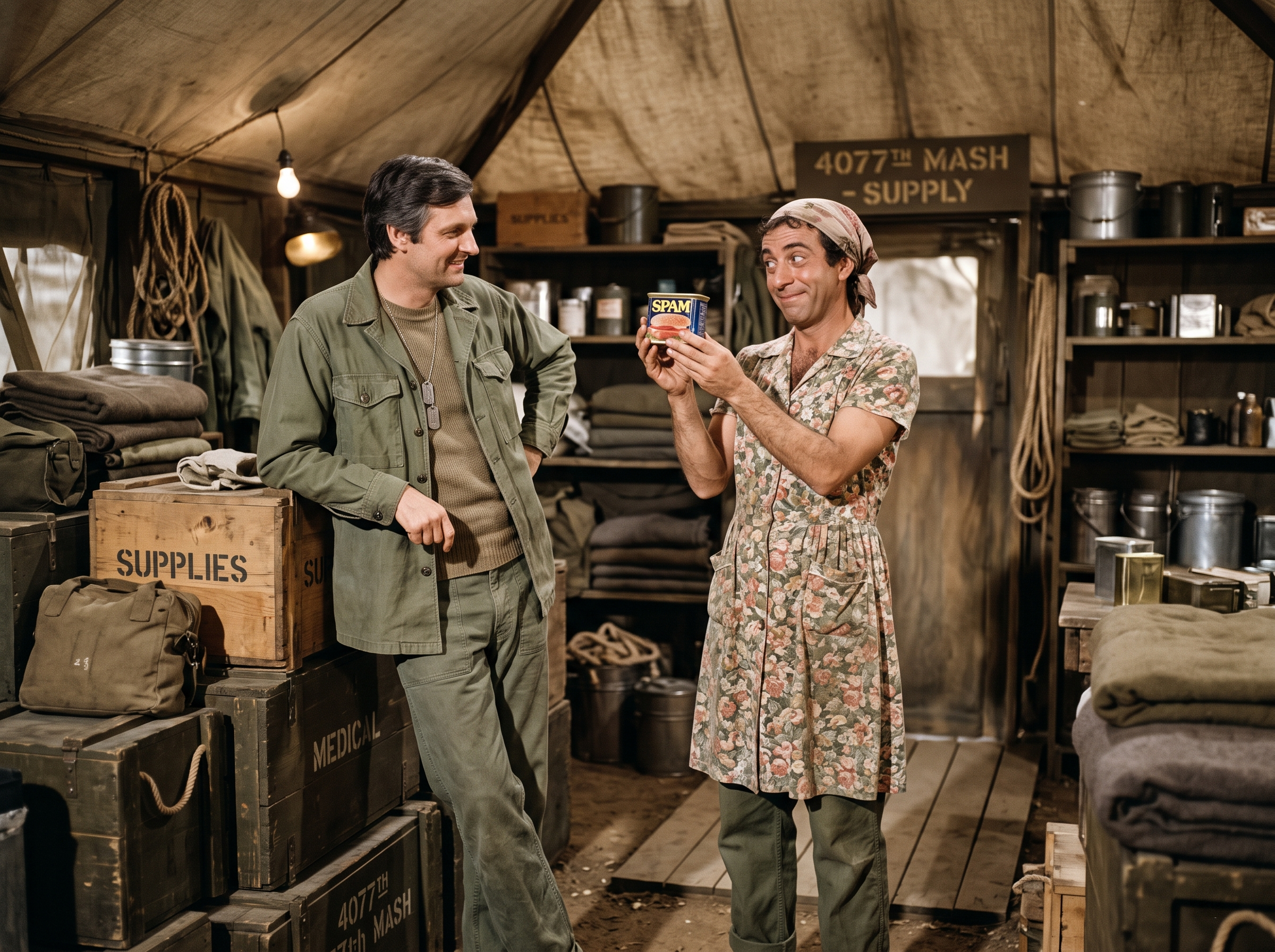
The choppers had finally stopped coming.
For forty-eight straight hours, the 4077th had been a bloody, chaotic machine, running entirely on black coffee, bad jokes, and sheer, desperate willpower.
Hawkeye Pierce had just stripped off his surgical gown, feeling like a man who had been hit by a jeep and then asked to perform a tap dance.
His eyes were burning, his hands were trembling with the phantom memory of forceps and clamps, and the mud of South Korea seemed permanently caked onto his boots.
He didn’t want the Swamp. He didn’t want the Officers’ Club. He just wanted a few minutes where nobody was bleeding, nobody was yelling, and nothing smelled like ether.
He wandered blindly into the supply tent, looking for a dark corner and a pile of wool blankets to collapse on.
The tent was quiet, smelling of canvas, mildew, and the stale dust of a hundred unopened wooden crates.
Hawkeye leaned heavily against a stack of boxes marked “MEDICAL SUPPLIES,” letting the cold wood seep through his green fatigue shirt.
He closed his eyes, ready to let the exhaustion drag him under.
Then, a sudden, deliberate clatter from the back of the tent made him jump.
“I wouldn’t fall asleep just yet, Captain,” a familiar, theatrical voice called out from behind a stack of cot frames. “You’ll miss the evening floorshow.”
Hawkeye opened one bleary eye.
Out stepped Corporal Maxwell Klinger, dressed in a faded floral print dress that looked like it had been violently wrestled from a Midwestern parlor sofa, complete with a matching babushka tied neatly under his chin.
Klinger wasn’t making his usual frantic plea for a Section 8. Instead, he had the quiet, deliberate air of a magician about to pull off his greatest trick.
“Max,” Hawkeye sighed, rubbing his temples. “If you’re going to tell me you’re pregnant and the father is a passing brigadier general, I just don’t have the energy to deliver the baby today.”
“Better than that, Captain,” Klinger said, taking a step forward. “I have procured a miracle.”
Klinger’s face was deadly serious, his dark eyes sparkling with a mischievous, almost frantic pride.
He held both hands behind his back, approaching Hawkeye like a servant approaching a tired king.
“I saw you in there today, Hawk,” Klinger said, his voice dropping the punchline tone for just a second. “You looked like a ghost that hadn’t had a decent meal since 1949. So, I used my considerable, highly illegal connections.”
Hawkeye watched, a small knot of tension forming in his gut.
When Klinger went out of his way, it usually meant a live chicken, a stolen jeep, or a bottle of something that could blind a horse.
Hawkeye was too tired to put out a fire, literal or metaphorical.
“Klinger, please,” Hawkeye pleaded, gripping the edge of the wooden crate. “Just tell me it’s not alive, and it won’t court-martial me.”
“Oh, it’s not alive, sir,” Klinger grinned, whipping his hands out from behind his back and thrusting his prize into the dim light of the hanging overhead bulb. “Behold!”
Hawkeye stared.
There, resting delicately in Klinger’s large, hairy hands, held aloft with the reverence of the Holy Grail, was a single, pristine can of SPAM.
Hawkeye stopped breathing.
It was the very thing they ate in the mess tent six days a week. It was the mystery meat that haunted their nightmares, the gelatinous block of despair that tasted of salt and sorrow.
He had just spent two days patching up kids from the front line, his nerves were completely shredded, and now Klinger was offering him the culinary equivalent of an insult.
For a terrifying, silent moment, Hawkeye just stared at the little blue can, feeling a dangerous, exhausted hysterical bubble rising in his chest.
The silence in the supply tent stretched tight, thick enough to cut with a scalpel.
Klinger held the can aloft, his eyebrows raised in hopeful, goofy anticipation, completely unbothered by the fact that he looked like a slightly hairy peasant woman offering a sacrifice to the gods of logistics.
Hawkeye stared at the can. He stared at Klinger’s earnest, ridiculous face. He felt the heavy, crushing weight of the war pressing down on his shoulders.
And then, slowly, a warm, genuine smile broke across Hawkeye’s exhausted face.
The dangerous tension melted away, replaced by a quiet, affectionate amusement. He leaned back against the supply crates, letting out a soft, breathless laugh.
“SPAM, Max?” Hawkeye chuckled, shaking his head. “You tracked me down, dressed like my Aunt Martha on a Sunday picnic, to offer me the very thing Igor has been using to patch the holes in the mess tent roof?”
Klinger lowered the can slightly, his grin widening as he realized Hawkeye wasn’t going to snap.
“Ah, but Captain Pierce,” Klinger said, slipping into a terrible, exaggerated French accent. “This is not your everyday, run-of-the-mill, enlisted man’s SPAM. Look closely!”
He stepped closer, tapping the tin with a manicured fingernail.
“This is vintage. A 1951 reserve. I traded a pristine pair of sheer nylons—my last good pair, I might add—and a slightly used hubcap to a supply sergeant in Seoul for this little beauty.”
Hawkeye crossed his legs, resting his elbow on the crates, thoroughly enjoying the distraction.
“You gave up your nylons for canned pork?” Hawkeye asked, his eyes crinkling. “Max, your dedication to my digestive misery is truly touching.”
“It’s not just pork, sir,” Klinger insisted, cradling the can against his floral bodice. “It’s a symbol. It’s a reminder of home. A reminder of America. A reminder that somewhere out there, a massive factory is grinding up unspeakable things just to keep us regular.”
Hawkeye let out a genuine, hearty laugh, the sound bouncing off the canvas walls.
It felt good. It felt like oxygen finding its way back into his lungs.
“Besides,” Klinger said, his voice dropping its theatrical tone again. He looked down at the tin, then back up at Hawkeye. “You didn’t eat dinner yesterday. Or the day before. You just drink that battery acid you make in your still and go back into the OR.”
Hawkeye’s smile softened.
Beneath the dresses, the crazy schemes, and the desperate attempts to get home, Klinger was always watching out for them. He was the chaotic heartbeat of the 4077th, noticing when the doctors were too tired to notice themselves.
“It was a rough session, Max,” Hawkeye said quietly, the memory of the operating room flashing behind his eyes for a brief second.
“I know, Captain,” Klinger said gently. “That’s why I brought the good silver.”
He reached into the deep pocket of his floral apron and pulled out two slightly bent metal spoons. He handed one to Hawkeye with a flourish.
“Shall we dine, monsieur?” Klinger asked, popping the key off the bottom of the tin and beginning to roll back the metal strip.
The familiar, salty, slightly metallic smell of the preserved meat hit the air.
Under any other circumstances, Hawkeye would have gagged. But right now, standing in the dim, dusty supply tent with a man in a dress who had given up his best hosiery just to make sure a tired surgeon ate something, it smelled like a four-star restaurant.
Hawkeye took the spoon.
“Max,” Hawkeye said, his voice thick with a sudden, quiet emotion. “I would be honored.”
They stood there in the quiet of the tent, leaning against the rough wooden boxes labeled for a war they all hated.
Klinger scooped out a chunk of the pink meat and ate it with an exaggerated look of culinary ecstasy. Hawkeye followed suit, chewing the salty block with a resigned smile.
It was terrible. It was greasy and heavily processed and tasted vaguely of the tin it came in.
But as Hawkeye watched Klinger dramatically critique the “mouthfeel” of the SPAM, he realized he wasn’t thinking about the blood anymore. He wasn’t thinking about the sound of the choppers, or the endless stretch of days ahead of them.
He was just a guy, standing in a tent, sharing a joke and a terrible meal with a friend.
“You know, Klinger,” Hawkeye said, pointing his spoon at the corporal. “If you ever do manage to convince them you’re crazy and get sent home… I’m really going to miss the service around here.”
Klinger beamed, adjusting his babushka with a delicate touch.
“Only the best for you, Captain,” Klinger said softly. “Only the best.”
They finished the tin in silence, the quiet camaraderie speaking louder than any joke.
Outside, the wind howled across the Korean mountains, carrying the cold reality of the war.
But inside, illuminated by a single, swaying lightbulb, they were safe. They were family. And for just a few minutes, that was enough to keep the darkness away.
In a place where everything was broken, they survived by holding each other together with bad jokes, stolen moments, and the finest vintage in all of Korea.