The Weight of a Flowered Dress
Some days in the Korean mud, the only way to keep from losing your mind was to pretend the world still had a little color left in it.
Inside the commander’s office of the 4077th, the air was thick with the scent of stale coffee, old paper, and the quiet exhaustion that followed a thirty-hour session in the Operating Room.
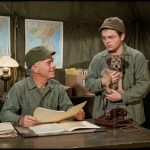
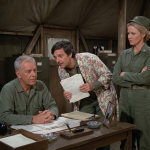
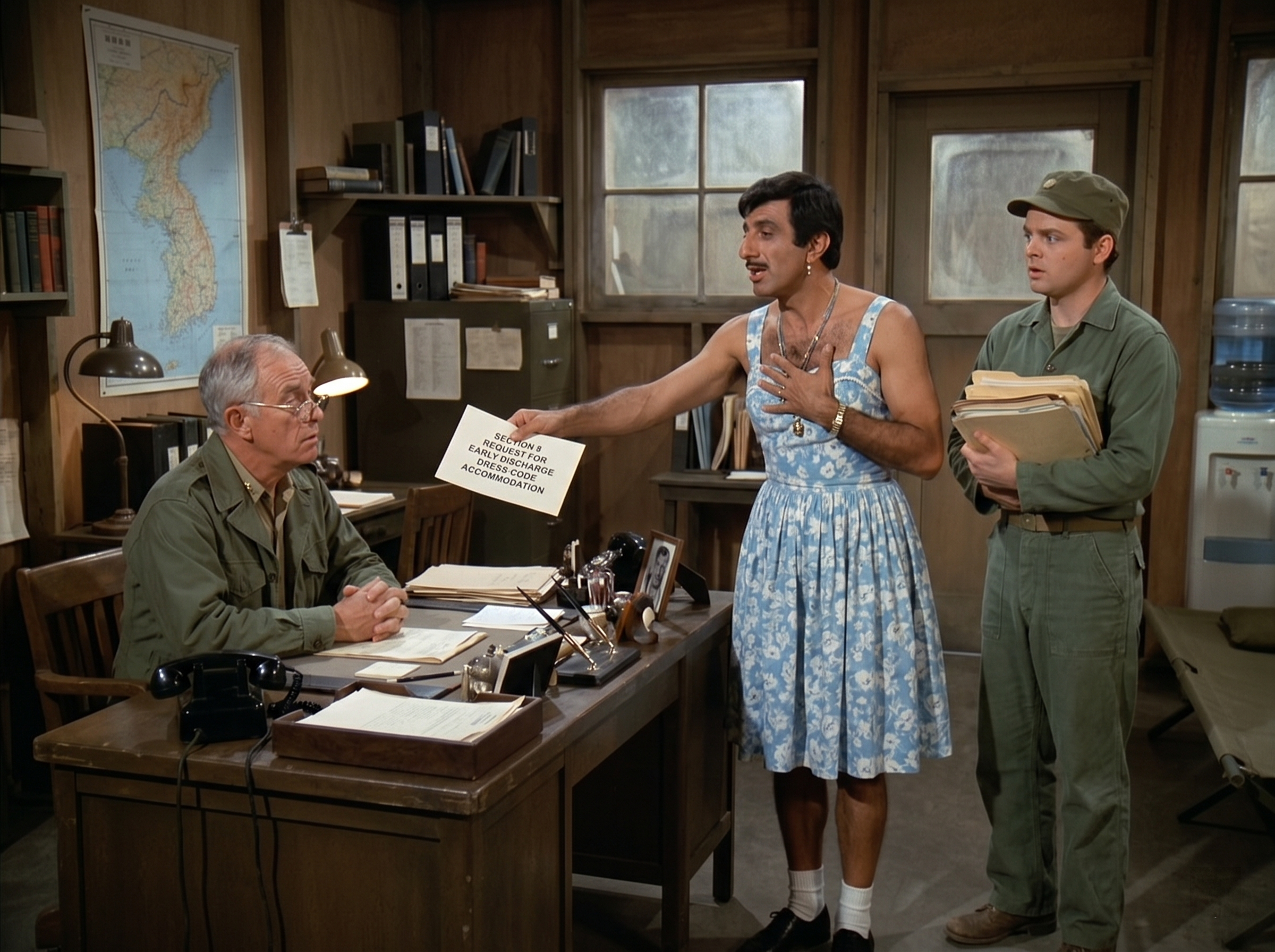
Colonel Potter sat behind his heavy wooden desk, his spectacles resting low on his nose as he stared down at a crisp piece of paper that had just been thrusted into his personal space. His face was a map of deep wrinkles, etched by years of cavalry discipline and months of sheltering a group of brilliant, broken surgeons from the harsh realities of a forgotten war.
Standing directly across from him, looking entirely out of place yet fiercely dignified, was the camp’s most dedicated legal optimist, dressed in a bright blue, floral-print sundress.
With one hand resting dramatically over his heart and the other firmly presenting his latest document, Corporal Klinger stood his ground, his dark eyes wide with an intense mix of desperation and theatrical hope. The paper in his hand bore bold, typed letters that summarized a years-long crusade: “SECTION 8 REQUEST FOR EARLY DISCHARGE / DRESS CODE ACCOMMODATION.”
A few steps back, clutching a stack of heavy beige personnel folders to his chest, Radar O’Reilly watched the exchange with an expression of pure, frozen anxiety. His oversized olive-drab cap sat tilted forward, and his eyes darted nervously between the Colonel’s tightening jaw and Klinger’s perfectly coordinated white socks.
Radar knew the exact temperature of the room before anyone else did, and right now, the barometer in the front office was dropping fast.
For months, Klinger’s wardrobe had been a source of colorful amusement—a running joke that gave the surgeons a reason to smile between incoming choppers. But today was different; the laughter in the swamp had dried up after three straight days of casualties from the front, and everyone’s nerves were worn down to a single, raw thread.
Klinger took a deep, theatrical breath, his chin tilting upward as he prepared to deliver a speech he had likely rehearsed in front of the latrine mirror for a week.
“Colonel, sir, I implore you to look at the psychological evidence staring you right in the face,” Klinger pleaded, his voice carrying a tremor that was only half-acted. “A man cannot properly defend democracy while worrying if his spaghetti straps are slipping, nor can he find peace of mind when his favorite gingham pattern is being ruined by mortar dust.”
Potter didn’t move a muscle, his hand remaining clasped in front of him, his eyes locked onto the typed page with an unreadable, stony glare.
The silence stretched on, heavy and suffocating, until the distant, unmistakable *thump-thump-thump* of incoming medical choppers began to rattle the windowpanes.
The sound of the helicopters always changed the air in the room, shifting the atmosphere instantly from administrative comedy to life-or-death reality.
Radar flinched, his head instantly cocking to the side as his internal radar registered the number of incoming birds before they could even be seen over the hills. “Six choppers, Colonel,” he whispered, his earnest voice breaking the tension like a glass rod. “They’re coming from the sector near the punchbowl.”
Potter finally closed his eyes for a brief second, the exhaustion of his age showing through his military posture, before looking back up at the man in the blue sundress.
Klinger didn’t drop his arm, but the theatrical flare in his shoulders visibly withered, replaced by the sudden, sobering weight that every member of the 4077th carried. He looked at the paper in his hand, then at the map of Korea hanging on the wall behind the Colonel’s desk—a map covered in red grease-pencil marks marking lines that moved but never seemed to end.
“Corporal,” Potter said softly, his voice devoid of its usual gravelly fire, sounding more like a tired father than a commanding officer. “You’ve got a lot of heart, and God knows you’ve got a lot of style. But right now, out on that pad, there are boys who don’t care if you’re wearing an army parka or a ballgown, as long as you’re there to help carry the litter.”
Klinger stood frozen for a moment, the document still extended, looking down at the bold letters of his coveted Section 8 request.
Slowly, his arm lowered to his side. The defiance drained from his posture, leaving behind just another tired kid from Toledo who wanted nothing more than to go home to his mother’s cooking, but knew deep down that he couldn’t leave his friends behind.
“Radar,” Potter snapped, the authority returning to his tone as he stood up from his chair. “Get Hawkeye and B.J. out of the swamp. Tell Margaret to prep Pre-Op. We’re going to be in for a long night.”
“Yes, sir,” Radar said, already moving toward the door, his heavy boots clattering against the floorboards as he managed to navigate past Klinger without dropping a single file.
Klinger remained by the desk for a split second, looking at the Colonel, who was already reaching for his scrub jacket hanging on the back of the door. Without a word, Klinger folded the Section 8 paperwork neatly, sliding it into the waistband of his blue dress, and turned toward the exit.
By the time he hit the dirt outside, the rotors were kicking up dust clouds across the compound, blinding and choked with grit.
Hawkeye and B.J. came sprinting out of the swamp, their eyes bloodshot, tucking their shirts into their trousers as they ran toward the landing pad. B.J. caught sight of Klinger running alongside them, the blue floral skirt flapping wildly in the rotor wash against his hairy legs.
“Nice pattern, Klinger!” Hawkeye yelled over the roaring engines, a brief, exhausted smirk flashing across his face. “But I think blue makes you look a little too stable for a discharge!”
“Save it, Doc!” Klinger yelled back, grabbing the handles of the first litter as the chopper skids touched the earth. “Just make sure you don’t get blood on my lace!”
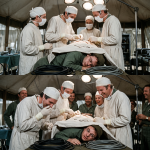
For the next fourteen hours, nobody thought about discharge papers, military regulations, or the absurdity of a man in a dress working the triage lines. Underneath the bright blue fabric was a soldier who stayed up until dawn, holding flashlights when the generator flickered, wiping sweat from the surgeons’ brows, and offering quiet, reassuring words to frightened young men who just needed to hear a human voice.
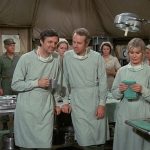
As the sun finally began to peek over the Korean hills, casting a pale gold light across the exhausted camp, Potter walked out of the O.R. tent, unbuttoning his soiled gown.
He saw Klinger sitting on an overturned crate near the edge of the compound, his face smudged with grease, his white socks covered in dark mud, and his head resting tiredly against a wooden post. The blue dress was ruined, stained and torn at the hem, but Klinger was carefully smoothing out the creases in the skirt with his rough hands, looking out at the mountains.
Potter walked over, stopping just a few feet away, and pulled a cigar from his pocket, lighting it with a quiet sigh.
“Tomorrow, Klinger,” Potter muttered around the cigar, not looking directly at him but keeping his eyes on the horizon. “Tomorrow, you can file that paperwork again. And I’ll deny it again.”
Klinger looked up, a faint, genuinely warm smile breaking through the grime on his face as he adjusted his necklace. “Thank you, Colonel. I already have a yellow taffeta number picked out for the occasion.”
Potter gave a single, slow nod, a soft chuckle escaping his chest as he walked away, leaving the Corporal alone in the quiet morning light. In the 4077th, sanity was a relative term, and sometimes, a piece of blue fabric was the only anchor keeping the whole world from drifting away.
Pull up a chair, pour a cup of swamp gin, and remember the family we found in the most unforgettable place on earth.