THE SMALLEST SOLDIER IN KOREA
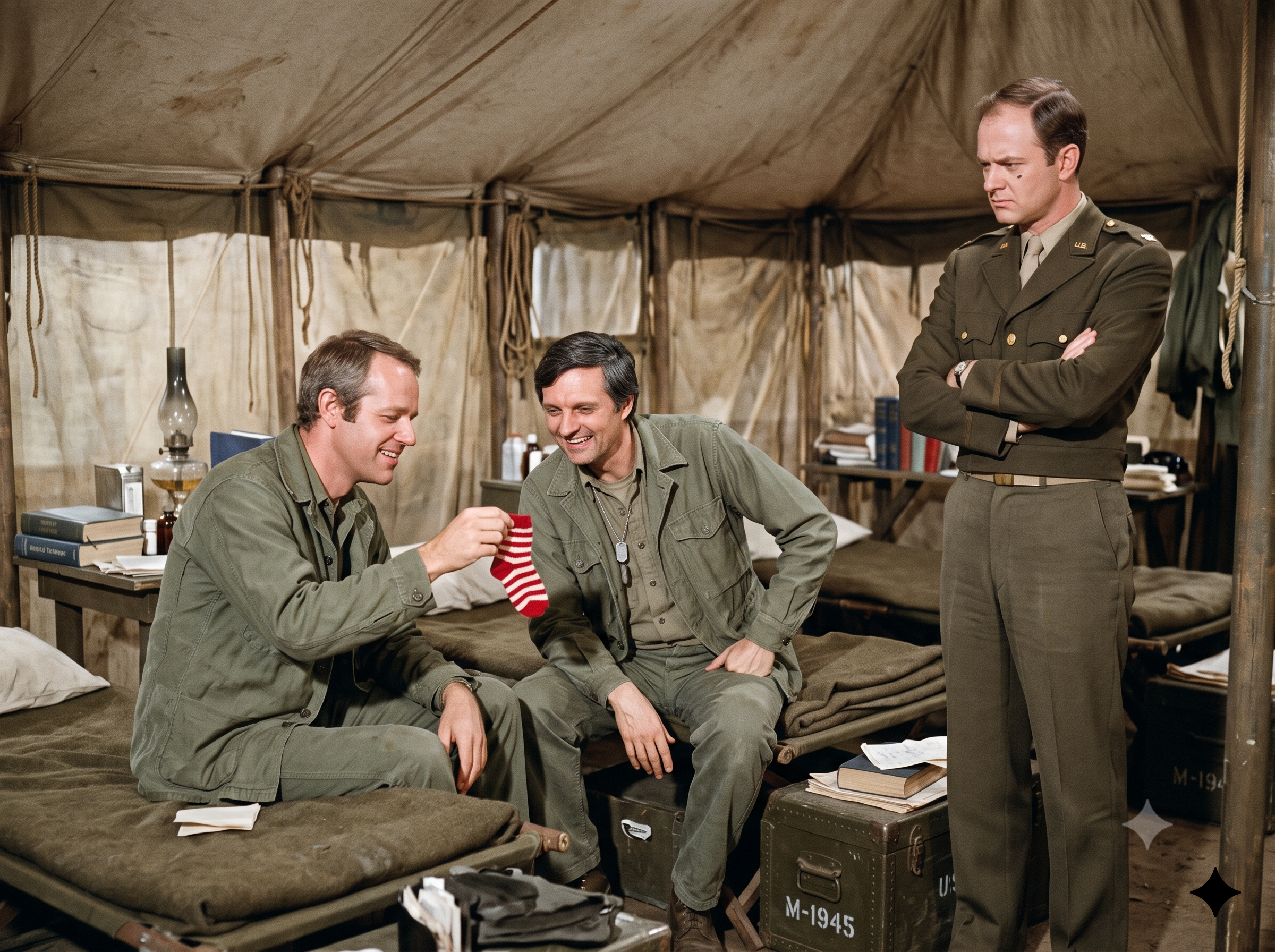
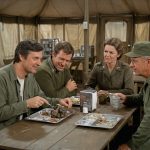
The rain in Korea didn’t just fall; it saturated everything, bleeding the color out of the canvas and turning the camp into a lake of gray mud. The air inside The Swamp was thick, smelling of old coffee, damp blankets, and the pervasive exhaustion of the 4077th. On a bad day, the sound of the constant downpour against the tent walls was enough to drive a man mad.
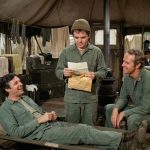
Captain B.J. Hunnicutt was just trying to keep his eyes open. He was seated on his cot, slumped forward, his large, capable hands resting in his lap. The letter from Peg—the one he’d read so many times the ink was fading—was tucked safely into the back pocket of his fatigue trousers.
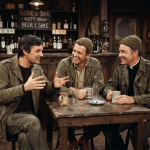
Sitting beside him on the next cot was Hawkeye Pierce. Hawkeye was an artist of posture, a man who could turn the act of sitting into a statement of lazy defiance against the entire war. He was currently slouching, legs stretched out, his expression an open book of fatigue, cynicism, and something quietly watchful.
Across from them, standing sharply, was Major Charles Emerson Winchester III. Winchester was a pillar of starch and disapproval, arms crossed tightly, his very uniform seeming to lecture the messy reality of The Swamp. His refined, aristocratic face bore a scowl that could freeze the mud, though his eyes often betrayed the loneliness he refused to acknowledge.
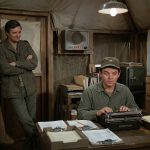
A package had just arrived, courtesy of Radar, who had slipped inside looking like a drowned rat and disappeared just as quickly. The brown paper was already waterlogged, disintegrating in B.J.’s fingers. Inside, there were a few bars of soap, a new pair of wool socks for him, and a small, distinctively shaped object wrapped in tissue paper.
B.J. carefully unfolded the tissue. He froze. His heart didn’t just skip a beat; it seemed to perform a complete double-flip.
Hawkeye looked up, the corner of his mouth twitching with a tired wisecrack ready to deploy. “What have we there, Beej? A replacement heart for Frank Burns? He never uses his.“
B.J. didn’t answer. He couldn’t. He didn’t even hear him. He was completely mesmerized.
Slowly, carefully, like he was handling the most delicate piece of surgical gauze, B.J. pinched the tiny, tiny object between his thumb and index finger. It was ridiculous. It was impossible. It was the smallest, most hopeless, most beautifully knitted piece of wool he had ever seen.
It was a sock. A baby bootie, maybe. A red-and-white striped knitted sock, perhaps three inches long, complete with a tiny, imperfect cuff and a hopelessly dropped stitch near the heel.
“Well, now,” Hawkeye said, his voice dropping an octave, the sarcasm draining away.
B.J. held it up (as seen in the image), the tiny red and white stripes a sharp, jarring contrast to the endless olive drab of the tent. He looked at it with an expression of pure, unadulterated wonder, a soft, warm smile spreading across his face.
“It’s from Erin,” B.J. said quietly, his voice thick. “Peg’s letter said Erin ‘knitted’ it herself. It’s her first project. She wants me to wear it.“
Hawkeye leaned in closer, studying the little sock, his smile genuine but carefully contained. “Well, isn’t that just… microscopic. B.J., your feet must be the envy of the entire miniature community.“
Winchester scoffed. Standing in his perfect uniform, he seemed utterly affronted. “Utterly preposterous. A testament to the chaos of domestic sentimentality. What, pray tell, does she expect you to achieve with that? Protection for your left thumb?“
B.J. didn’t even look at Charles. He was lost in the memory of a little girl, miles away, who thought her daddy might need a tiny wool sock. The warmth of home, of family, of love that reached across an entire ocean, was suddenly concentrated into that single, imperfect, striped bootie.
The noise of the rain outside seemed to fade. B.J.’s smile softened, but the moisture in his eyes was unmistakable. Hawkeye put a gentle hand on B.J.’s shoulder, a silent gesture that required no words.
But across the room, Winchester just stood, arms still tightly crossed, his face a mask of refined irritation. Yet, if anyone had been looking closely at his eyes—which were fixed, just for a moment, not at the sock, but at B.J.—they might have seen something other than dismissal. The tension in the small canvas room was absolute, a delicate thing balanced on the tip of a tiny knitted sock.
“It is, fundamentally,” Charles continued, his voice resonating through the small space, “an exercise in futility. A poorly tensioned, hopelessly shapeless artifact that serves only as a reminder of an absence that sentimentality cannot bridge.“
Hawkeye turned, ready to deliver a scorching reply. B.J. just held the sock, the smile slightly faltering.
“Charles, must you turn everything into a lecture on disappointment?” Hawkeye said, his voice quiet but sharp. “It’s a gift. From a little girl. To her father.“
“And it is useless,” Charles snapped back. He began uncrossing his arms, stepping closer, though his face remained controlled and slightly scowling. “What is the purpose of sentiment, Captain Hunnicutt, if it provides neither utility nor comfort, but only highlights the impossible chasm between this… mud-pit… and everything civilized?“
B.J. finally looked at Charles. He wiped a hand across his eye quickly. “I know it’s useless, Charles. That’s not the point. The point is… she wanted to make it for me.“
Charles stood near the edge of B.J.’s cot. He didn’t look at B.J., or Hawkeye, or the sock. His gaze was distant, fixed on the rain-streaked canvas wall near the lamp. The habitual scowl was still there, but the edges were softer.
Slowly, carefully, Winchester uncrossed his arms. He took a long, steady breath, as if bracing himself for something unpleasant. He did not ask permission. He simply reached out a hand and took the tiny knitted sock from B.J.’s large, scarred fingers.
“The tension,” Charles muttered, examining the knitting with an air of professional condescension, his eyebrow arched as if critiquing a failed surgery. He ran a finger over the dropped stitch. “Utterly abysmal. Any first-year surgical resident knows better than to leave loose ends.“
Hawkeye watched, speechless. B.J. simply waited.
Charles held the tiny sock, pinching it delicately between his own immaculate thumb and index finger. The scowl on his face began to fracture. His eyes moved from the sock, not to B.J., but inward.
“My… my Aunt Honoria,” Charles began, his voice surprisingly quiet, devoid of its usual booming theatrics. He hesitated. “She used to knit. For me. Terrible mufflers. She always miscounted the stitches. And they were… scratchy. Hopelessly, aggressively scratchy wool, invariably in the most garish shade of orange.“
Hawkeye and B.J. stared. They didn’t move. They barely breathed.
“I hated them,” Charles continued, still looking at the tiny sock. “I used to hide them. In the closet. Behind the boots. I told her I had lost them.“
He gave a small, quiet, almost imperceptible scoff. “She just made more. Each one worse than the last.“
The mask of refined irritation began to crumble completely. His expression softened into a quiet, almost childlike tenderness that Hawkeye and B.J. had never seen before. It wasn’t the mask; it was a human moment, shared in the mud and the gray.
Charles carefully held the sock, his gaze fixed on it. “I haven’t thought of her mufflers in years. They were, in fact, preposterous. But they were made… they were made with a certain… clumsy affection.“
The silence in the tent was heavy, but it was no longer tense. It was warm. It was human. It was full of the sound of three men, tired and far from home, acknowledging the same burden.
Hawkeye finally spoke, his voice unusually gentle, stripped of its protective sarcasm. “We all have our scratchy orange mufflers, Charles.“
Charles looked up then, meeting B.J.’s gaze. The scowl was gone, replaced by a quiet, shared understanding. For a brief, singular moment, there were no majors, no captains, no Boston high society or Iowa cornfields. There were just three soldiers, bonded by the fatigue, the war, and the fragile, tiny threads that still tied them to home.
B.J. nodded, his eyes clear now. A genuine, warm smile returned, a mirror to Hawkeye’s own quiet smile of observation and affection. Winchester, returning to his typical posture, carefully handed the sock back to B.J. with an elaborate, almost theatrical flourish of his hand, as seen in his original pose. He immediately folded his arms back across his chest, the scowl settling back into place, though perhaps a shade less severe than before.
“The knitting,” Charles pronounced, his voice regaining its practiced resonance, “is nevertheless appalling. Utterly, fundamentally, abysmal.“
Hawkeye chuckled, a dry, warm sound. “God forbid you should ever lower your standards, Charles. The entire military-industrial complex might collapse.“
“I simply prefer competence, Captain Pierce,” Charles replied, turning away slightly. “Even in the service of pathetic sentiment.“
B.J. took the tiny sock, his smile soft and steady. He carefully folded it into the clean wool sock that had also arrived, placing it gently on his footlocker alongside his beloved books. It would stay there, safe and sound, a small, striped, useless reminder of the love that reached across the mud.
The rain outside continued its relentless drumbeat against the canvas, but inside The Swamp, a small, tiny event—a preposterous, red-and-white striped knitted sock—had managed, just for a few moments, to let three tired men remember that there was still a world beyond the war, and that they were not alone.
A tiny red-and-white striped reminder of the messy, imperfect love that keeps us human when the whole world is drab.