The Fragile Geometry of Flowers and Hope
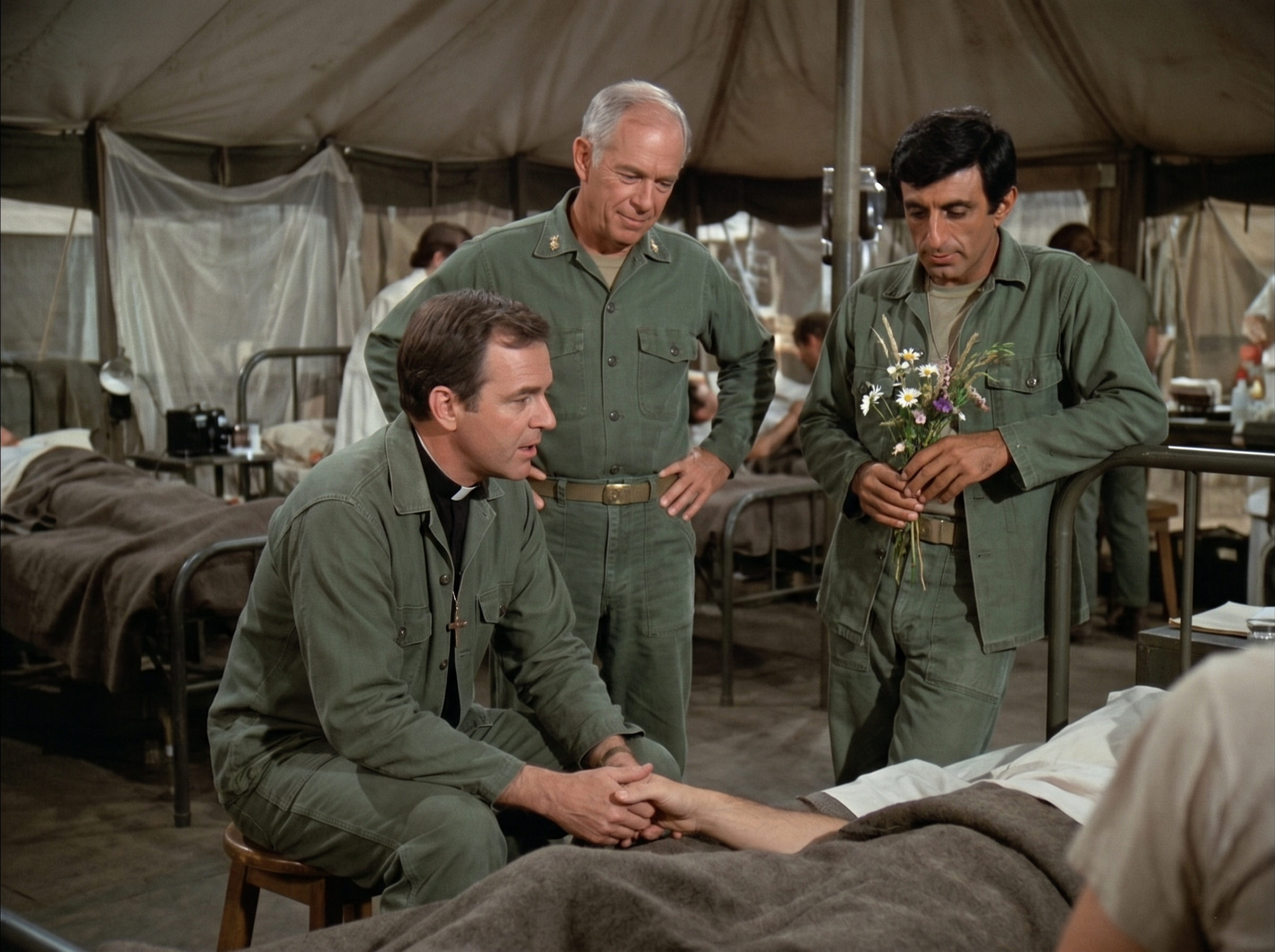
The smell of canvas, disinfectant, and spent energy always hung heaviest over Post-Op. It was a silent testament to the long hours and longer odds.
Sometimes, the loudest sound in the entire 4077th wasn’t the artillery or the chopper blades; it was the quiet breathing of a soldier hanging on.
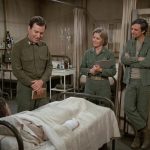
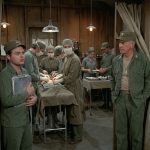
This particular Wednesday afternoon was no exception. Three of the unit’s steady pillars—Colonel Potter, Father Mulcahy, and Corporal Klinger—were gathered around a quiet bedside, forming a protective, weary huddle.
Father Mulcahy, as gentle and steady as always, was closest. He was hunched low on a wooden stool, wearing his fatigue jacket over his clerical shirt.
He reached out, his soft, healing hands covering the bandaged wrist of Corporal Thompson. Thompson was motionless under a rough brown blanket, his face pale against the white pillow.
Mulcahy wasn’t speaking; he was simply *offering*, his thumbs tracing tiny circles of comfort, bridging the terrible gap between a quiet ward and a waiting family back in Ohio.
Standing just behind him was Colonel Potter. Sherman Potter, the old horse cavalryman, looked every bit the weary commander, his hands planted firmly on his hips, jaw set in a determined frown. He watched Thompson’s chest rise and fall, measuring the breath with a practiced, critical eye.
Potter wasn’t giving orders; he was holding watch. He was a general standing guard over a private, ensuring the fragile spark didn’t slip away.
And then there was Klinger.
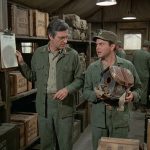
Maxwell Klinger, usually seen in some theatrical confection, was today the picture of somber, olive-drab earnestness. He stood a few feet back, leaning against the metal rail of an adjacent bed, his gaze fixed intently on Mulcahy’s hands.
The most striking detail, however, was in Klinger’s large, careful grip. He wasn’t clutching section eight discharge forms. He was holding a small, delicate bouquet of wildflowers.
There was a clutch of dainty white daisies, some tiny purple blossoms, and a sprig of wild grass. They looked pathetically beautiful against the rough texture of his uniform.
“Where did you even *find* those, Klinger?” Potter asked, his voice low but sharp enough to cut the quiet.
Klinger started, his grip tightening on the stems. “Just… out there, Colonel. Over near the perimeter fence. By the mortar pit.”
“The mortar pit,” Potter repeated, his tone skeptical.
“Well, yes, sir. But they were *outside* the pit. Practically asking to be picked. I figured… I figured maybe they’d help Thompson. Something real. Something not olive drab.”
Mulcahy looked up then, his eyes soft. “It’s a lovely gesture, Corporal.”
“Gesture? Son, in this ward, it’s a logistic challenge,” Potter said, but there was no real malice in it. “Now, what’s your plan? Where do you put them? Every surface here is sterile for a reason.”
Klinger hesitated, looking around the stark, functional ward. The nearest side table was crowded with gauze and medical tape. There was nowhere to simply *put* the flowers.
“I thought… perhaps I could just… hold them? For him?” Klinger offered, a hopeful, awkward grin touching his face.
Just then, a nurse hurried in from the main surgical tent. “Colonel! Major Houlihan needs a second opinion on Bed 4. He’s hypotensive.”
Potter snapped straight. “Dammit. On my way.” He paused, looking back at Mulcahy and Klinger. “Watch him. Both of you.”
As Potter rushed out, Klinger was left standing with his delicate burden, the only bit of color and life in the entire gray room.
The immediate emergency was over, replaced by an unsettling, suspended tension.
He looked from the unconscious Thompson to the frail daisies. “So… now what, Father?”
Mulcahy, still holding the soldier’s hand, took a slow breath. The ward felt very quiet. “Now, Corporal,” he whispered, looking up at Klinger, “we just pray the flowers keep holding their breath until he wakes up.”
Klinger didn’t move. He became a living statue of wildflowers and earnest concern.
Post-Op hummed around him. The clatter of trays, the rhythmic *whoosh-hiss* of an oxygen tank, the quick, efficient steps of nurses—all of it felt distant.
Mulcahy remained seated, his hands gently framing Thompson’s wrist. It was a tableau of faith, medicine, and unexpected foliage.
Five minutes stretched into ten. Klinger’s arms were beginning to burn with fatigue, but he wouldn’t dare shift, worried the slight rustle of the stems might disrupt the precarious silence.
The wildflowers, cut from the dry earth, were already beginning to droop ever so slightly. The daisies were bowing their heads. The grass was losing its spring.
“He’s been so quiet,” Klinger murmured, his voice cracking. “Since before you even got here.”
Mulcahy nodded slowly. “Quiet can be a good thing, Maxwell. It’s the sound of the body doing its hardest work. Restoring order.”
Klinger didn’t answer. He just adjusted his grip on the bouquet, willing it not to fade faster than the man in the bed. He remembered picking them, seeing the spot of purple against the dusty, dangerous landscape. It had felt like a small act of defiance.
Suddenly, Thompson’s hand twitched.
It was slight, nearly imperceptible, but Mulcahy felt it immediately. His gaze intensified.
Then Thompson moaned. It was a sound like a rusted hinge, weak and full of old pain, but it was the most beautiful sound Klinger had heard all week.
“Klinger,” Mulcahy said, his voice rising, “Look.”
Thompson’s eyelids fluttered. Slowly, fighting against a crushing weight, they opened. He blinked, staring blankly at the canvas ceiling, confused and disoriented.
His eyes drifted down, settling on Mulcahy’s face, then traced up past the crucifix to Klinger, who was leaning in slightly, the bouquet clutched tight.
Thompson’s gaze fixed on the flowers.
For a long moment, there was no recognition, just dull confusion. Then, a faint, fragile smile began to break on his face. Not a smile of joy, but of profound relief.
His voice was a dry rasps. “Pretty,” he whispered. “Daisies.”
A heavy breath, held by everyone in the circle, was released. Klinger felt his eyes sting.
Potter chose that moment to return, stepping quietly back into the ward. He stopped as he saw Thompson’s open eyes. He assessed the slight smile, the movement.
Potter’s face softened. He walked over to the side of the bed, putting a hand on Klinger’s shoulder, not the flowers. He nodded, first to Mulcahy, then to Klinger.
“Good work, men,” he said simply. He looked at Klinger’s bouquet. “Especially you, Klinger. Looks like logistics was wrong.”
Potter reached into his pocket and produced a small, empty glass vial that once held antibiotics. “Nurse Kelly! Let’s find a little water for this garden.”
As Nurse Kelly arrived with a small cup of water, Klinger, his hand trembling slightly, carefully transferred the wildflowers, one by one, into the tiny improvisational vase.
They stood them upright on the bedside tray, right next to the rolls of bandage. The daisies were drooping, the purple blossoms closed, and the grass was limp, but they stood.
Thompson, the smile fixed on his lips, closed his eyes again. His breathing had changed, deepened. He was asleep, not unconscious.
The four of them—Potter, Mulcahy, Klinger, and Kelly—stood around the tiny, fragile arrangement.
“They don’t look like much,” Klinger whispered, almost apologetic.
“They’re exactly enough,” Mulcahy replied, looking at the sleeping boy and the dying flowers. “Exactly enough.”
The 4077th didn’t stop. Outside, the choppers would return. But for this one quiet afternoon, under a hot canvas tent, a few dusty stems and three friends had held the line against the dark.
Sometimes the strongest medicine came in the form of a small, wild hope that refused to be forgotten.