The Sergeant Major’s New Sunday Best
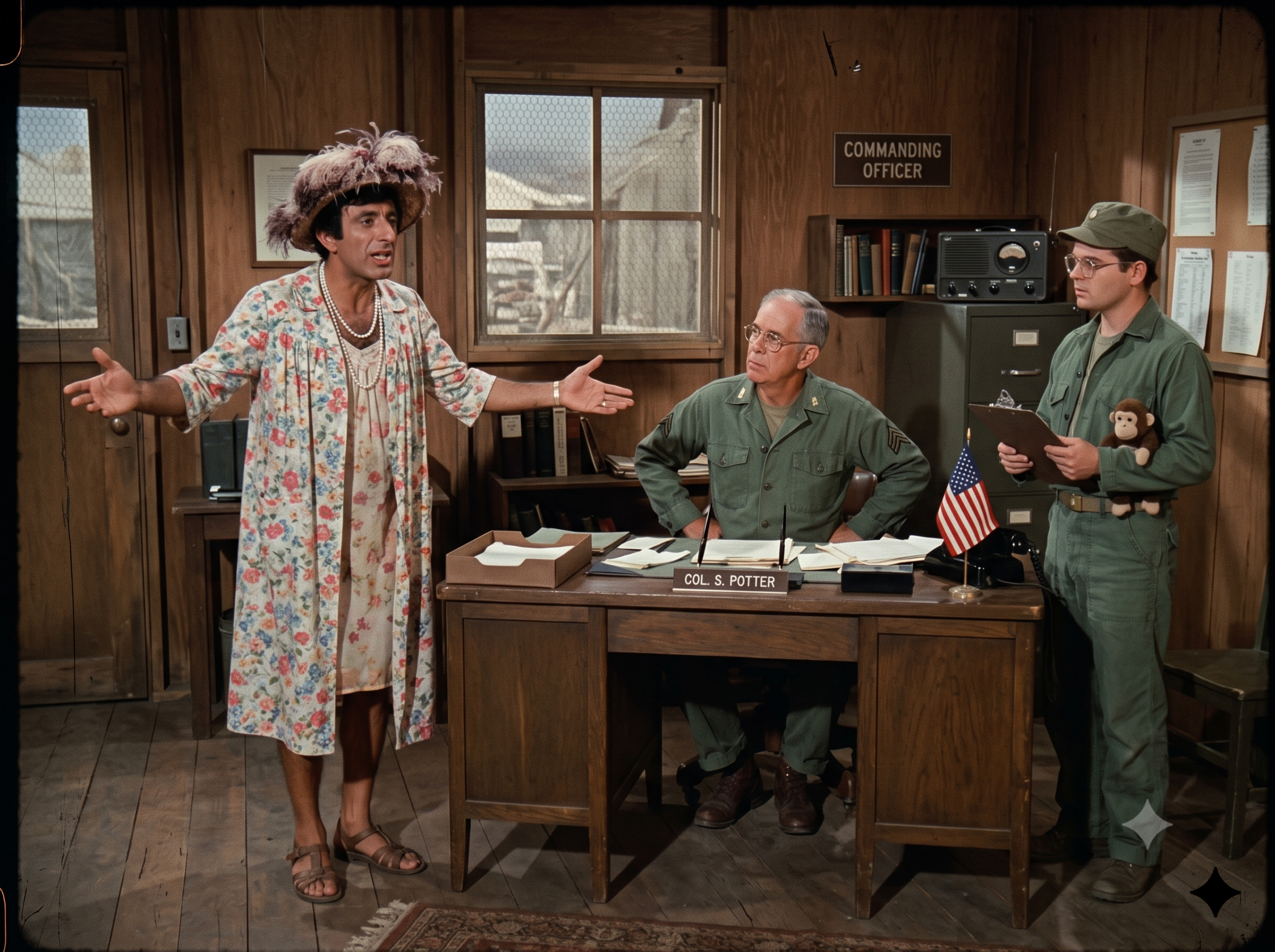
The afternoon heat in Korea was a heavy, physical thing, the kind that pressed against the plywood walls of Colonel Potter’s office until the air felt thick enough to chew. Outside, the 4077th was mostly quiet, the usual hum of generators replaced by the lazy buzzing of flies. But inside, the silence was broken by the distinct, rhythmic *clack-clack-clack* of sandals hitting the floorboards.
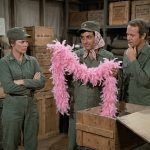
Corporal Maxwell Q. Klinger stood in the center of the room, looking like he’d just stepped out of a surrealist fashion show in Paris—or perhaps a very confused garden party in Ohio. He was draped in a floral housecoat that screamed “suburban relaxation,” topped with a feathered hat that had seen better days, and a string of pearls that caught the harsh, filtered light from the window.
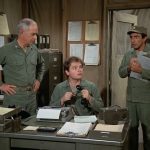
Colonel Potter sat behind his desk, his face a masterpiece of stoic confusion, one eyebrow arched so high it was practically retreating into his hairline. Beside him, Radar O’Reilly stood rigid, his clipboard held like a shield, clutching a small toy monkey as if it were a tactical advantage. The contrast was startling: the raw, military austerity of the office versus the sheer, defiant whimsy of Klinger’s ensemble.
Klinger spread his arms wide, the floral fabric flowing like a makeshift cape. “Colonel, I’m telling you, this is the look for the season,” he announced, his voice vibrating with theatrical sincerity. “It’s breezy, it’s chic, and frankly, I think it’s the only way to convince the medical board that I’ve finally lost my marbles in a truly stylish fashion.”
Potter didn’t bark. He didn’t yell. He just leaned back, tapped his fountain pen against his blotter, and stared, his eyes twinkling with a mixture of exasperation and genuine curiosity. Radar shifted his weight, his knuckles white against the clipboard, clearly paralyzed between his duty to the Colonel and his innate desire to make sure Klinger wasn’t actually having a breakdown.
“Klinger,” Potter started, his voice a gravelly low-tide, “you’ve been a nun, a debutante, and a statue. But this? This looks like you raided a grandmother’s closet during a tornado.”
Klinger didn’t flinch. He leaned in, his expression dropping into something strangely vulnerable, the humor momentarily stripped away by the crushing weight of the war that sat between them. “Colonel, it’s not just a look. I need out. Today. I need to know that there’s a world left where men wear suits, not fatigues, and where I can sit on a porch without worrying about incoming mortars.”
The tension in the room spiked. It wasn’t just Klinger’s costume anymore; it was the naked, desperate hope behind the performance. Radar looked at the floor, his heart clearly breaking for his friend, while Potter’s jaw tightened, the lines around his eyes deepening as he realized that the farce was, as always, a mask for something much heavier.
Colonel Potter looked at Klinger—really looked at him—and saw the tremor in his hands beneath the flowery sleeves. He knew that for all the feathers and the pearls, there was a man underneath who was just plain tired of being afraid. Potter sighed, a long, weary sound that seemed to deflate the entire room. He pushed his chair back and stood up, his uniform sharp and solid against the rustic decor of the office.
“Klinger,” he said, his tone shifting from commander to the weary father-figure he had become to them all. “You’ve got grit, I’ll give you that. More grit than some of the guys I served with back in the Big War. But this… this is a cry for help that’s going to get you a one-way ticket to a ward where they don’t appreciate haute couture.”
Radar stepped forward, his voice barely a whisper. “Sir, maybe he’s just… you know, having a rough week? We all are. The last chopper flight was full, and… well, it’s been quiet lately. Too quiet.”
Klinger’s theatrical posture wilted just a fraction. He looked down at the pearls, then back up at the two men who held his fate in their hands. “I just want to go home, Colonel,” he said, his voice stripped of the Klinger-esque bravado. “I want to be somewhere where the only thing I have to worry about is whether or not I remembered to water the petunias.”
Potter walked around the desk, his heavy boots slow and deliberate. He stopped right in front of Klinger, the two of them standing in the patch of dusty sunlight filtering through the window. For a moment, the war didn’t exist. There was just a man in a dress and an old soldier trying to make sense of a world gone mad.
Potter reached out and straightened Klinger’s collar, the move so paternal and gentle that Radar actually sniffled. “You’re a pain in my backside, Klinger. You’re a tactical nightmare and a stain on the decor of the U.S. Army. But you’re one of my boys.”
Potter turned to Radar. “Radar, get this man a cup of coffee. And not the sludge from the mess hall. Find the good stuff we’ve been hiding from Winchester.”
Radar’s face lit up with a grin that reached his eyes. “Yes, sir! Right away, sir!” He practically skipped toward the door, leaving his toy monkey on the edge of the desk.
Klinger looked around, the bravado returning, though it was softer now, tempered by the small kindness he’d just received. “Does this mean I get a pass, sir?”
Potter sat back down, picking up his pen. “It means you get a cup of coffee, Corporal. And then, you go put on a uniform that doesn’t have ruffles. We’ve got a camp to run, and I need my clerk to be able to walk without tripping over his own hemline.”
Klinger gave a mock salute, the feathered hat wobbling precariously. “Yes, sir. But I’m keeping the pearls. They tie the outfit together.”
As Klinger walked out, the sound of his sandals fading down the wooden hallway, Potter watched him go, a small, sad smile playing on his lips. He looked over at Radar’s toy monkey sitting on the desk, a tiny, incongruous symbol of the absurdity they lived with every single day. They were a ragtag family, held together by shared trauma, stubborn hope, and the occasional bit of sanity-saving nonsense.
The office settled back into its routine, the quiet returning, but it felt different now. It felt like they had all exhaled at once. In the middle of nowhere, surrounded by a war that made no sense, they had managed to find one more moment of grace.
Sometimes, it’s the strangest costumes that remind us we’re still human.