A Toledo Springtime in the Supply Tent
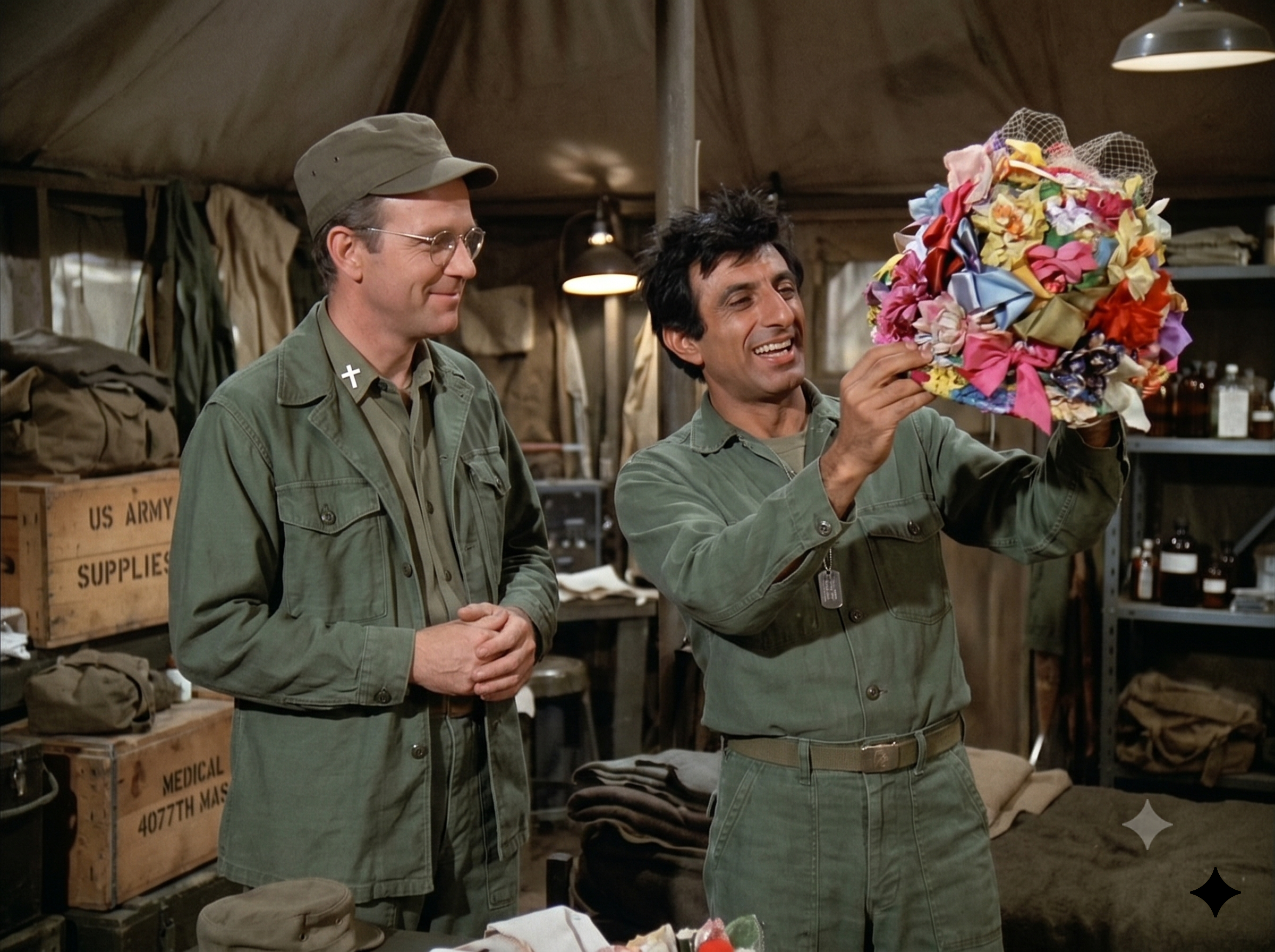
In a world painted almost exclusively in mud, blood, and olive drab, color was a rare and precious commodity at the 4077th.
The war had a way of washing everything out. It bleached the canvas tents under the harsh Korean sun, it turned the jeeps into rolling blocks of dust, and it drained the light right out of the doctors’ eyes after a forty-eight-hour marathon in the OR.
Father Francis Mulcahy knew this better than anyone. He spent his days searching for small mercies in a place that offered very few.
On this particular Tuesday, the camp was enjoying a rare, fragile lull. The generators were quiet. The sky was empty of helicopters.
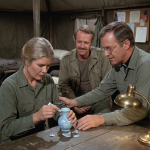
Seeking nothing more than a quiet moment and a stack of scratchy wool blankets for the Post-Op ward, the good Father stepped into the dim, canvas-walled sanctuary of the supply tent.
The air inside was heavy with the familiar, dry scent of stored canvas and pine. It was a dusty haven of wooden crates, stacked inventory, and folded linens.
But today, the supply tent held a miracle.
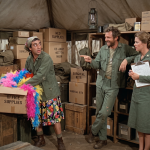
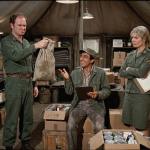
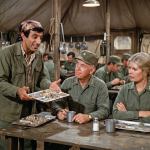
Standing right in the center of the cramped space, bathed in the soft, warm glow of a single practical overhead bulb, was Corporal Maxwell Klinger.
For once, Klinger wasn’t wearing chiffon, satin, or a velvet evening gown. He was dressed in standard-issue Army green fatigues, his silver dog tags dangling quietly against his chest.
Yet, in his hands, he held the most magnificent, chaotic object within a hundred miles of the 38th Parallel.
It was a hat.
But calling this object a hat was like calling the Sistine Chapel a painted ceiling. It was a glorious, theatrical explosion of fabric.
Dozens of silk ribbons, velvet bows, and delicate fabric flowers were clustered together in a wild, vibrant bouquet. There were bright pinks, sunny yellows, deep blues, and brilliant reds.
It looked as though a beautiful springtime garden had violently collided with a high-end haberdashery.
Klinger held the creation up to the light with profound, almost reverent pride. His face was split in a wide, beaming grin of pure triumph.
“Father,” Klinger breathed, his dark eyes shining as he gently rotated the floral crown. “Behold. The Toledo Springtime Special.”
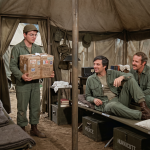
Mulcahy stopped in his tracks near a large wooden crate boldly stenciled with the words MEDICAL 4077TH MASH.
Instinctively, the priest folded his hands modestly at his waist. He looked at Klinger, and then at the hat, offering a soft, amazed smile of genuine wonder.
“My word, Max,” Mulcahy whispered. “Wherever in this barren country did you find such a magnificent thing?”
“Find it? I birthed it, Father!” Klinger declared, his chest puffing out. “This is the result of three weeks of intensive bartering, a needle I borrowed from Major Houlihan’s tent when she wasn’t looking, and my own sheer, unadulterated genius.”
Klinger adjusted the hat again, the bright ribbons catching the warm camp light. For a fleeting moment, the war simply didn’t exist. There was only this vibrant, absurd piece of art.
But the peace of the 4077th was always fragile.
Suddenly, the tinny screech of the camp PA system crackled to life, hissing with loud static that echoed off the canvas walls.
At the exact same moment, the heavy, rhythmic thud of distant artillery rumbled through the wooden floorboards, rattling the medical supplies on the metal shelving behind them.
Klinger’s beaming smile froze instantly. His shoulders tensed, and his grip tightened protectively on the delicate ribbons.
The PA system hummed loudly, a harbinger of the grim reality that always threatened to swallow them whole. In the span of a single heartbeat, the vibrant, colorful illusion of Klinger’s masterpiece was about to be crushed by the cold machinery of war.
The PA clicked, and the bored, nasal voice of the camp clerk finally echoed through the heavy canvas.
“Attention, all personnel. The mail jeep has blown a tire on Route 12. Mail call is delayed until tomorrow morning. That is all.”
The PA clicked off with a final, sharp pop.
It wasn’t choppers. It wasn’t wounded. It wasn’t a call to the OR. It was just another mundane, bureaucratic frustration of Army life.
Klinger’s tense shoulders dropped a full two inches. He let out a long, shuddering breath, the fear leaving his face as his trademark, resilient grin slowly returned.
Father Mulcahy let out a breath of his own, his tightly folded hands relaxing against his green jacket. The quiet, dusty hum of the supply tent wrapped around them once again.
“A false alarm, it seems,” Mulcahy said gently, his smile returning as he stepped closer to inspect the hat.
“Thank the stars,” Klinger muttered, shaking his head and wiping a bead of sweat from his brow. “For a second there, I thought they were gonna ask me to wear this directly into surgery. And frankly, Father, the lighting in the OR does terrible things to this specific shade of magenta.”
Mulcahy chuckled, a warm, quiet sound that filled the small space. He looked closely at the hat, then up at Klinger’s face.
The Corporal looked incredibly tired. Beneath the wide grin and the theatrical pride, there were deep, dark circles under his eyes. Like the rest of the camp, Klinger had been up for two days straight during the last heavy push of casualties.
Yet, here he stood, pouring what little exhausted energy he had left into a bundle of bright ribbons.
“It is truly a marvel, Max,” the priest said, his voice filled with gentle, undeniable admiration. “The craftsmanship is quite… robust. The colors are extraordinary.”
“It’s my masterpiece, Father,” Klinger said, his loud theatrical voice softening into something much more intimate.
He looked at the hat not with the manic energy of a soldier trying to fake a Section 8, but with a strange, quiet affection.
“I traded powdered eggs to the village elders for the silk,” Klinger explained quietly. “I traded three tins of SPAM to Rizzo just for the velvet scraps. It took me nights of squinting by a flashlight to get the bows tied just right.”
He looked at Mulcahy, his dark eyes deeply earnest.
“When you look at this, Father,” Klinger continued, rotating the hat one last time, “you don’t smell the iodine. You don’t hear the generators. You just feel like you’re walking down Main Street in Toledo in mid-July, heading to the Roxy to catch a Sunday matinee.”
Klinger gently touched a yellow ribbon. “It ain’t just a ticket out of here anymore. It’s a ticket back home. Even if it’s just in my head.”
Mulcahy felt a sudden, sharp ache in his chest. It was the ache of profound humanity that he witnessed every single day in this terrible, wonderful place.
He looked at the weary Corporal standing among the crates of US ARMY SUPPLIES. He saw Klinger not as a desperate soldier trying to desert, but as a man bravely clinging to his own soul.
The wild eccentricity wasn’t madness at all. It was armor.
In a world that constantly demanded dull uniformity and death, Maxwell Klinger had chosen to build a fortress out of velvet, silk, and stubborn life.
“I think,” Mulcahy said softly, his voice thick with emotion, “that it is a beautiful thing to carry a piece of home with you, Max. The Lord works in mysterious ways, and sometimes, I strongly suspect, He uses haberdashery to keep our spirits whole.”
Klinger beamed, his chest puffing out with dignified pride. He carefully set the hat down on a canvas bag, treating it with the reverence of a crown jewel.
“Wait till Colonel Potter sees it,” Klinger laughed, the old spark returning to his voice. “It’ll either get me my discharge, or he’ll ask to borrow it for his next anniversary dinner with Mildred!”
Mulcahy smiled his gentle smile, his heart suddenly much lighter than it had been in weeks. He reached over and picked up the stack of scratchy wool blankets he had originally come in for.
“I look forward to the grand debut, Corporal,” Mulcahy said, turning toward the tent flap.
He paused at the exit, clutching the blankets to his chest, and looked back over his shoulder.
Klinger was still standing by the wooden supply crates, bathed in the soft glow of the practical camp light, gently adjusting a single blue ribbon on his masterpiece with a look of total peace.
The war raged on outside, loud, cruel, and endless.
But inside the dusty supply tent, a tired man had built his own private springtime out of scraps, and for today, at least, the flowers were in full bloom.
Sometimes, the greatest act of survival isn’t ducking the artillery, but remembering how to bloom in the dirt.