The Occupant of the Swamp and the Postcard from Ottawa
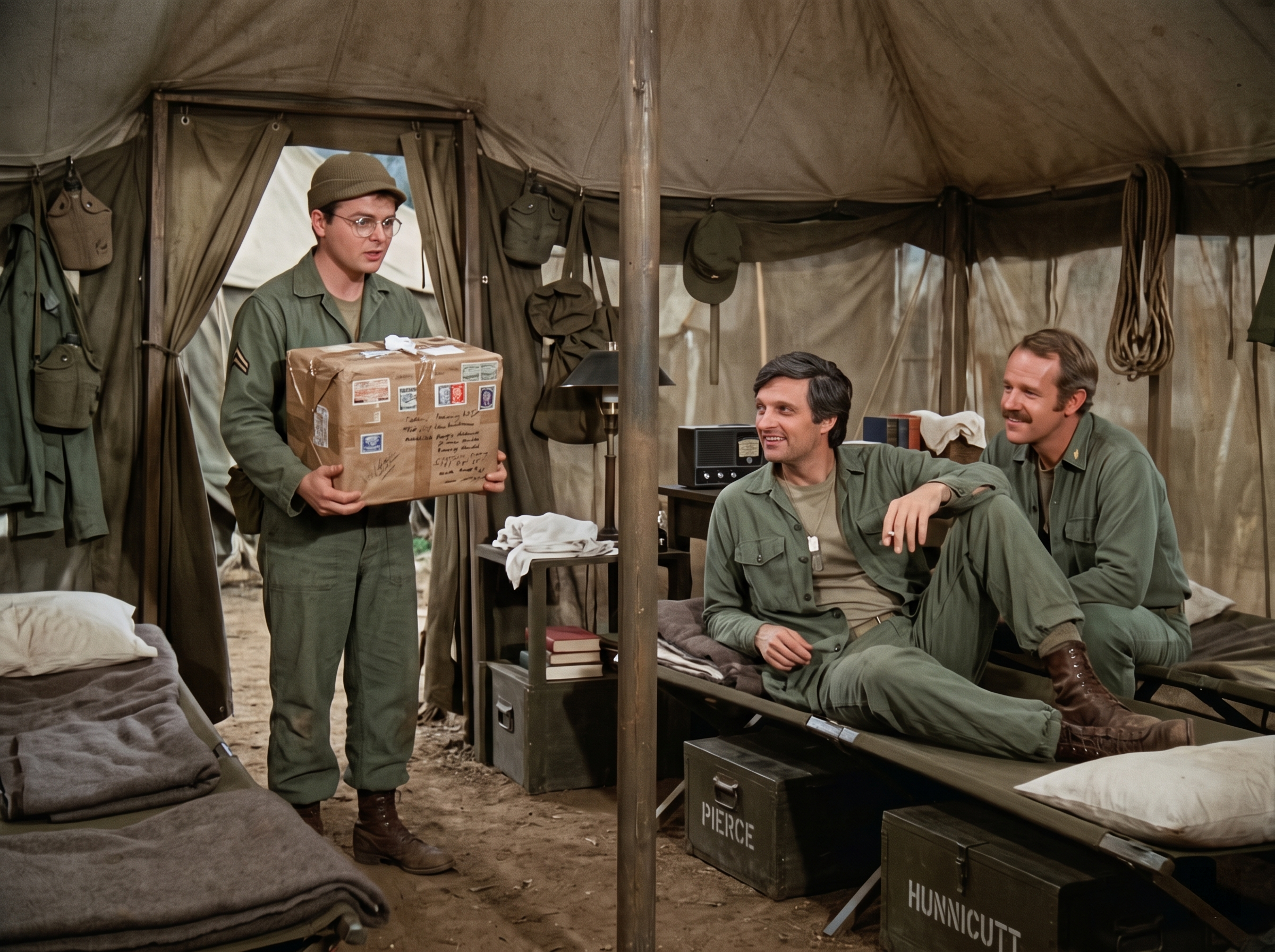
Mail call at the 4077th was always an emotional gamble.
Most days, you got bills or letters that were three months old.
Once in a blue moon, you got a package.
A real package. With things that smelled like home.
Today was a very quiet afternoon in The Swamp.
They were still scrubbing the operating rooms, the echoes of a 40-hour casualty surge fading away.
Hawkeye Pierce was down on his cot, trying to reclaim his humanity with a single, weary cigarette.
He looked around at the clutter—the cots, the footlockers, the canvas walls that didn’t stop the cold, the heat, or the smell.
Beside him, B.J. Hunnicutt was lounging with his hands behind his head.
B.J. was smiling that quiet smile that always said “I’m thinking of Peg and the baby,” or “I’m thinking of a very bad joke.“
Right now, it was probably both.
He was tired. They were all tired. They were just men existing in an olive-drab box.
Then, the flap of the tent parted.
It wasn’t a prioritized call from Colonel Potter’s office.
It wasn’t Major Houlihan looking to inspect something.
It was Walter O’Reilly. But not as they knew him.
Radar usually buzzed with nervous energy, carrying papers that needed signatures.
Today, he was walking slowly. Almost reverently.
He held a large, lopsided package, wrapped in the thickest, brownest paper available in 1952.
The box was covered in more postage than any three men in Korea had ever seen.
It had stamps from Ottawa, Iowa, from Chicago, from San Francisco.
It looked formidable. It looked expensive.
Radar stopped just inside the entrance, clutching it.
He looked at Hawkeye, then at B.J.
“Captain Pierce. Captain Hunnicutt,” he announced, his voice surprisingly steady.
“Mail call. And it’s… this.“
He held it out, not releasing his grip. He seemed almost nervous to deliver it.
Hawkeye squinted. He sat up, the cigarette dangling.
“Well, kid,” Hawkeye said, his usual dry wit returning.
“That box looks like it survived a tour of duty before it even got to us.“
B.J. just smiled wider, curious.
The tension in the air changed. The exhaustion was replaced by simple, child-like curiosity.
Radar finally walked toward them and set the formidable box down.
He did it so carefully, you would think it was a delicate surgical instrument.
They all leaned in, the messy interior of The Swamp suddenly very small.
“What do you think is in it, Radar?” B.J. asked, his voice soft.
“I don’t know, Captain,” Radar whispered. “It’s heavy. And it rattles.“
“Wait,” he added, his expression turning deadly serious.
“It’s not addressed to anyone.“
Hawkeye nearly choked. “Not addressed? To who, then?“
Radar pointed to the messy label, written in meticulous block letters.
“It’s just addressed to ‘Occupant, The Swamp’.“
The three men froze. A package addressed only to their shared chaos.
They knew something powerful was about to happen.
They just didn’t know if it was comic or tragic.
They were looking at the box when the quiet was broken by the sound of heavy boots.
They all knew that sound. It was the father figure of the 4077th.
Colonel Sherman Potter stepped into The Swamp, looking dry and efficient.
He took one look at the group huddled over the massive box.
“Looks like you three have managed to occupy yourselves without starting a poker game or distilling the floorboards,” Potter said, his dry Texas drawl filling the tent.
He stopped, eyeing the package. “Is that mail? And who did you rob to get it?“
“It’s the damnedest thing, Colonel,” Hawkeye said. “Radar says it’s for ‘Occupant’.“
“Meaning us,” B.J. added.
Colonel Potter looked at the box, his bushy eyebrows raising.
He recognized the postage. “Iowa,” he muttered. “My neck of the woods.“
He reached into his pocket and produced a well-worn pocketknife.
“Let’s see what Ottawa has to say to the finest surgeons, and clerk, in Korea.“
Potter sliced the heavy twine. They all held their breath.
Radar looked nervous enough to pass out. He valued order above all things, and a package addressed to ‘Occupant’ was chaos on cardboard.
The brown paper was peeled back, revealing a simple, sturdy wooden box.
Potter worked the blade under the lid and pryed it open.
Inside, protected by shredded newspaper, was the treasure.
It was not food. It was not scotch.
It was a perfectly hand-crafted, meticulously detailed wooden model of a B-29 Superfortress.
And taped to its fuselage was a note.
“Mickey sent it,” Radar whispered, his voice suddenly thick. “My little brother.“
Potter, the old cavalry officer, just stood there. He looked from the plane to Radar.
Hawkeye looked at B.J. Their faces were free of quips or jokes.
They were looking at something pure. Innocence, delivered straight into hell.
“Mickey says,” Radar continued, reading the note, “that he knows I always liked models. He saved up his paper route money for six months to buy the wood and have it shipped.“
Hawkeye took a deep breath. His sharp tongue was usually his best weapon against despair.
Looking at Radar’s raw, tearful face, the cynicism withered.
He saw the sacrifice in the postage, the labor in the carved wings.
Hawkeye looked down at his cot, at his rumpled clothes, at his friend.
For a moment, he wasn’t just a weary surgeon stuck in a war zone.
He was a friend of a man who was still loved by a little boy back in Iowa.
“Well, kid,” Hawkeye said, his voice unusually gentle.
“I think we just found a new co-occupant. And I bet Mickey never thought it would look this good in a swamp.“
B.J. reached out and gave Radar’s arm a supportive squeeze.
“It’s beautiful, Radar. Truly. It’s the best piece of equipment we have.“
Colonel Potter just grunted, but his eyes were bright. He patted the plane’s wing.
They didn’t break out the good whiskey that night. They didn’t start a round of jokes.
They cleared a small space on top of B.J.’s footlocker, right between his family photos.
They set the wooden plane down, and the four of them just stared at it.
The war, with its endless cycle of chaos and fatigue, faded away for a moment.
They were just four men sharing a quiet, tender realization that a child’s love was stronger than any army’s artillery.
It was just a piece of painted wood.
But to the occupants of The Swamp, it was the only thing in Korea that felt like a promise that home, and the innocence that lived there, was still waiting.
The messy tent was full of warmth, tenderness, and found family.
They didn’t just have to survive the war.
They just had to keep building it together.