A Delivery to the Front Lines of the Heart
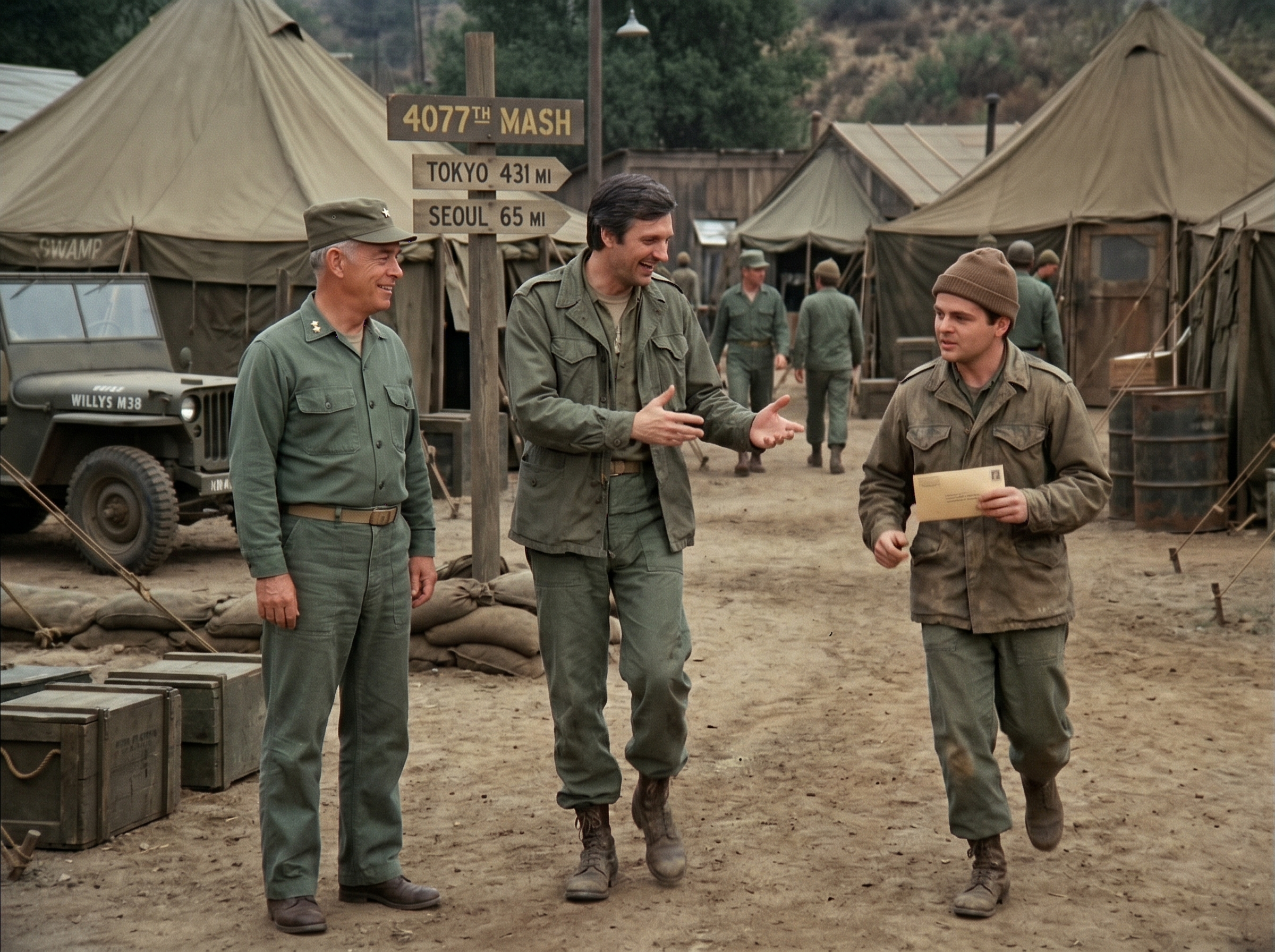
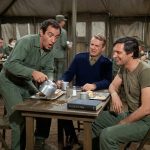
There were rare, fragile afternoons at the 4077th MAS*H where the war simply forgot to show up.
The relentless roar of incoming choppers would fade into a distant memory, replaced by the quiet, dusty breeze sweeping down through the Korean hills. On days like this, the compound felt less like a combat hospital and more like a strange, misplaced neighborhood. The dirt paths baked in the soft daylight, turning the ground a familiar, dusty beige.
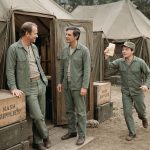
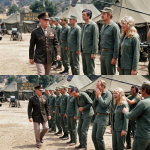
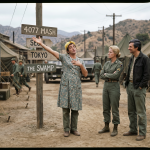
Colonel Sherman T. Potter stood near the motor pool, enjoying a rare moment of peace. His posture was compact and stable, his hands resting comfortably by his sides. He wore his worn green fatigues with the natural, lived-in ease of a man who had spent a lifetime in the Army. He wasn’t looking for trouble, and for once, trouble wasn’t looking for him. He just watched the gentle rhythm of his camp, his eyes filled with a quiet, fatherly pride.
Nearby, the familiar wooden signpost stood as a silent witness, its arrows pointing to worlds that felt impossibly far away: TOKYO 431 mi. SEOUL 65 mi. A battered Willys M38 jeep sat parked in the shade of the faded canvas tents, its engine ticking softly as it cooled in the afternoon air.
Captain Benjamin Franklin Pierce wandered out from the Swamp, looking for a distraction. He was moving with that restless, nervous energy that always seemed to hum beneath his skin after a long shift. He wore his practical, olive-drab field jacket, the collar turned up slightly against the chill.
Hawkeye was just about to pitch a complaint to Potter about the quality of the powdered eggs when a small, olive-drab whirlwind came shuffling up the dirt path.
It was Corporal Walter “Radar” O’Reilly.
Radar wasn’t quite running, but he was moving with an urgent, purposeful shuffle. His posture was slightly unsure, a little off-balance, but his face was lit up with a brilliant, innocent pride. He wore his thick woolen knit cap pulled down low, his oversized field jacket practically swallowing his small frame. Clutched tightly in his hands was a battered manila envelope.
Hawkeye saw him coming and immediately stepped into his path, his hands flying up in an expressive, theatrical gesture. The weariness in his eyes vanished, replaced instantly by his trademark defensive wit.
“Hold the presses, folks!” Hawkeye announced loudly, gesturing toward Radar with a broad, playful smile. “The pony express has arrived. Tell me, Radar, did you run all the way from Seoul, or did you just strap a saddle to a passing supply truck?”
Radar skidded to a halt, his chest heaving slightly. He looked up at Hawkeye, completely ignoring the joke. His eyes were wide and earnest, fixed entirely on the task at hand.
“It’s not the regular mail, Captain,” Radar said, his voice breathless but steady. “It’s a special delivery. It came in on the supply chopper, but it wasn’t in the regular sacks. The pilot had it in his jacket.”
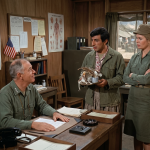
Potter turned his head, his interest piqued. He stepped closer, his boots crunching softly on the dry earth. “Special delivery? From division?”
“No, sir,” Radar said, holding the envelope out toward Hawkeye. The paper was creased, stained with grease, and covered in a messy web of international routing stamps. “It’s for Captain Pierce.”
Hawkeye looked at the envelope. His hands, which had just been dancing in the air with comedic flair, suddenly dropped to his sides. The playful grin slowly melted off his face.
He didn’t reach for it right away. In a place where bad news usually arrived by telegram and worse news arrived by helicopter, a battered envelope covered in red re-routing stamps felt like a ticking bomb.
“For me?” Hawkeye asked, his voice dropping its theatrical volume, suddenly sounding very small in the open air.
“Yes, sir,” Radar said softly, pushing it forward an inch. “I think you’re going to want to open it.”
Hawkeye reached out, his fingers brushing the worn edge of the paper. He recognized the return address scribbled in the corner. It wasn’t from his father in Crabapple Cove. It wasn’t from an old girlfriend.
It was from a small town in Ohio. A town he had only ever heard about once, in the delirious, morphine-laced ramblings of a dying nineteen-year-old kid three months ago.
Hawkeye stared at the ink, the silence in the compound suddenly feeling incredibly heavy.
The wind rustled the heavy canvas of the nearby tents, a soft, scratching sound that seemed to echo in the quiet space between the three men.
Hawkeye swallowed hard. His thumb traced the edge of the Ohio postmark. The envelope was thick, heavier than a simple letter. He could feel the eyes of Colonel Potter and Radar watching him, waiting, but giving him the space he needed.
“Go ahead, Hawk,” Potter said quietly. It wasn’t an order; it was a steady, grounding anchor. Potter’s voice had that deep, gravelly warmth that made you feel like no matter what the piece of paper said, the world would keep spinning.
Hawkeye slipped his finger under the flap of the envelope and tore it open. The paper gave way with a crisp tear. He reached inside and pulled out a folded letter, and tucked behind it, a small, black-and-white photograph.
Hawkeye looked at the photograph first.
It was a picture of a front porch in Middle America. There was a wooden swing, a screen door, and a scruffy hound dog sleeping on the steps. Sitting on the swing was a young man. He looked thin, and his left arm was heavily wrapped and strapped across his chest in a sling. But he was sitting upright. He was smiling. And he was alive.
Next to him sat an older woman, her arm wrapped tightly around his good shoulder, looking into the camera with a fiercely proud, tearful smile.
Hawkeye’s breath hitched in his chest. The dusty beige compound, the smell of canvas, the distant rumble of the generators—it all faded away.
Three months ago, that boy had been lying on a table in the center ring of the OR. His chest had been torn apart by shrapnel, his blood pressure dropping so fast they couldn’t pump the plasma in quickly enough. Hawkeye had spent five agonizing hours elbow-deep in the kid’s chest, stitching together veins that felt like wet tissue paper, fighting the reaper for every single heartbeat.
When they finally loaded the boy onto the evacuation bus days later, Hawkeye hadn’t been sure he would survive the bumpy ride to Kimpo, let alone the flight to Tokyo. He had filed the boy’s face away in that dark, heavy cabinet in the back of his mind—the place where he kept the ghosts of the ones he wasn’t sure he had saved.
“Well, I’ll be damned,” Hawkeye whispered, his voice cracking.
He unfolded the letter. It was written in a neat, sloping cursive.
Dear Captain Pierce,
You don’t know me, but I am Tommy’s mother. He arrived home last week. The doctors at Walter Reed told us that the surgeon at the 4077th who put him back together performed a miracle in the mud. Tommy says you joked with him about the Cleveland Indians before he went under. He wanted me to send you this picture, so you could see the handiwork.
There are no words big enough to say thank you. So I will just say this: Because of you, my kitchen is messy again. Because of you, the dog has someone to fetch for. Because of you, my world is whole.
God bless you, Captain.
Hawkeye read the words twice, his eyes blurring. He didn’t try to wipe the moisture away. He just stood there, letting the profound, crushing weight of the gratitude wash over him. In a war that took so much, in a place that demanded unending exhaustion and offered so little in return, this was everything. This was the fuel.
He slowly handed the photograph to Potter.
The Colonel took it by the edges, adjusting his grip to see it clearly in the muted daylight. A slow, deeply affectionate smile spread across Potter’s weathered face. He remembered the boy, too. You never really forgot the close calls.
“That’s a fine-looking porch, Pierce,” Potter said softly, his voice full of quiet respect. “And a finer piece of doctoring. You did good. You did real good.”
Potter handed the photo back. His eyes met Hawkeye’s, communicating a silent, shared understanding of exactly how much a moment like this cost, and exactly how much it was worth.
Hawkeye looked down at Radar. The young corporal was practically vibrating with joy. He hadn’t read the letter, but he didn’t need to. Radar possessed a profound, almost supernatural empathy. He had known, just from the weight of the envelope and the look on the chopper pilot’s face, that this was something Captain Pierce desperately needed.
“How much did it cost to get this routed directly to us, Radar?” Hawkeye asked, his tone gentle, the usual sarcasm completely stripped away.
Radar kicked at the dirt, suddenly looking a bit shy, though the pride never left his face. “Well, sir… it cost a slightly used Jeep carburetor, a bottle of the Colonel’s cigars—sorry, Colonel—and about two hours of sweet-talking a dispatcher in Tokyo over the radio.”
Hawkeye reached out and placed a hand on Radar’s shoulder. He gave it a firm, grateful squeeze. “You’re a lifesaver, Walter. In more ways than one.”
Radar beamed, his chest puffing out just a fraction beneath his oversized jacket. “Just doing my job, Captain.”
Hawkeye looked back at the photograph, slipping it carefully into the breast pocket of his green jacket, pressing it close to his heart. He looked around the compound. The wooden signpost, the parked jeep, the faded canvas tents. It was still a dirt-filled parking lot in the middle of a war. They were still thousands of miles from home. They were still tired.
But as the soft sky blue peeked through the dusty clouds above them, the 4077th didn’t feel quite so far from the rest of humanity.
Hawkeye took a deep breath of the crisp afternoon air, a genuine, easy smile finally settling on his face. He looked at Potter and Radar.
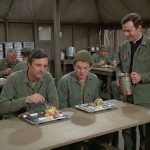
“Come on,” Hawkeye said quietly, gesturing toward the mess tent. “I think this calls for a celebration. I’ll buy you both a cup of whatever it is they’re calling coffee today.”
As the three men turned and walked shoulder-to-shoulder down the dirt path, the war seemed to hold its breath, giving them just a little more time to simply be human together.
In the middle of the madness, it was the small, quiet victories that carried them through to tomorrow.