A Swamp Lullaby
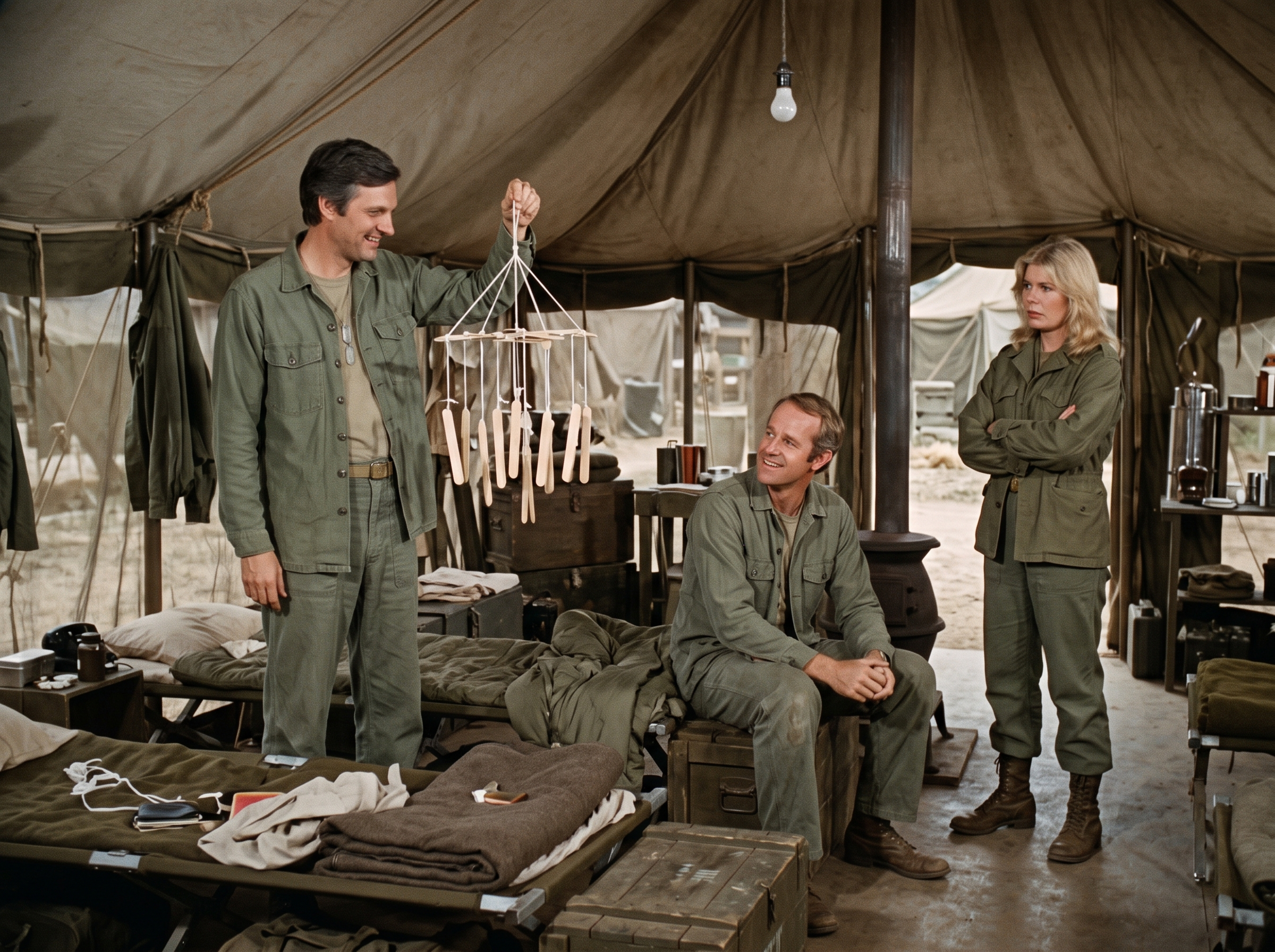
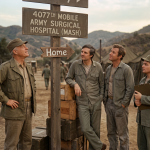
There were two types of quiet at the 4077th Mobile Army Surgical Hospital.
There was the heavy, breathless quiet that hung over the camp right before the choppers arrived. And then there was the hollow, stretching quiet that settled in days after the fighting stopped, when the adrenaline faded and the sheer weight of being three thousand miles away from home crashed down on you.
It was the second kind of quiet in the Swamp this afternoon.
The air in the canvas tent was stagnant, smelling faintly of old coffee, damp wool, and the lingering sting of antiseptic.
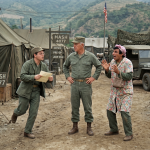
Hawkeye Pierce stood proudly in the center of the floor. He was holding up what looked like a bizarre medieval torture device, or perhaps a very confused chandelier.
It was, in fact, a makeshift mobile.
He had constructed it entirely from scavenged surgical string, a bent wire coat hanger, and two dozen wooden tongue depressors. He held it up by a top loop, watching the flat wooden sticks dangle and sway lazily in the stale air.
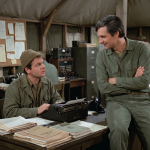
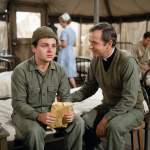
B.J. Hunnicutt sat nearby on a heavy wooden supply crate, his hands resting on his knees.
He was wearing his rumpled green fatigues, his boots scuffed with Korean dust. A slow, bemused grin was spreading across his tired face as he looked up at his bunkmate.
“Hawk, I have to admit,” B.J. said, his voice thick with the kind of exhaustion that sleep never fully cured. “That is the most spectacular waste of medical supplies I’ve seen since Frank tried to bandage his own ego.”
Hawkeye admired his handiwork, giving the string a gentle twist.
“It’s not a waste, Beej. It’s art,” Hawkeye said, his eyes crinkling with a proud, goofy smile. “It’s a kinetic sculpture. It’s a statement on the fragile human condition. Plus, it doubles as kindling if the stove goes out.”
“I think the American Medical Association might have a problem with you turning diagnostic tools into wind chimes,” B.J. chuckled softly.
“The AMA lacks vision,” Hawkeye countered, watching the sticks slowly rotate. “These little pieces of wood have spent their entire lives looking down people’s throats. I am giving them a chance to fly. I’m a liberator of lumber.”
Just then, the canvas tent flap flew open.
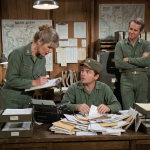
Major Margaret Houlihan stood in the doorway, framed by the bright, dusty light of the compound.
Her arms immediately crossed over her chest. Her posture was rigid, military straight, and her eyes narrowed as she took in the strange wooden contraption dangling from Hawkeye’s hand.
“Pierce,” Margaret sighed. The sound carried a familiar mix of professional annoyance and profound, bone-deep exhaustion. “What in the name of all that is military are you doing now?”
“I’m bringing culture to the masses, Margaret,” Hawkeye grinned, stepping toward her so she could get a better look. “Care to invest? I call it ‘Ode to a Sore Throat’.”
Margaret didn’t smile. She stared at the wooden sticks, her brow furrowing.
“Do you have any idea how many throats those depressors could have depressed?” she asked. But the usual fire wasn’t quite there in her voice today. She sounded too tired to yell.
“At least twenty,” Hawkeye shot back. “But they are currently serving a much higher purpose.”
B.J. shifted on his wooden crate. His gentle smile faded just a fraction.
He looked away from Hawkeye and locked his eyes onto the swaying wooden sticks. His shoulders suddenly slumped, the humor draining out of the room in an instant.
He had received a letter from Peg that morning.
It was a wonderful, terrible letter. It mentioned that little Erin had finally started reaching up toward the new, brightly painted wooden mobile hanging over her crib in Mill Valley.
Hawkeye knew about the letter. He had read it sitting across from B.J. in the mess tent.
Margaret, ever observant, noticed the sudden, heavy shift in B.J.’s posture. She looked from the silly wooden toy in Hawkeye’s hand to the sudden, distant, glassy look in B.J.’s eyes.
The Swamp fell completely silent. The joke had landed, but it had dug far deeper than anyone intended, leaving a raw, aching nerve exposed.
The silence stretched out, thick and fragile.
It was broken only by the faint *clack-clack* of the wooden tongue depressors gently bumping into one another as Hawkeye’s hand trembled slightly.
Margaret took a slow step into the tent. Her arms remained crossed, but the rigid, defensive line of her shoulders softened.
She had spent enough time patching up these men in the OR to know when one of them was bleeding on the inside.
“It’s for Erin,” B.J. said quietly. His voice was barely above a whisper, rough and tight.
He wasn’t looking at Hawkeye or Margaret. He was just watching the little wooden sticks spin, his mind thousands of miles across the ocean, picturing a bedroom he hadn’t seen in far too long.
Hawkeye lowered his arm slightly, the theatrical bravado completely draining from his face.
“Peg said she liked watching things spin,” Hawkeye mumbled. He suddenly looked intensely interested in the messy knot he had tied at the top of the string.
“I figured… since you’re missing the real thing, the Swamp could use a little nursery decor,” Hawkeye added softly. “Even if it is in olive drab.”
Margaret uncrossed her arms. She let them fall to her sides.
She looked at Hawkeye—really looked at him—and saw the deep, bruised exhaustion under his eyes.
He hadn’t made a joke. He hadn’t built a prank to annoy Frank or Charles.
He had spent his only two hours of free time trying to build a bridge across the Pacific Ocean for his best friend. He had taken the sterile, terrifying tools of their miserable trade and tried to turn them into something that meant love.
B.J. finally looked up from the mobile.
He looked at Hawkeye, his mustache twitching as he forced back a sudden, overwhelming wave of emotion. He took a deep breath, grounding himself in the dusty reality of the tent.
“It’s terrible, Hawk,” B.J. said, his voice cracking just a little. “It’s completely asymmetrical. The knots are sloppy. And it smells faintly of iodine.”
Hawkeye offered a weak, crooked, apologetic smile. “I’m a surgeon, Beej. Not a carpenter.”
“But,” B.J. continued, standing up from the heavy supply crate.
He walked over to Hawkeye. He reached out and gently tapped one of the wooden sticks with his index finger, sending the whole mobile spinning in a slow, graceful circle.
“It is the most beautiful thing I’ve seen in months,” B.J. said softly.
Margaret cleared her throat. It was a sharp sound, but it didn’t carry any of her usual reprimand.
“Well, it needs to be hung properly,” she said briskly, though her eyes were shining with unshed moisture. “If you just leave it dangling from your hand like a dead fish, Pierce, the strings are going to get tangled.”
Hawkeye looked at her in mild surprise. “Major Houlihan. Are you offering your interior design services to the Swamp?”
“I am offering to prevent a safety hazard,” Margaret replied, lifting her chin with a touch of her old pride.
She walked over to the center pole of the tent, right near B.J.’s bunk.
“Hang it here,” Margaret instructed, pointing up to a crossbeam. “Above the stove pipe. When the winter comes, the heat rising off the iron will catch the wood. It’ll spin on its own.”
Hawkeye and B.J. exchanged a look. It was a look of quiet, profound gratitude.
Hawkeye climbed up onto B.J.’s footlocker, stretching his tall frame toward the slanted canvas roof.
With careful, steady hands—the exact same hands that had tied off countless delicate arteries in the darkest hours of the night—he secured the heavy string to the tent frame.
He stepped back down, dusting his hands on his green fatigue pants.
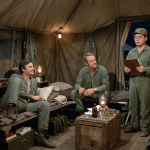
The three of them stood there in the center of the messy, dusty, cluttered tent.
Below them was the grime, the blood, and the endless waiting of a war they didn’t want. But above them, catching a faint, warm draft from the open doorway, the little wooden mobile began to turn.
*Clack. Clack. Clack.*
It was a hollow, wooden sound. But in the deep quiet of the 4077th, it sounded like music.
It sounded like peace. It sounded like a nursery in California.
“Not bad, Pierce,” Margaret said softly, her eyes fixed on the spinning wood.
She reached out, letting her hand rest lightly on B.J.’s shoulder for just a second. It was a rare, fleeting gesture of absolute comfort from the head nurse, speaking volumes she could never say out loud.
Then, adjusting her collar, she turned back into the stern Major.
“Just don’t let Colonel Potter see it,” she said over her shoulder as she walked toward the door. “He’ll have you painting it regulation green by morning.”
“Goodnight, Margaret,” Hawkeye called out softly.
“Goodnight, boys,” she replied, disappearing out into the dusty compound.
B.J. sat back down on his crate. He didn’t say anything for a long time. He just watched the little sticks of wood spin in the warm afternoon air.
Hawkeye moved over to his own cot, kicking off his heavy boots with a tired sigh. He lay back against his thin pillow, lacing his hands behind his head.
“You know, Beej,” Hawkeye said to the canvas ceiling. “If we put a little bell on it, we could train Winchester to salute every time the wind blows.”
B.J. chuckled. It was a warm, grounded sound that filled the tent.
“Let’s just leave it exactly the way it is, Hawk,” B.J. said quietly, his eyes never leaving the mobile. “It’s perfect.”
They didn’t talk anymore after that.
They just lay in the quiet, listening to the gentle, spinning rhythm of the wood, letting it carry them thousands of miles away from the war, back to the places where they belonged.
Sometimes the greatest medicine prescribed at the 4077th didn’t come from a bottle, but from the hands of a friend who knew exactly where it hurt.