A Quiet Word in the Canvas Shadows
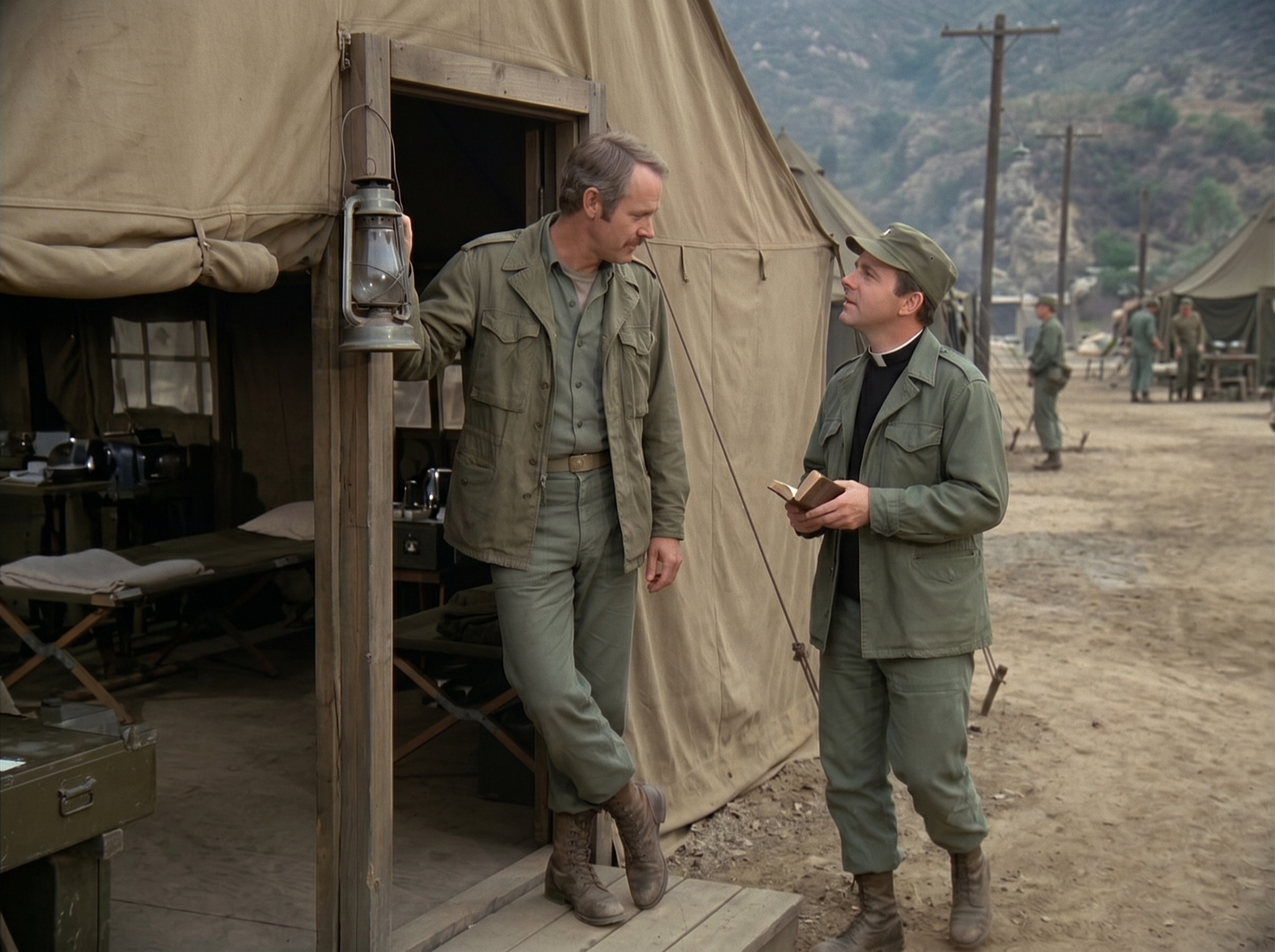
The choppers had finally stopped flying, leaving the 4077th suspended in a rare, golden hour of absolute silence.
For the last thirty-six hours, the sky above the camp had been a relentless highway of noise, rotor wash, and urgency.
Now, the evening had settled over the compound like a heavy, dusty blanket.
The harsh sun had dipped behind the Korean hills, replacing the blinding daylight with a soft palette of canvas tan and dusty beige.
Captain B.J. Hunnicutt stood alone in the doorway of the Swamp.
He was too tired to take the final step inside.
His large frame leaned heavily against the rough wooden tent frame, his posture slack with an exhaustion that went straight to the bone.
The yellow light from a single lantern hanging nearby spilled over his shoulder, illuminating the lived-in, worn fabric of his olive-drab undershirt.
He didn’t want to sleep, even though his body screamed for a cot.
Going inside meant facing the quiet.
Inside the Swamp was the lingering smell of Hawkeye’s stale cigars, the empty cots, and the crushing weight of another day survived far from home.
B.J. just needed the twilight air.
He stared out at the dirt path, trying to clear the lingering images of the operating room from his mind.
Down the dusty camp path, picking his way carefully around the jeep ruts, came Father John Mulcahy.
The priest moved with the slow, deliberate steps of a man who had spent the entire day tending to the invisible wounds of a battered flock.
His collar was slightly loose, his uniform just as rumpled and practical as any other soldier’s in the camp.
In his hands, he held a small, dark, leather-bound book.
Mulcahy looked up from the dirt path and spotted the tall surgeon framed in the canvas doorway.
The priest’s face, usually bright with determined optimism, shifted instantly.
It softened into an expression of deep, sincere, and worried concern.
B.J. Hunnicutt was the emotional anchor of the camp, the steadying force when the madness threatened to pull everyone else under.
But tonight, the anchor looked completely worn through.
“Evening, Father,” B.J. said, his voice barely rising above the hum of the camp generator.
“A quiet evening, thankfully, Captain,” Mulcahy replied, stopping a few feet away from the tent.
Mulcahy noticed the profound distance in B.J.’s eyes.
It was a look the priest knew all too well.
It was the look of a man whose body was standing in the middle of a war zone, but whose heart was desperately trying to navigate its way back to California.
“You look like a man who is standing on the edge of a very steep cliff, B.J.,” Mulcahy observed gently.
B.J. offered a small, sad, self-deprecating smile.
“Just trying to remember the way to Mill Valley, Father. I think I’ve misplaced the map in all this mud.”
Mulcahy took a slow step closer, his eyes locked on his friend.
“It’s the sudden silence, isn’t it?” the priest asked softly. “When the noise finally stops, the distance feels so much wider.”
B.J. closed his eyes, leaning his head back against the canvas tent frame.
The armor he wore so well finally cracked.
“I couldn’t remember her laugh today, Father,” B.J. confessed, his voice breaking with quiet panic.
“I stood at the scrub sink trying to hear Erin’s laugh, and… there was just nothing there.”
The painful confession hung in the cool evening air, feeling heavier than the dust settling around them.
To lose a memory in this place was a terrifying thing for anyone.
For B.J. Hunnicutt, it was the only currency that kept him sane, and in that moment, he felt utterly bankrupt.
Father Mulcahy didn’t offer a quick, easy reassurance.
He didn’t quote scripture or deliver a practiced, hollow platitude about the resilience of the human spirit.
Instead, he stepped right up to the doorway, moving into the warm, analog glow of the hanging lantern.
He looked down at the small, worn book in his hands, then held it out toward the exhausted surgeon.
“I believe you left this in the mess tent earlier today, Captain. It was tucked behind the powdered egg tray.”
B.J. opened his eyes and looked down.
His breath caught sharply in his throat.
It was his small pocket diary.
It was the book where he kept Peg’s latest letters folded between the pages, alongside a tiny lock of Erin’s hair and his daily drafted notes to his wife.
He reached out and took the book, his large hands holding it as if it were the most fragile, precious object in the world.
“I… I didn’t even realize it was missing yet,” B.J. murmured, pulling the diary tightly to his chest.
“If I had lost this…”
“You didn’t lose it, B.J.,” Mulcahy said, his voice acting as a soothing, grounding balm.
“It was just temporarily misplaced. Much like that memory of yours.”
B.J. looked up at the priest, a profound sense of gratitude washing over his deeply lined face.
“It scares the hell out of me, Father,” B.J. admitted openly, all of his usual emotional defenses fully dropped.
“Every day I’m here, I feel like another piece of my real life gets painted olive drab. I’m terrified I’m going to go home and feel like a stranger in my own living room.”
“I know, my friend,” Mulcahy said, his eyes crinkling with profound, quiet empathy.
“This place takes so much from all of you. It constantly asks for your sleep, your peace of mind, your patience, and your youth.”
Mulcahy gently placed a hand on B.J.’s arm.
He offered the physical, grounding comfort of a true friend, rather than the formal, distant blessing of a clergyman.
“But it cannot take your love for your family,” Mulcahy continued. “That isn’t stored in a canvas tent, or in a fleeting memory, or even in that little leather book.”
B.J. looked down at the diary, tracing the worn cover with his thumb.
“Where is it, then?”
“It’s in the very core of who you are,” Mulcahy replied softly, his voice full of absolute certainty.
“The reason you are so incredibly tired, B.J., the reason you ache so deeply for them right now, is because that love is still fiercely alive.”
Mulcahy offered a warm, reassuring smile that reached his eyes.
“A mind can get exhausted. A memory can hide behind a thirty-six-hour day in the operating room. But the heart does not forget its home.”
B.J. stood quietly for a long moment, letting the priest’s wise words settle deep into his weary bones.
The tight, suffocating panic that had been gripping his chest began to slowly loosen.
As he held the book to his chest, he could almost smell the pine trees of California.
He could almost hear the sound of his front door opening in Mill Valley.
“You always have a way of finding the right bandages for the invisible wounds, Father,” B.J. said.
A genuine, tender warmth finally returned to his eyes, chasing away the ghosts of the OR.
“We all do what we can, Captain,” Mulcahy said, his own shoulders relaxing as he saw B.J.’s emotional crisis pass.
“Now, I highly suggest you go inside and write a letter to your beautiful girls. Tell them about your day, or simply tell them you miss them.”
B.J. nodded, standing up a little straighter in the doorway, the crushing weight of the war feeling a little lighter.
“I think I will. But first…” B.J. gestured toward the chaotic interior of the Swamp.
“Hawkeye managed to distill something that loosely resembles gin this morning. Care to join me for a medicinal sip?”
Mulcahy chuckled softly, adjusting his collar with a familiar, modest gesture.
“Well, considering the terrible amount of dust in my throat from this walk, I suppose it would be a grave sin to refuse a doctor’s direct orders.”
B.J. smiled, stepping aside to let the priest enter the canvas sanctuary.
The exhaustion hadn’t completely vanished, but it had magically turned into something bearable.
It had transformed into a quiet, shared tenderness between two friends who were simply trying to survive the madness together.
As they stepped out of the harsh Korean night and into the glowing interior of the tent, the war felt just a little bit further away.
Sometimes, the greatest medicine in the 4077th wasn’t found on an operating table, but in the quiet, dusty comfort of a true friend.