The Color of Home at the 4077th
Some days in Korea don’t end when the sun goes down; they just bleed into the next morning, carrying the same exhaustion, the same mud, and the same heavy silence.
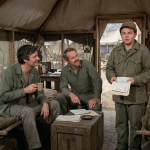
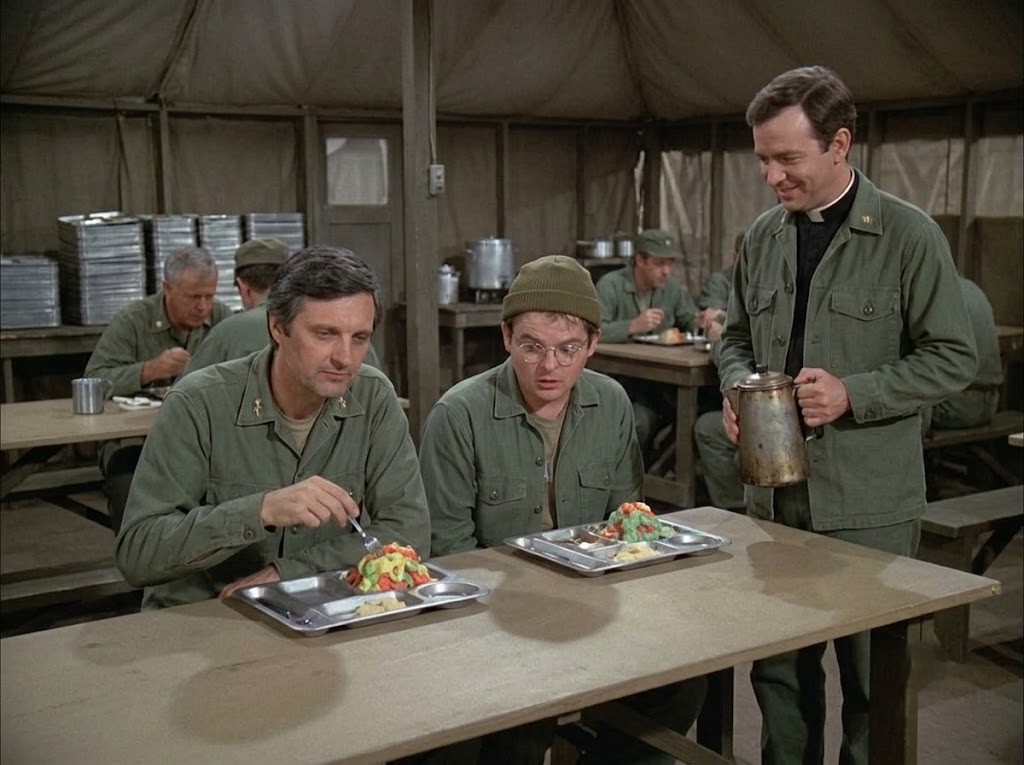
After an eighteen-hour marathon in the Operating Room, the world shrinks down to the size of a tin mess tray and the dull ache in your lower back. Hawkeye Pierce stared down at his breakfast, his fork hovering like a surgical instrument over a mound of something that defied the laws of nature.
It was bright green and neon red—a terrifying culinary experiment that looked more like a melted box of crayons than actual food.
Beside him, Radar O’Reilly sat frozen, his knit cap pushed back just enough to reveal a forehead wrinkled in profound, childlike bewilderment. Radar wasn’t even holding his utensil; he was simply trying to comprehend how Igor had managed to make eggs look like a technicolor nightmare.
“I think it’s looking at me, Hawk,” Radar whispered, his voice cracking slightly in the humid tent air. “And I think it wants revenge.”
Hawkeye sighed, his shoulders slumping under his fatigue-green shirt. “Don’t be ridiculous, Radar. To want revenge, it would have to have a soul, and we both know the mess tent was abandoned by God somewhere around 1951.”
Just then, Father Mulcahy materialized beside their table, a battered, soot-stained coffee pot held gently in his hand like a sacred relic. His face wore that familiar, soft-spoken smile—the kind that usually meant he was either about to ask for a donation to the orphans or offer comfort to a soul on the brink of collapse.
He looked down at the vibrant, multicolored heaps on their trays, his smile faltering for just a fraction of a second before recovering its steady, pastoral warmth.
“Ah, good morning, fellows,” Mulcahy said, his voice a calm oasis in the middle of the dreary mess hall. “I see Igor has attempted a bit of… artistic flair with the powdered eggs today.”
Hawkeye poked a vibrant green chunk with his fork, watching it wobble with a consistency that belonged in a rubber factory. “Artistic flair, Father? This isn’t breakfast; it’s a chemical spill. I feel like I should operate on it before I eat it.”
Radar looked up at the priest, his large eyes filled with genuine anxiety. “Is it safe, Father? I mean, if I eat the green part, will my insides turn green too? My mom always said to beware of strange colors in nature.”
“Your mother was a wise woman, Radar,” Hawkeye muttered, finally working up the courage to scoop a small portion of the red section onto his fork. “But out here, we don’t have nature. We just have Army surplus.”
Mulcahy leaned in closer, tipping the coffee pot slightly as if the aroma of chicory could mask the visual assault on the table. “Actually, Radar, I believe Igor was trying to lift everyone’s spirits. He told me he was attempting to recreate a traditional Sunday gelatin mold from back home in Ohio. He used food coloring from the officers’ club supply.”
Hawkeye paused, the fork halfway to his mouth. The dry humor faded from his eyes for a brief moment, replaced by the profound, crushing weight of the last three days in the OR.
They had lost two boys on the tables last night. Two boys who would never see an Ohio Sunday again.
“He tried to make it look like home,” Hawkeye said quietly, his voice losing its sarcastic edge, leaving only the raw, exposed nerves of a man who hadn’t slept in thirty-six hours.
He stared at the bright, artificial colors, and suddenly, the ridiculous green eggs didn’t feel like a joke anymore. They felt like a mirror holding up all the desperation, the homesickness, and the fragile, heartbreaking ways the people in this camp tried to keep from falling apart.
His hand began to tremble slightly, the fatigue finally catching up to his fingers, as the quiet of the mess tent seemed to grow deafeningly loud.
Father Mulcahy noticed the tremor in Hawkeye’s hand immediately, his own expression shifting from gentle amusement to deep, quiet concern. He placed a steadying hand on the surgeon’s shoulder, the simple warmth of the gesture anchoring Hawkeye back to the room.
“It’s a difficult morning, Captain,” Mulcahy said softly, his voice carrying no judgment, only a deep, unconditional understanding of the horrors they all shared.
Radar looked between the two men, sensing the sudden shift in the atmosphere with that uncanny intuition of his. He reached out and quietly pushed his own tray an inch forward, as if offering to share the burden of the strange meal.
“Igor really did try hard, Hawk,” Radar offered quietly, his innocent voice breaking the heavy spell. “He was crying a little bit while he was mixing the green part. He said he missed his mother’s kitchen so much it made his teeth ache.”
Hawkeye closed his eyes for a second, inhaling the sharp, comforting scent of the coffee Mulcahy was now pouring into his tin cup. When he opened his eyes, the cynical, fast-talking doctor was back, but his gaze was entirely tender.
“Well,” Hawkeye said, clearing his throat and forcing a small, tired smile. “If Igor shed tears into the green section, it probably improved the flavor. Heaven knows it needed salt.”
A quiet ripple of laughter passed between the three of them—a small, necessary release of the pressure building in their chests.
In the background, the low murmur of other tired soldiers, the clatter of tin cups, and the distant, rhythmic thumping of chopper blades provided the soundtrack to their existence. But right here at this wooden table, the world was held together by a thread of shared humanity.
Hawkeye looked up at Mulcahy, who was watching him with those kind, patient eyes that had seen the worst of humanity but refused to lose faith.
“Pour the coffee, Father,” Hawkeye said, his voice steady now. “Pour it until the cup overflows, or until I forget what day of the week it is. Whichever comes first.”
“Gladly, Hawkeye,” Mulcahy replied, carefully filling the tin cup to the brim with the dark, steaming liquid. “And remember, the Lord works in mysterious ways. Even through the medium of green food coloring.”
Radar finally picked up his fork, tentatively touching a piece of the red section. “You know, if you close your eyes, Hawk, it almost smells like strawberry jam. If you try really, really hard.”
Hawkeye took a sip of the scalding coffee, feeling the heat spread down his throat and into his tired bones. He looked at Radar, then at the gentle priest standing guard over their little table, and felt a sudden, fierce wave of gratitude for this strange, mismatched family.
They were miles from home, surrounded by mud and misery, eating food that looked like a carnival accident.
But they had each other.
“You’re right, Radar,” Hawkeye said, taking a bite of the neon breakfast and chewing it with a look of exaggerated, theatrical relish. “It tastes exactly like July in Maine. If July in Maine was made of processed rubber and hope.”
Radar smiled, his shoulders relaxing as he took his own first bite, while Father Mulcahy gave them a final, warm nod before moving on to the next table of tired souls.
The war was still waiting for them just outside the canvas walls of the tent. The choppers would fly again, the sirens would wail, and the OR would fill with the casualties of a broken world.
But for five more minutes, under the warm canvas and over a tray of ridiculous, colorful eggs, the 4077th was home.
Sometimes home isn’t a place you go back to; it’s the people who stand by you in the mud, turning the darkest mornings into something we can survive together.