The Truffles and the Masterpiece
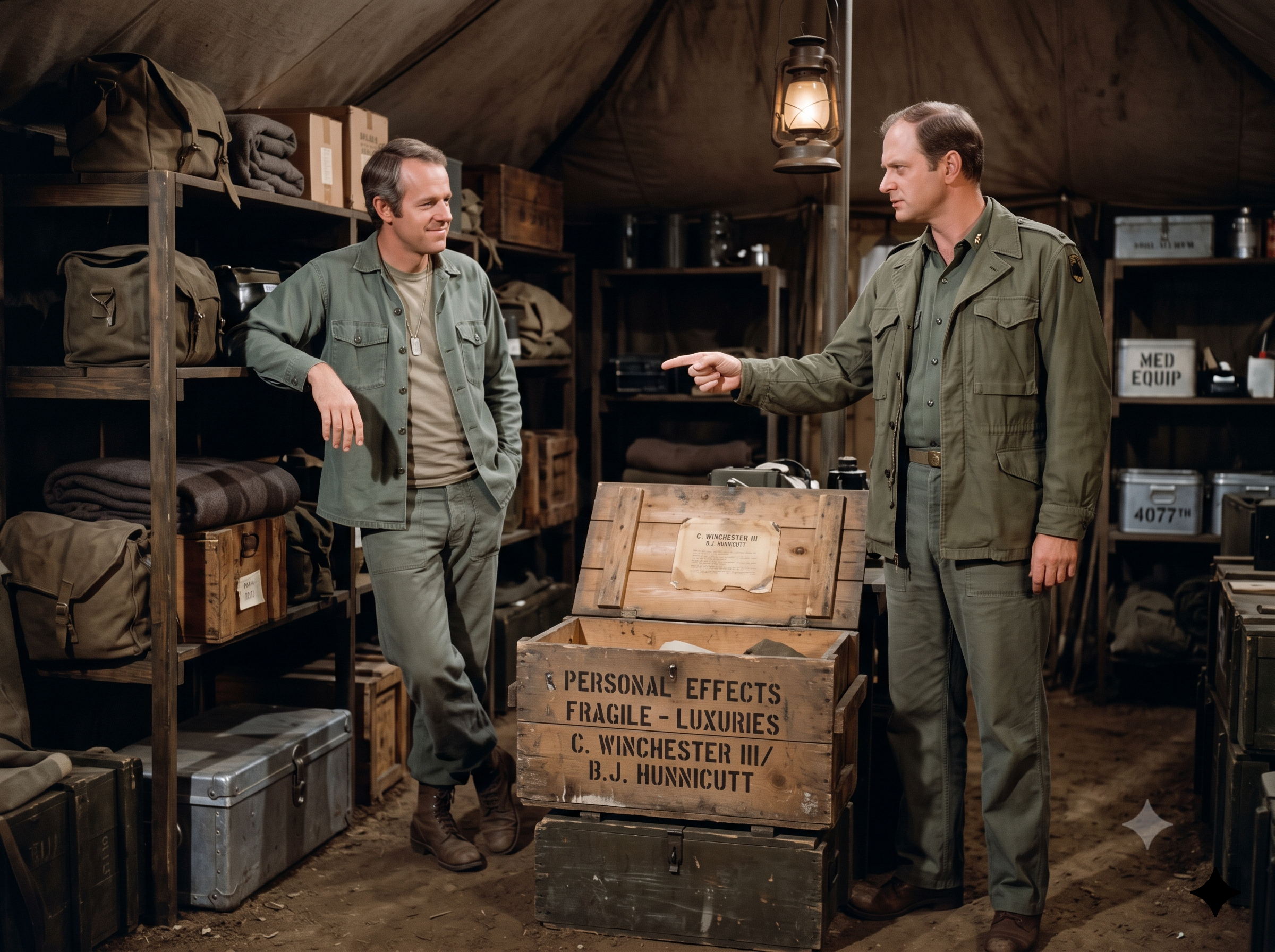
In a place entirely devoted to mud, blood, and endless exhaustion, the loss of a single luxury item could easily escalate into an international crisis.
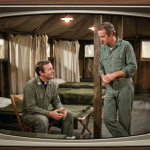
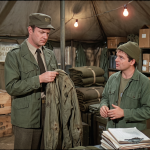
The 4077th supply tent smelled reliably of canvas, mothballs, and stale dust. It was a quiet, forgotten corner of the camp, lit only by a single, bare bulb hanging from the center pole. The light was a soft, practical warm camp glow, slightly dimmer than the harsh glare of the O.R. tents. It cast long, wavering shadows against the stacks of dull metal storage racks and the endless mountains of scratchy, folded olive-drab blankets.
Major Charles Emerson Winchester III stood in the center of the cramped aisle, radiating sheer, unadulterated outrage.
Despite having just finished a punishing twenty-four-hour shift in surgery, Charles stood perfectly upright. His fatigue shirt was rumpled, his face drawn with deep lines of exhaustion, but his posture remained impeccably Bostonian. He was conducting an invisible symphony of irritation, his hands moving with controlled, articulate gestures.
“It is a matter of profound principle, Hunnicutt,” Charles seethed, his voice dripping with dry superiority. “A tin of imported, hand-foraged Périgord truffles. Sent all the way from my mother’s private grocer. It is not merely food, it is a culinary masterpiece. And it has been pilfered by the barbarians in this godforsaken dustbowl!”
A few feet away, B.J. Hunnicutt leaned casually against a metal shelf.
His arms were relaxed, his hands shoved deep into the pockets of his worn fatigue trousers. He watched Charles’s performance with a knowing smile and a look of quiet irony. B.J. looked perfectly at home in the dingy supply room, his pink shirt dusted with dirt, his mustache twitching as he suppressed a laugh. He seemed entirely unbothered by Charles’s escalating theatrics.
“Maybe the truffles just realized where they were, Charles,” B.J. offered mildly. “I hear French fungi have very delicate sensibilities. They probably caught the first jeep to Seoul rather than face the mess tent.”
“Do not attempt to deflect my ire with your pedestrian farmhouse humor!” Charles snapped, pointing a long, accusing finger at a specific wooden crate resting on a canvas bag.
It was a sturdy little box, sealed tight, bearing faded, water-stained paper labels on its sides. Charles glared at it as if it had personally insulted him.
“That is my care package,” Charles declared, stepping closer to the crate. “The seal has been visibly tampered with. I can see the pry marks on the wood. I know for a fact that my truffles were packed precisely between the cashmere socks and the shortbread. And yet, when I reached inside this morning, the tin was absent!”
“A tragedy,” B.J. said softly, his smile never wavering. “A dark day for the palate of the Republic.”
“I demand you empty your pockets, Hunnicutt,” Charles demanded, his refined irritation reaching a boiling point. “You and your hyena bunkmate possess a notorious disregard for the sanctity of private property.”
B.J. just chuckled, shaking his head. “I didn’t take your truffles, Charles.”
“Then you will not mind if I conduct a thorough inventory of this tampered vessel to document the exact extent of your thievery,” Charles huffed.
He gripped the lid of the wooden crate and gave it a violent, entirely uncharacteristic yank. The weakened wood groaned and popped open with a sharp crack. Charles thrust his hand deep inside the box, ready to pull out Hawkeye’s dirty laundry or whatever crude practical joke had been left in place of his gourmet prize.
He grabbed hold of something flat and strange.
Charles yanked his hand out, fully prepared to deliver a magnificent, multi-syllabic tirade. But as he looked at the object in his hand, the color suddenly drained from his face.
His rigid posture faltered. The pompous bluster vanished from his eyes, replaced by utter, profound bewilderment. He stared at the object as if it were a live grenade, his mouth opening and closing without a sound.
“Hunnicutt…” Charles whispered, his voice dropping an octave, completely stripped of its usual arrogance. “What… what in the name of heaven is this?”
Charles held up a slightly crumpled piece of thick, heavy construction paper.
It was covered in bright, chaotic smears of purple and yellow finger-paint. It was messy, innocent, and entirely out of place among the grim, dull colors of a mobile army surgical hospital.
Across the aisle, the quiet irony melted instantly from B.J.’s face.
The knowing smile vanished. B.J. pushed himself off the metal shelf, his casual slouch replaced by a sudden, intense stillness. His eyes locked onto the messy piece of paper, and for a split second, the heavy, aching fatigue of the war crashed down over him.
“Give me that,” B.J. said. His voice wasn’t angry, just incredibly soft and suddenly thick with emotion.
He stepped forward and took the paper from Charles’s hands with absolute gentleness, holding it by the edges as if it were a priceless medieval artifact.
Charles looked down at the wooden crate. He squinted in the dim, yellow camp light, wiping a layer of Korean dust off the faded paper label. It didn’t say Boston. It said Mill Valley, California.
The realization hit Charles like a physical blow. He hadn’t been opening his own care package. In his exhausted, self-righteous fury, he had mistaken the crates. He had been tearing apart a package meant for B.J.
“My dear Lord,” Charles breathed, genuine horror washing over his features.
The snobbish aristocrat disappeared, leaving only the well-bred, fundamentally decent gentleman beneath. Charles straightened his collar, thoroughly ashamed. “Beej… I am profoundly sorry. The crates… the labels were obscured. I had no idea I was trespassing on your personal correspondence.”
B.J. didn’t seem to hear the apology. He slowly sat down on a stack of canvas bags, his eyes completely absorbed by the purple and yellow smears.
“Peg wrote a letter with it,” B.J. murmured, tracing the edge of the paper with his thumb. “She says Erin made this at the kitchen table. She says it’s a picture of our dog, Waggles.” B.J. let out a shaky, quiet breath that sounded dangerously close to a sob. “I’m pretty sure it’s just a purple blob. But… God, it’s beautiful.”
The silence in the supply tent felt heavy and sacred. The distant, rhythmic thumping of chopper blades echoed somewhere over the mountains, but inside this dim, dusty room, there was only the crushing, tender weight of a father’s homesickness.
Charles stood awkwardly for a moment, his own trivial problems entirely forgotten. He looked at the brilliant, messy colors of the painting, and then at the profound, naked love on B.J.’s face. It was a kind of messy, unconditional warmth that Charles had rarely experienced in his own cold, formal upbringing.
Slowly, carefully, Charles stepped over and sat down on a neighboring wooden crate. He didn’t sit too close, honoring B.J.’s space, but close enough to offer quiet solidarity.
Charles leaned forward, resting his elbows on his knees, and studied the finger-painting with absolute, respectful seriousness.
“I must disagree with you, Hunnicutt,” Charles said softly, his tone rich with genuine dignity. “It is quite clearly a dog. The post-impressionist use of the purple hue captures the animal’s spirit perfectly. She is clearly a child of immense, raw talent.”
B.J. looked up, his eyes a little bright, and managed a small, grateful smile. “Thanks, Charles.”
They sat together in the warm, dim light, two men from completely different worlds, united by the shared, bone-deep exhaustion of the 4077th.
After a long moment, B.J. cleared his throat. He carefully tucked the painting back into his fatigue pocket, close to his chest. Then, he reached over to the bottom metal shelf, moving a stack of folded blankets.
From behind the blankets, B.J. pulled out a small, shiny, pristine tin. He tossed it lightly through the air.
Charles caught it. He looked down at his own hands. It was the imported Périgord truffles. The seal was completely unbroken.
“Hawkeye and I saw the mail corporal tossing the bags off the truck yesterday,” B.J. explained quietly, his voice returning to its normal, steady rhythm. “Your crate hit the ground hard. The wood splintered. I saw the tin inside, and I knew if the camp mice—or the Swamp rats—got to it, you’d never see it. I put it in here for safekeeping until you woke up.”
Charles stared at the little tin. He had spent the last twenty minutes raging about thieves and barbarians, while B.J. had been quietly protecting the very thing Charles loved.
Charles looked from the luxury tin in his hands to the chest pocket where B.J. had hidden his daughter’s painting. In the dim light of the supply tent, Charles suddenly understood with absolute clarity who possessed the true luxury item.
“I see,” Charles said softly, his voice thick with a rare, unspoken gratitude. He ran his thumb over the smooth metal of the tin. “Well. It appears I owe you an apology. And a debt of thanks.”
“Don’t worry about it, Charles,” B.J. said, standing up and stretching his tired back. “Just don’t tell Hawk I did something nice for you. It’ll ruin my reputation.”
Charles allowed a small, genuine smile to touch his lips. He looked down at the tin again.
“I find myself entirely without proper crackers,” Charles said, his tone casual but incredibly warm. “But if you have a few minutes to spare before evening rounds, Hunnicutt… I believe I have a smuggled silver spoon in my pocket. And I cannot think of a man I would rather share this with.”
B.J. looked at Charles, his ironic smile finally returning, softer and kinder than before.
“Pull up a crate, Major,” B.J. said gently. “Let’s eat.”
In the heart of a war that took everything, the greatest luxuries they ever found were simply each other.