A Toast to the Moments We Borrow
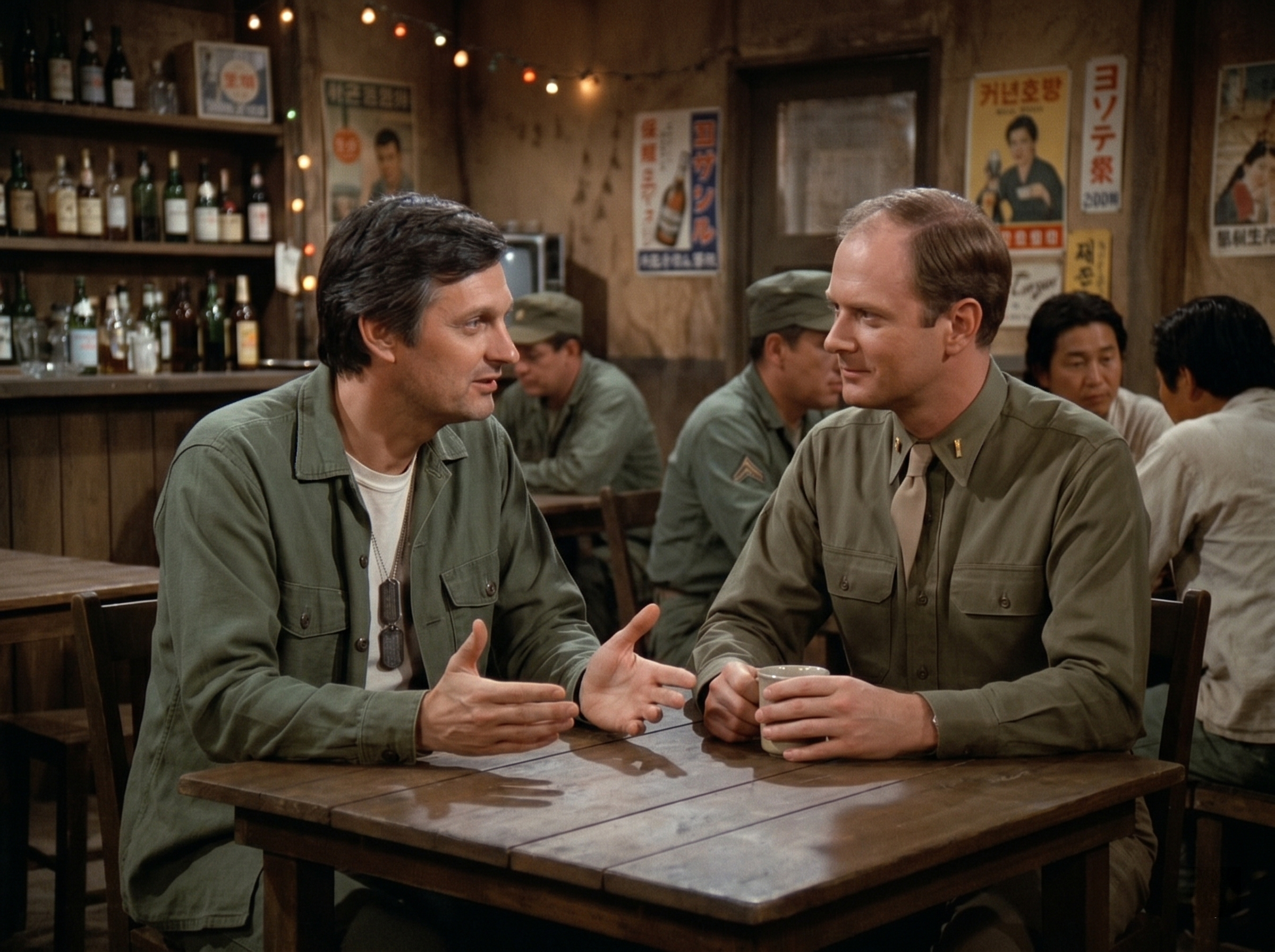
If the 4077th was a body, the Swamp was its heart, but Rosie’s Bar was its messy, reliable soul.
It was the one place where the war didn’t just feel smaller; sometimes, if you squinted hard enough at the lights, it completely disappeared.
Which was exactly what Hawkeye and B.J. were trying to make it do on this particular Tuesday evening.
They had been here for an hour, or maybe three, time having lost all meaning after 36 straight hours of surgery.
Surgery, and then the long, terrifying silence that always followed a large casualty intake, the silence where you waited to see which of your saves would hold.
Now, sitting in the warm, dim glow of Rosie’s, the exhaustion was finally catching up, clinging to them like the smell of antiseptic.
“You know,” Hawkeye was saying, his hands moving with that nervous energy that even a gallon of Rosie’s worst scotch couldn’t seem to tame. “I think I’ve figured it out, Beej.”
His white undershirt was visible beneath his open-collared fatigue jacket, dog tags clinking against each other, a rhythmic reminder of where they were.
“Figured what out, Hawk?” B.J. asked, his tone affectionate and grounded, the reliable steadying hand.
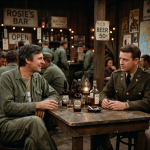
He sat across from Hawkeye, his uniform neat, shirt tucked, and a tan tie knotted carefully, a contrast to Hawkeye’s controlled dishevelment that mirrored their dynamic perfectly.
B.J. was holding a ceramic mug with both hands, using its warmth to thaw the chill that never seemed to leave his fingers after a long shift.
“This is not a bar,” Hawkeye declared, his eyes flashing with playful defiance.
“It’s not?” B.J. suppressed a smile.
“Absolutely not,” Hawkeye said, widening his stance, leaning in. “This is an elaborate psychological study in temporal displacement.”
“See all these lights?” He waved an expansive hand, almost brushing B.J.’s cup, gesturing to the colorful string lights that zig-zagged above them.
“I’m convinced they’re not just standard Christmas reject bulbs. They’re transmitters, beaming us false memories of a place called ‘Tuesday.’”
“Where I come from,” Hawkeye went on, “Tuesdays are for grocery shopping and maybe an interesting debate over meatloaf. Here, Tuesdays mean I just spent twenty-four hours in a bloody jigsaw puzzle.”
B.J. nodded slowly, his eyes soft. “It’s true. The concept of ‘weekday’ feels a little fictional when the only calendar that matters is the triage slate.”
“Exactly!” Hawkeye clapped his hands once. “Which means this scotch isn’t just scotch. It’s medical-grade amnesia, prescribed by Doctor Rosie.”
He was using humor to build a protective wall, a trick B.J. recognized instantly.
The rest of the bar buzzed with quiet conversation. Through the hazy air, other soldiers in uniform sat at worn tables. A Korean civilian watched them from across the room. The shelves behind the bar held a museum’s worth of mismatched liquor bottles.
Posters with Korean script and smiling faces plastered the wall, a cheerful, jarring juxtaposition to the weary faces beneath them.
This wasn’t just a scene in a bar; it was a snapshot of their fragile, shared survival.
Then, Hawkeye’s expression suddenly shifted, the mask of sarcastic detachment cracking for a brief, raw second.
His hands, which had been performing an animated monologue, stilled, one palm remaining open on the scarred table.
“I saw him, Beej,” he whispered, his voice losing its theatrical bounce. “The one we lost right at dawn.”
B.J. didn’t speak immediately. He understood the rules of the game. Sometimes, you just had to let the silence sit between you, a heavy, shared burden.
The noise of the bar seemed to fade into a background hum.
He gripped his mug a little tighter, the warmth stabilizing him.
“You mean the kid from Nebraska?” B.J. finally said, his voice quiet.
“Yeah. The one with the cornflower-blue eyes and the letter to his mother tucked in his shirt pocket,” Hawkeye said, his eyes unfocused, staring somewhere far beyond Rosie’s.
His other hand came up, palm open, as if trying to grasp something that had already slipped through his fingers.
“He was talking about going to his junior prom, Beej. He wanted to know if I thought the powder-blue tux was too much. I told him he’d be the talk of the town.”
“I think he believed me,” Hawkeye added, the humor in his voice replaced by a devastating, tender logic. “I *needed* him to believe me.”
“And that,” B.J. said gently, “is why we’re here, Hawk. Because you gave that kid twenty minutes of believing he was going to prom. That’s a hell of a gift.”
Hawkeye finally looked back at him, the sarcasm trying to claw its way back. “I’m a regular humanitarian. Next week, I’m opening a free balloon animal stand.”
B.J. smiled, a genuine, tired smile. “I’ll bring the balloons.”
He took a slow sip from his mug, then set it down with a deliberate *clink*.
“But in all seriousness, Hawk, we do what we can. We’re doctors. We aren’t gods.”
Hawkeye’s hands dropped back to the table, his fingers tracing a deep groove in the wood.
“Sometimes I think if I can just joke about it, I can make it less real,” Hawkeye admitted.
“That’s one way to keep the jigsaw puzzle from falling apart,” B.J. said.
He leaned forward, mirroring Hawkeye’s earlier posture, bringing their private conversation even tighter.
“You know, Radar was crying in the supply tent earlier. He told me he was worried we wouldn’t have enough blood to save everyone next time. The kid’s nine parts heart, one part clipboard.”
“I told him to worry about getting me a proper martini olive, and I’d handle the blood supply,” Hawkeye said, the witty defense mechanism starting to build itself back up.
The tension was easing, the shared burden having been acknowledged, named, and for now, put aside.
“You’re a good man, Hawkeye Pierce,” B.J. said, and for once, the words felt simple and undeniable.
“And you,” Hawkeye countered, a glint of the old fire returning to his eyes, “are surprisingly well-dressed for a Tuesday.”
He gestured to B.J.’s tie. “What’s the occasion? Meeting with a diplomat, or just hoping to get lucky with Rosie?”
B.J. laughed, a rich sound that cut through the heaviness. “My mother-in-law sent this. She thinks ties keep a man grounded. I wear it so she doesn’t send me a bow tie next.”
“Always the practical one,” Hawkeye said, raising his own glass (Rosie’s finest gin, which tasted mostly like kerosene and optimism) for a toast.
“To ties, to tears, and to the time we’ve stolen from the war,” he said, his voice firming up.
“And to that kid with the cornflower-blue eyes,” B.J. added softly, raising his mug. “May he have the dance of his life.”
They clicked their glasses together, a small, profound act of friendship and shared humanity.
For a few minutes, in the dim, chaotic warmth of Rosie’s Bar, surrounded by the posters, the string lights, and the tired soldiers, the war, the loss, and the surgical shifts receded.
They were just two friends, sharing a quiet moment and a terrible drink, proving that even in the darkest corners, tenderness and humanity could always find a seat at the table.
Because sometimes, a terrible martini shared with a friend is the most profound therapy in the world.