The Weight of a Feather and a Form: A Quiet Moment in Colonel Potter’s Office.
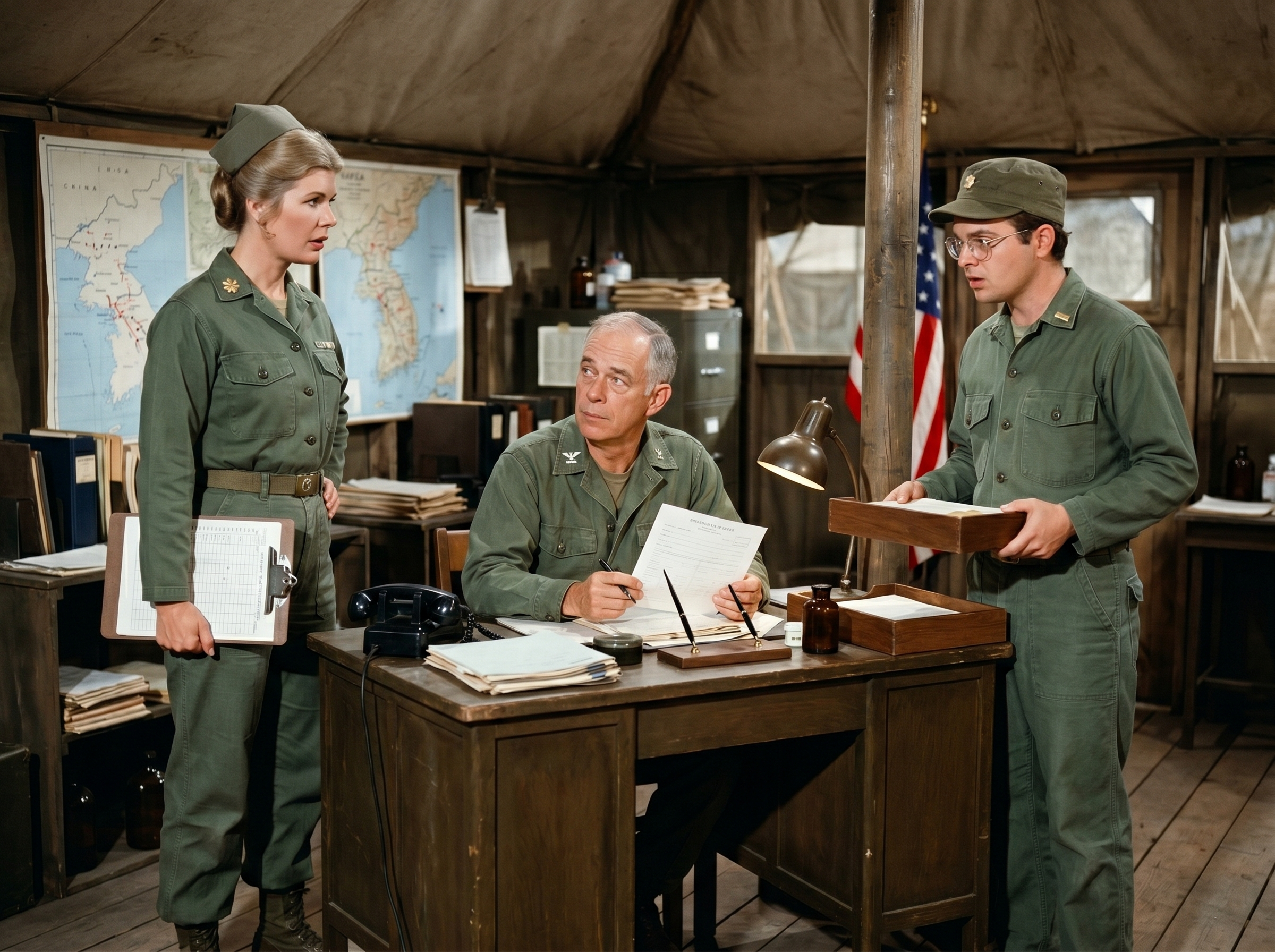
Sometimes the paperwork feels heavier than the steel.
In the CO’s office, the quiet can be thicker than the mud outside.
It was just after morning surgery, the adrenaline fading into that deep, slow fatigue that never quite leaves you.
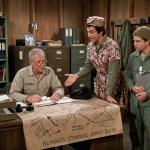
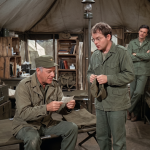
Colonel Sherman Potter sat behind his heavy wooden desk, surrounded by the only stability he truly knew in this place: orders, maps, and the worn American flag.
He held a form in his hand, a request he had already denied three times.
His eyes looked up from the paper, weary but resolute.
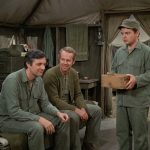
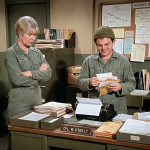
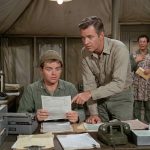
Radar stood on the other side of the desk, holding the wooden tray filled with inbound mail and requisitions, as if he were presenting evidence at a court-martial.
His glasses caught the light from the desk lamp, and his expression was a perfect mix of polite subservience and earnest, nervous pleading.
“It came back, sir,” Radar whispered, his voice cracking slightly. “Central Supply says the replacement part is ‘not in inventory’ and I have to ‘submit form 807-B’ again.”
Colonel Potter sighed, a sound like an old hinge finally giving out. “Radar, son, we’ve submitted every form in the book. If we need 807-B, I’ll find it and use it to roll a cigar.”
To Potter’s left, Major Margaret Houlihan stood at perfect attention, or as close as one can get in a canvas tent.
She clutched her own clipboard like a shield, loaded with patient charts and her own demands for more blankets.
Margaret was professional, focused, and quietly exasperated.
“Sir,” she said, her tone professional but edged with the stress of the ward. “With all due respect, if Supply can’t provide a spare tire for the generator, the operating room will lose lighting. Again.”
Radar looked from the Major to the Colonel, eyes wide, waiting for the miracle he always tried to procure.
He held up the wooden box, offering the pile of official refusals.
Potter didn’t look at the box; he looked at Radar, seeing not the papers but the tired heart of the boy who always wanted to fix everything.
Potter stared at the form, his fingers tightening.
The silence grew heavy, filled only by the hum of the desk lamp and the distant, constant noise of helicopters.
The silence finally broke with the simple, mechanical clatter of the field phone on the desk.
Potter lifted the receiver, his motion slow.
“Potter here. Yes. No. Supply? Again? No, I am quite aware of Form 807-B.”
He spoke with the flat, tired sarcasm of a man who had heard every excuse.
Radar winced, lowering his tray.
Margaret shifted, her fingers tracing the edge of her clipboard.
“Colonel, is there any update on the whole blood shipment?” she interrupted, her voice a shade softer.
Potter looked at her, held her gaze. “No, Major. No update.”
He hung up the phone and looked back at Radar, who was still waiting, holding the box like a loyal retainer.
“Radar, son,” Potter began, and his voice was completely different now—fatherly, gentle, and absolutely defeated. “You take that box of ‘no’s and you put it on the stack. I know you want to fix this, son. We all do.”
Potter dropped the form he had been holding back onto his desk.
Radar set the box down with a quiet thud next to the stack of other boxes. He looked at the Colonel, then the Major.
Margaret didn’t snap at him. She didn’t complain about the generator.
Instead, she did something remarkable. She set her own clipboard down on the edge of the desk.
She adjusted her garrison cap, smoothed her uniform, and then looked at Radar, her expression softening into a rare moment of genuine, quiet respect.
“You tried, Walter,” she said, using his proper name, which she only used when she meant it. “You always try.”
Radar nodded, the small act of appreciation almost overwhelming him. He looked at the floorboards.
Potter watched them both. The Major’s professional steel and the Corporal’s endless, naive loyalty. This was his command. Not the maps or the flag, but these people.
He picked up the pen and scribbled a name and number.
“Radar,” Potter said, handing him the slip. “Forget central. You call a friend I know in Tokyo. Tell him I need that generator part yesterday. And the blood shipment. We may not get the ‘B’ form, but we’ll get what we need.”
He patted Radar’s arm and then looked at Margaret. “Major, about those blankets. Come back later this afternoon, and we’ll figure something out. Together.”
Radar saluted—a real salute, not a frantic ‘get out of trouble’ salute—and picked up his tray of mail. “Yes, sir! On it, sir!” He bounced toward the door, his spirits lifted by a single slip of paper and a moment of kindness.
Potter sat back in his chair, watching him leave. Margaret watched him too, her own shoulders relaxing.
For a moment, they just shared the silence. It wasn’t the heavy silence of fatigue anymore. It was the quiet tenderness of a shared burden.
Potter picked up the pen again, and Margaret picked up her clipboard, the routine—their only defense against the madness—beginning again.
The papers might weigh a ton, but sometimes a small human kindness is all it takes to keep the whole camp afloat.