The Weight of the Glass and the Warmth of the Lantern
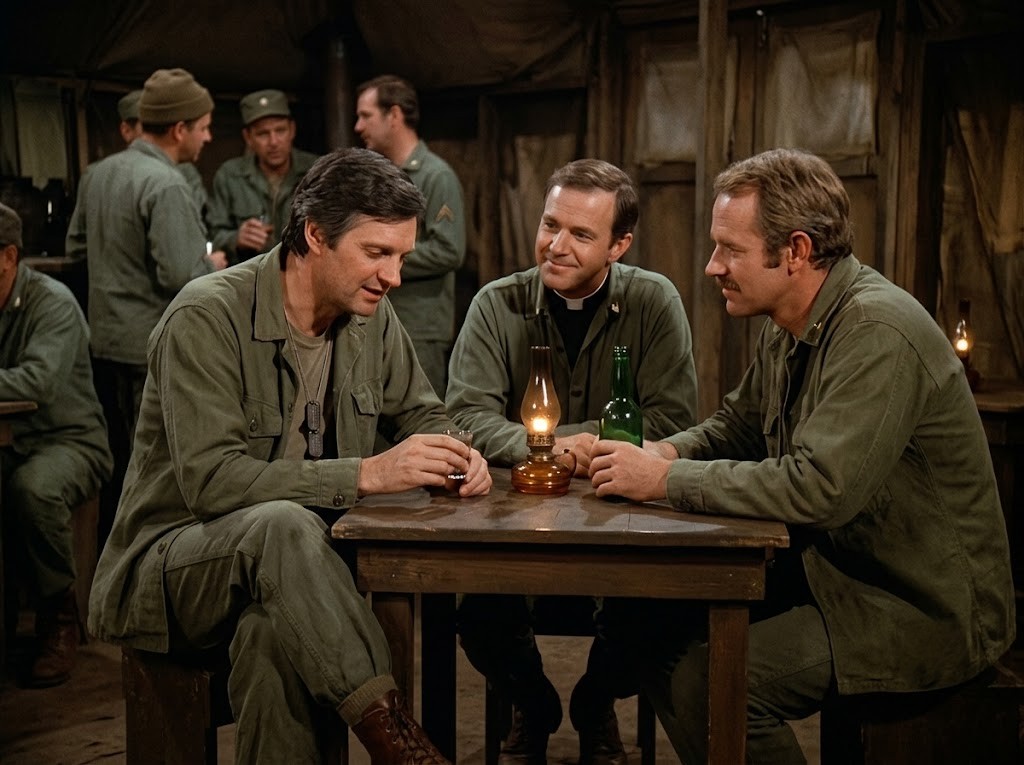
The hum of the 4077th Officer’s Club was always a little louder on the nights following a double shift in O.R. It was the kind of noise meant to drown out the silence of the Korean hills, a collective effort by tired people trying to remember what normal felt like.
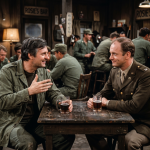
In the corner, sitting around a scarred wooden table, the world shrunk down to the radius of a single kerosene lamp. The amber glow flickered against the canvas walls, casting long shadows that seemed just as exhausted as the men sitting beneath them.
Hawkeye Pierce stared down into his shot glass, his fingers tracing the rim as if looking for an exit strategy. His dog tags dangled loosely over his olive-drab undershirt, a metallic reminder of a reality he spent every waking hour trying to joke his way out of.
“You’ve been staring at that local kerosene for ten minutes, Hawk,” B.J. Hunnicutt said, his hand resting firmly on a green glass bottle. “If you keep it up, it’s going to start staring back, and frankly, it doesn’t have your eyes.”
Hawkeye didn’t look up right away, a rare occurrence for a man whose mouth usually moved faster than a scalpel. He let out a dry, breathy chuckle that didn’t quite reach his eyes, his shoulders shifting under his loose fatigue jacket.
“I’m just conducting a highly scientific experiment, Beej,” Hawkeye murmured, his voice laced with the heavy fatigue that only comes after thirty-six straight hours of stitching human beings back together. “I’m trying to see if the density of this stuff can successfully dissolve the memory of today’s third casualty.”
Sitting between them, Father Mulcahy listened with the quiet, unshakeable patience that made him the bedrock of the camp. His clerical collar peeked out from beneath his standard-issue fatigue shirt, a bridge between two worlds that often felt completely incompatible.
Mulcahy looked at Hawkeye, his face softening into a gentle, compassionate smile that carried no judgment, only a deep, human understanding. He didn’t offer a sermon or a platitude; he just offered his presence, his eyes reflecting the warm light of the lantern.
“It was a difficult afternoon, Captain,” Mulcahy said softly, his voice a calm anchor in the rowdy room. “Sometimes the spirit requires a moment to simply sit still before it can move forward again.”
“My spirit isn’t just sitting still, Father, it’s checked into a motel in Vermont and left a ‘Do Not Disturb’ sign on the handle,” Hawkeye joked weakly, finally looking up. But the humor faded quickly, replaced by a sudden, sharp vulnerability that caught both of his friends off guard as his hand began to tremble slightly against the glass.
B.J. noticed the tremble instantly, his grounded nature taking over without a second thought. He didn’t make a big deal of it, knowing Hawkeye’s pride, but he leaned in closer, shifting the green bottle slightly as if shielding his friend from the rest of the noisy tent.
“Hey,” B.J. said, his voice dropping to a low, steady register that belonged strictly to the two of them. “We did everything we could out there today, Hawk. Every single thing. You know that, right?”
Hawkeye looked from B.J. to the Father, the weight of the endless war pressing down on his chest. For a second, the witty defenses completely evaporated, leaving behind just a tired doctor from Maine who wanted nothing more than to go home.
“Sometimes ‘everything’ feels like a drop in a bucket with a hole in the bottom,” Hawkeye admitted, his voice barely above a whisper. He looked at the shot glass again, the amber liquid shimmering under the lantern light. “You save ten, you lose one, and it’s always the one you remember when the lights go down.”
Father Mulcahy reached out, his hand resting briefly near the center of the table, offering a silent gesture of solidarity. “The ones we lose don’t diminish the lives of the ones who walk away, Hawkeye. If anything, your grief proves that the place inside you that cares hasn’t been hardened by this place. And that is a victory in itself.”
Hawkeye let out a long, slow breath, the tension in his shoulders finally beginning to ease under the steady gaze of his friends. He looked at Mulcahy, a faint, genuine smirk playing at the corner of his mouth.
“Father, if you keep being this insightful, I’m going to start charging you for my psychiatric services,” Hawkeye said, the familiar spark of dry wit returning to his eyes.
“Oh, I think my tab is already covered by the sheer number of confessions I’ve had to listen to regarding your shenanigans with the camp’s plumbing, Captain,” Mulcahy replied without missing a beat, his smile widening.
B.J. laughed, a warm, booming sound that broke the last remnants of the heavy melancholy hanging over the table. He tipped his bottle slightly toward Hawkeye’s glass.
“To the plumbing,” B.J. proposed. “And to the best damn surgeon in Korea, even if he does brood like a tragic poet in a bad diner.”
Hawkeye finally lifted his glass, his hand steady now, the warmth of the small circle shielding him from the cold reality outside the canvas walls. He looked at B.J., then at the Father, feeling the quiet strength of the found family they had built in the mud of Uijeongbu.
“To friends who keep you from dissolving,” Hawkeye said softly, clinking his glass against B.J.’s bottle.
In the background, the laughter of other soldiers continued, a deck of cards was shuffled, and the distant clink of glasses echoed through the Officer’s Club. But at their small wooden table, under the gentle glow of the kerosene lamp, the world was exactly the right size for three men to find their footing again.
Beneath the canvas and the chaos of the 4077th, it was the quiet shared moments—and the friends who held the lantern—that kept the dark at bay.