The Weight of Words in a Canvas World
The 4077th had a very specific kind of silence.
It wasn’t the peaceful quiet of a Sunday morning back home in Maine or the hushed reverence of a library in Boston. It was a heavy, exhausted silence. It was the temporary pause between the distant thud of artillery and the inevitable, dreaded chop-chop-chop of incoming helicopters.
On this particular Tuesday afternoon, the camp was suffocating under that heavy quiet. The Korean sun beat down mercilessly on the canvas tents, turning the air stale and baking the ground into a fine, powdery dust that coated every surface, every boot, and every tired soul.
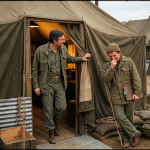
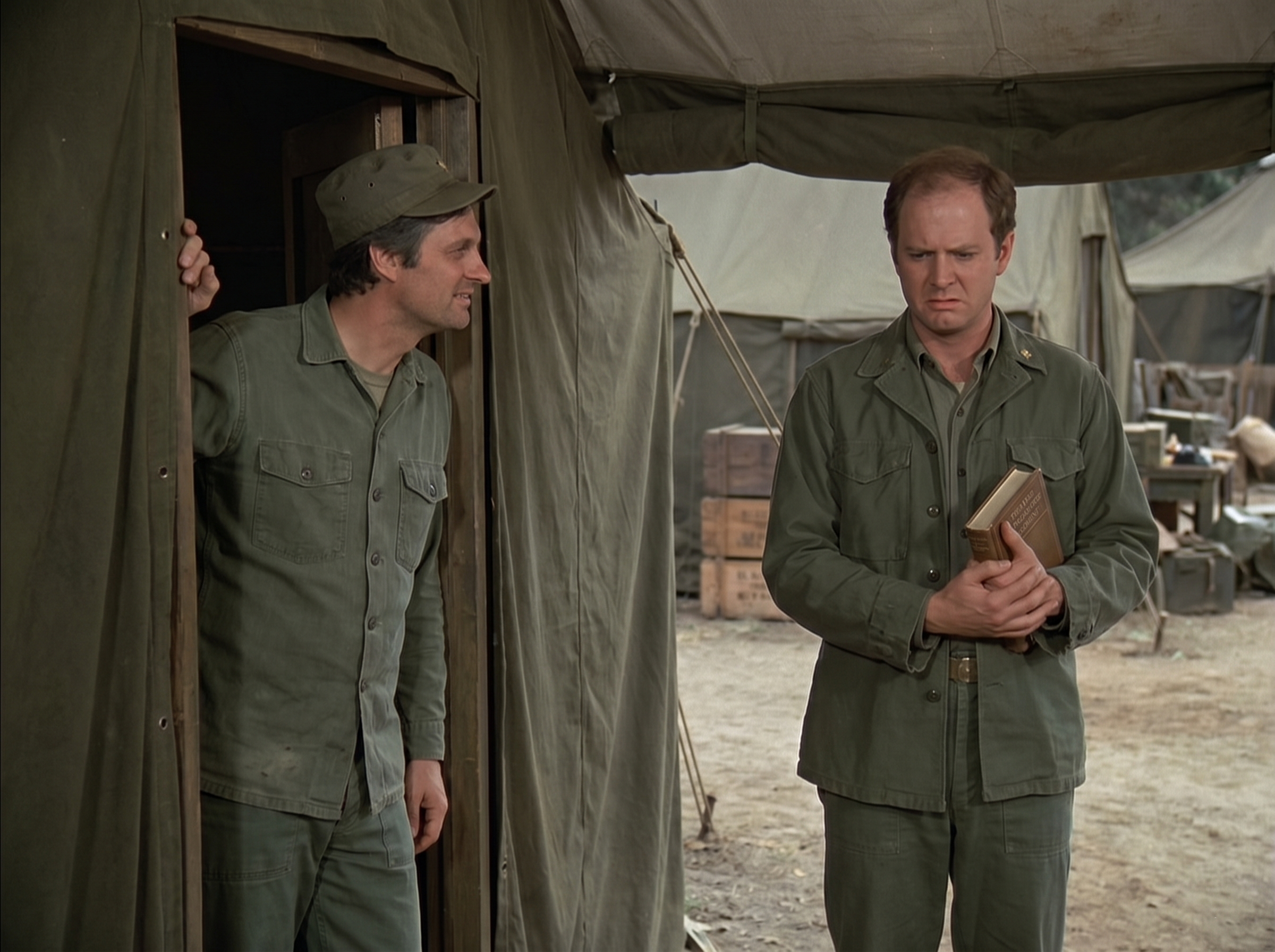
Benjamin Franklin “Hawkeye” Pierce pushed open the flimsy screen door of the Swamp. He leaned against the wooden doorframe, letting out a long, slow breath. He was wearing his standard, wrinkled green fatigues and his soft cap pulled low, his posture a masterclass in practiced slouching. He had spent the last fourteen hours elbow-deep in the tragedies of war, and his spirit was craving a distraction. Any distraction.
He was fully prepared to wander over to the mess tent to harass the cooks, or perhaps find B.J. for a game of cribbage that would inevitably devolve into trading terrible puns.
But as he looked out onto the dusty camp path, his eyes landed on Major Charles Emerson Winchester III.
Charles was standing just outside the tent, completely still. He was dressed in his usual impeccably pressed (or as pressed as one could manage in a war zone) fatigues, but his posture was completely wrong. The proud, aristocratic bearing that usually preceded him like a brass band was fractured.
Charles was staring down at a thick, cloth-bound book clasped tightly in his hands. He held it against his chest like a shield, or perhaps like a life preserver.
Hawkeye’s eyes, naturally observant and permanently exhausted, caught the subtle shift in the Major’s face. Charles’s brow was furrowed, his lips pressed into a tight, trembling line. His eyes, usually sharp and condescending, were swimming with a profound, unshielded sadness. It was the look of a man who was desperately trying to hold the pieces of his composure together while the world quietly dismantled him.
Instinct kicked in before empathy could catch up. Hawkeye, ever the court jester trying to keep the darkness at bay, let a dry, irreverent smirk touch his lips. He leaned a little further out the door.
“Careful, Charles,” Hawkeye called out, his voice carrying the familiar, teasing cadence. “If you squeeze that thing any tighter, you’re going to extract the plot. And I hear the ending is a real tearjerker.”
Hawkeye expected the usual retaliation. He expected Charles to draw himself up to his full height, deliver a blistering insult about Hawkeye’s pedigree, and march off to his cot.
Instead, Charles turned slowly.
The image of that moment would burn itself into Hawkeye’s memory. Charles didn’t sneer. He didn’t puff out his chest. He just looked at Hawkeye.
His face was a portrait of wounded pride masking a desperate, fragile vulnerability. Charles looked trapped, caught out in the open with his armor down, unable to summon the energy to put it back on. The silence stretched between them, thick and incredibly fragile.
Hawkeye’s smirk vanished instantly. He realized, with a sudden, sinking feeling in his gut, that he hadn’t just tossed a playful jab at a pompous roommate. He had inadvertently kicked a man who was already bleeding from an invisible wound.
For the first time since he arrived in this dusty corner of hell, Charles Emerson Winchester III looked utterly defeated. And Hawkeye Pierce, the man who always had a snappy comeback for everything, suddenly had absolutely no idea what to say.
The silence hung in the dusty air, punctuated only by the distant hum of a jeep grinding its gears near the motor pool.
Hawkeye slowly pushed himself off the wooden doorframe. The relaxed, irreverent slouch evaporated, replaced by the quiet, steady presence of a doctor evaluating a patient in distress. He didn’t make a joke. He didn’t apologize, knowing that pity would only humiliate Charles further.
He just took one step out into the sunlight.
Charles swallowed hard. His knuckles were white where he gripped the book. He looked down at the dusty ground, fighting a visible war behind his eyes. The famous Winchester pride was warring with the crushing, lonely reality of the 4077th.
“It is… a collection of essays,” Charles finally said, his voice barely above a whisper. It was tight, lacking its usual theatrical resonance. “From my father’s library.”
Hawkeye took another slow step forward, stopping a respectful distance away. He kept his hands loosely in his pockets, making himself as non-threatening as possible. “Heavy reading for a Tuesday afternoon, Major.”
Charles didn’t rise to the bait. He traced a finger over the worn, unassuming cover of the book. “My sister, Honoria, sent it in the last mail call. She thought it might provide a touch of civilization.”
Charles paused, taking a shaky breath. He looked up, his eyes meeting Hawkeye’s. The barrier was completely gone now.
“I opened it just a moment ago,” Charles continued, his voice cracking slightly. “And tucked between the pages… Honoria had placed a pressed autumn leaf. From the oak tree in our front courtyard in Boston.”
Hawkeye stayed perfectly still. He knew better than to interrupt. He knew what it felt like to have a piece of home suddenly dropped into the misery of Korea.
“I went to pick it up,” Charles said, his voice dropping to a devastated whisper. “I simply wanted to hold it. But it was too old. The journey was too long.”
Charles looked down at his own hands, his expression crumbling. “The moment my fingers touched it, Pierce… it disintegrated. It turned to absolute dust. Right here in this godforsaken dirt.”
The weight of the metaphor hung heavy between them. It wasn’t just a leaf. It was Charles’s dignity. It was his connection to his family. It was the fear that the refined, cultured man who had left Boston was slowly disintegrating in the mud and blood of a mobile army surgical hospital, turning into dust just like the leaf.
Hawkeye felt a hard lump form in his own throat. He looked at Charles—really looked at him. Beneath the classical music, the gourmet food, and the unbearable snobbery, Charles was just as homesick, just as terrified, and just as exhausted as the rest of them.
Hawkeye took his hands out of his pockets. He didn’t reach out to touch Charles—he knew the Major would recoil from the physical contact—but he closed the distance between them.
“Charles,” Hawkeye said quietly, his voice entirely stripped of irony. “The dust here… it gets into everything. It ruins the boots, it jams the rifles, it gets into the food.”
He paused, looking directly into Charles’s wounded eyes.
“But it doesn’t change what the leaf was. And it doesn’t change where it came from.” Hawkeye nodded toward the book in Charles’s hands. “The words are still in the book, Major. The dust can’t touch them. And it can’t touch Boston.”
Charles stared at Hawkeye. The tension in his jaw slowly began to loosen. The ragged, panicked breathing steadied. He looked down at the book again, his grip relaxing just enough to let the blood return to his knuckles.
For a long moment, the two men stood perfectly still on the camp path. They were worlds apart in upbringing, philosophy, and temperament. But right here, in the baking sun of a war they both hated, they were exactly the same. Just two tired doctors trying to hold onto the pieces of who they used to be.
Slowly, deliberately, Charles adjusted his posture. He pulled his shoulders back. He lifted his chin. The aristocratic armor was sliding back into place, but the jagged edges were softer now. He tucked the book carefully under his arm.
“Thank you, Pierce,” Charles said softly. It wasn’t a booming declaration. It was a quiet, genuine acknowledgment.
Hawkeye offered a small, crooked smile. The familiar glint returned to his tired eyes. “Don’t mention it, Charles. Seriously. If you tell anyone I was nice to you, it’ll ruin my reputation as the camp degenerate.”
Charles let out a short, breathy sound that was halfway between a sigh and a laugh. A small, sad smile tugged at the corner of his mouth.
“Your secret, Captain,” Charles replied, his tone dry but remarkably warm, “is entirely safe with me.”
Charles turned and walked slowly toward his quarters, his steps deliberate and measured. Hawkeye watched him go, the oppressive silence of the camp somehow feeling just a little bit lighter than it had a few minutes before.
Hawkeye turned back toward the Swamp, pushing the screen door open once more. They were thousands of miles from home, fighting a war of endless casualties and relentless fatigue, but they weren’t doing it alone.
In the heart of a war that took everything, the quiet moments of understanding were the only medicine that truly healed.