The Quietest War
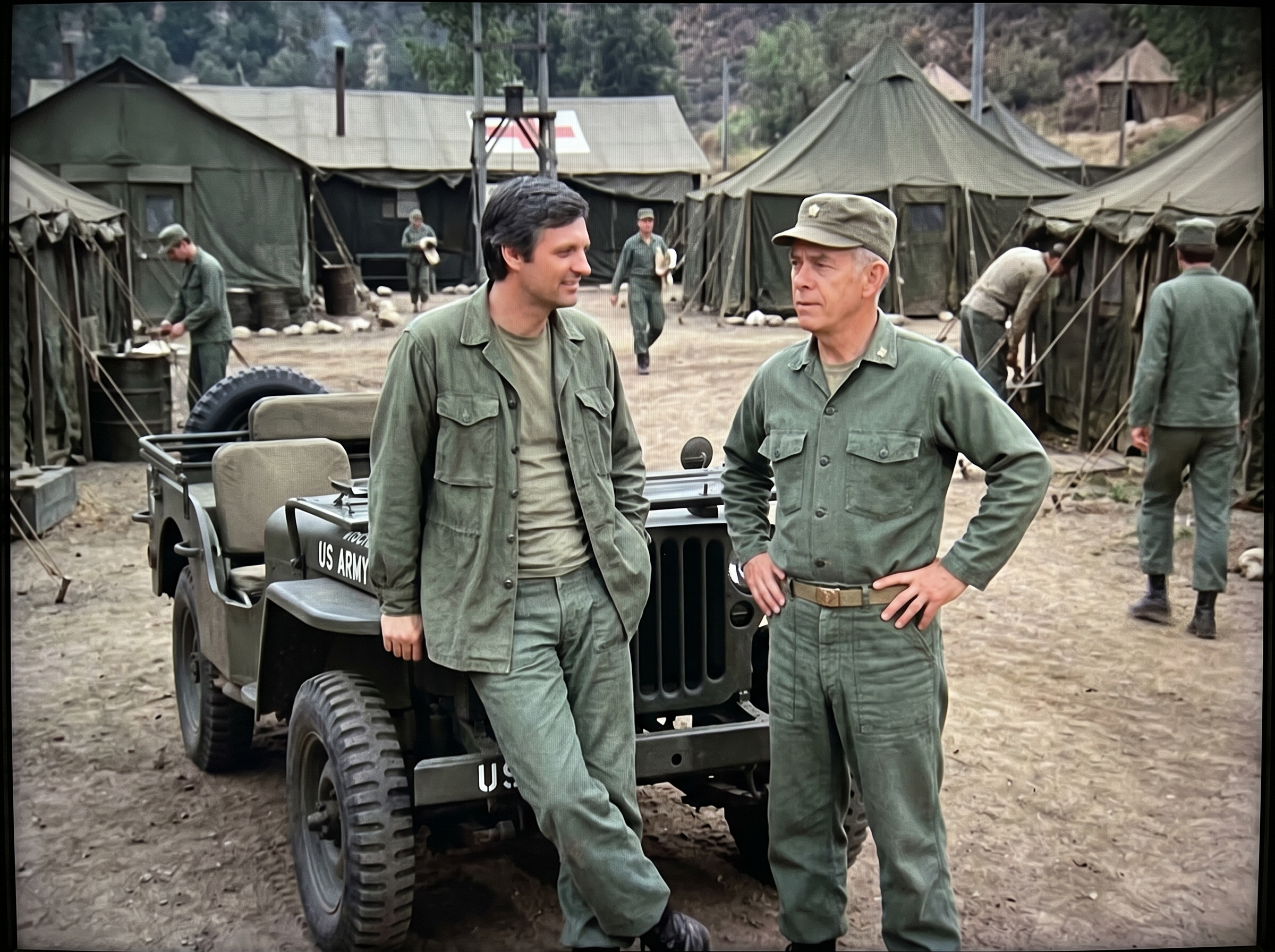
Sometimes, the loudest silence was the one right after the helicopters stopped. The last casualty was loaded onto a cot, the final OR shift wound down, and the entire 4077th took a breath it had been holding for three days straight. It was late afternoon, that golden-hour light illuminating the red cross on the main tent and making the dust devils on the compound floor look almost beautiful. In moments like this, the war seemed to recede into the hills, leaving only the sound of a jeep’s engine cooling and the distant, tinny music from the mess tent.
It was exactly this quiet that found Captain Hawkeye Pierce leaning against the front of his beloved, battered jeep, the white US ARMY letters fading like his optimism. He looked comfortable enough, hands deep in his pockets, posture casual. If you looked closer, you’d see the subtle lines of fatigue etched around his eyes, the kind that no amount of wisecracking or Swill could quite erase. He was looking up, that familiar smirk playing on his lips—a look that usually signaled he was either winding up for a grand philosophical point or waiting for a specific, refined brain to explode.
And that specific brain was standing right next to him. Major Charles Emerson Winchester III, immaculate as possible in a uniform that had survived a Korean dust storm, stood with hands planted firmly on his hips. Charles didn’t do ‘casual.’ Charles did ‘endurance.’ The expression on his face wasn’t quite frustration, but rather a profound impatience with the universe, an impatience that was currently directed squarely at the grinning captain leaning on his jeep. It was a stand-off of style and substance, and the rest of the camp knew to give them wide berth when this kind of silent negotiation was underway.
The immediate source of the tension was seemingly trivial. Charles had spent the last twenty minutes trying to procure a specific, delicate part for a record player he claimed was essential for his mental fortitude—a fortitude he insisted Hawkeye was trying to chip away at with “subpar humor and unauthorized relaxation.” Hawkeye had watched the Major attempt to pull rank with Klinger, negotiate with Radar, and finally try to command a supply sergeant who was more interested in a letter from home than any Brahms symphony. Now, Charles was simply standing, a beacon of refined indignation.
“One part, Pierce. One single, solitary needle,” Charles finally huffed, not taking his eyes off the middle distance. “Is it too much to ask for the simplest comforts of civilization while we are trapped in this… this open-air infirmary?”
“Ah, Charles, civilization is exactly what got us here,” Hawkeye said, his voice quiet, lacking its usual punch. “They don’t send the needle to play the music, Charles. They send the needle to patch the holes.”
The words landed softly in the afternoon air. The smirk remained, but for a microsecond, the humor behind Hawkeye’s eyes vanished, replaced by an ancient, weary understanding. And in that same microsecond, Charles’s jaw tightened, not in anger, but in acknowledgement. The tension between them was palpable, vibrating in the short space that separated them. They weren’t fighting about a record player; they were fighting the realization of where they truly were, and they both knew it. And that shared realization, suspended there in the golden dust, was heavier than anything a supply truck could deliver.
The moment stretched, the silence amplifying the weight of Hawkeye’s observation. Radar, passing near the supply tent with a clipboard and that perpetually earnest expression, sensed it and slowed down, pretending to check his notes but really observing his two officers with concerned eyes. Up on the hill, Father Mulcahy was making his rounds, his figure a comfort even from a distance. The 4077th family was all around them, yet in that instant, Hawkeye and Winchester felt a shared isolation.
“Don’t get poetic with me, Pierce,” Charles finally snapped, though the energy was gone from his voice. He looked down at his boots, a single hands-on-hips gesture relaxing slightly. “I simply wish to preserve what little dignity remains.”
“Dignity’s overrated, Charles,” Hawkeye replied, shifting his weight against the jeep’s bumper. “Comfort, that’s where the money is. And right now, I could use some comfort.” He paused, looking directly at Charles. “You look like you could, too.”
Charles Emerson Winchester III, descendant of royalty, looked at the exhausted surgeon. He looked at the tents, the mud, the distant hills. He looked at his own reflection in the dusty hood of the jeep and saw the fatigue and the loneliness that he hid beneath his pomposity. He knew he wasn’t fooling anyone, certainly not Hawkeye.
With a heavy sigh that was almost a concession, Charles allowed his hands to drop from his hips, a rare moment of unguarded posture. “The needle broke, Pierce. The very last one.” His voice was quiet, stripped of its habitual imperious tone, revealing a raw vulnerability beneath the Boston veneer. “A letter from my sister arrived this morning. She mentioned how much she missed hearing me play. And all I wanted was to pretend, for an hour, that I was listening with her.”
Hawkeye’s smirk softened. The competitive light in his eyes vanished, replaced by a genuine tenderness that often came to the surface after the operating room was empty. He pushed himself off the jeep bumper and took a half-step closer. “I know, Charles. I know.”
He reached into the pocket of his fatigues and pulled out a small object. It wasn’t a needle for a record player. It was a single, small, hand-painted toy soldier, one with a broken bayonet. “A kid gave me this last month. Wanted me to fix his leg. The boy, not the soldier.” He rolled it between his fingers. “When things get like this… I just hold onto it.”
Hawkeye offered the soldier to Charles.
For a moment, Charles just stared at it. It was cheap, broken, and undeniably human. He looked at Hawkeye’s face, which held nothing but understanding and a quiet, found-family compassion. The refined Major from Boston took the toy, his fingers careful around the tiny, broken soldier. A small, genuine, and deeply tired smile touched his lips.
“Thank you, Captain.” The words were modest, devoid of any title or pretense.
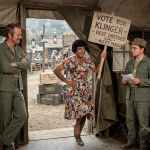
They stood there for another minute, not speaking. The gold faded to amber in the western sky. In the background, Klinger passed by, wearing a flamboyant evening gown, but neither Hawkeye nor Charles commented. They were beyond judgment in this moment. The world was at war, but in this small patch of dirt, in front of a battered jeep, a quiet truce had been declared, born from fatigue, respect, and a shared, bittersweet longing for home. They were just two tired men, bound by circumstances and, increasingly, by an unexpected, saving grace of friendship.
They found that the hardest part of the war was sometimes the quiet, when you had time to remember what you were missing.