The Campaign Trail at the 4077th
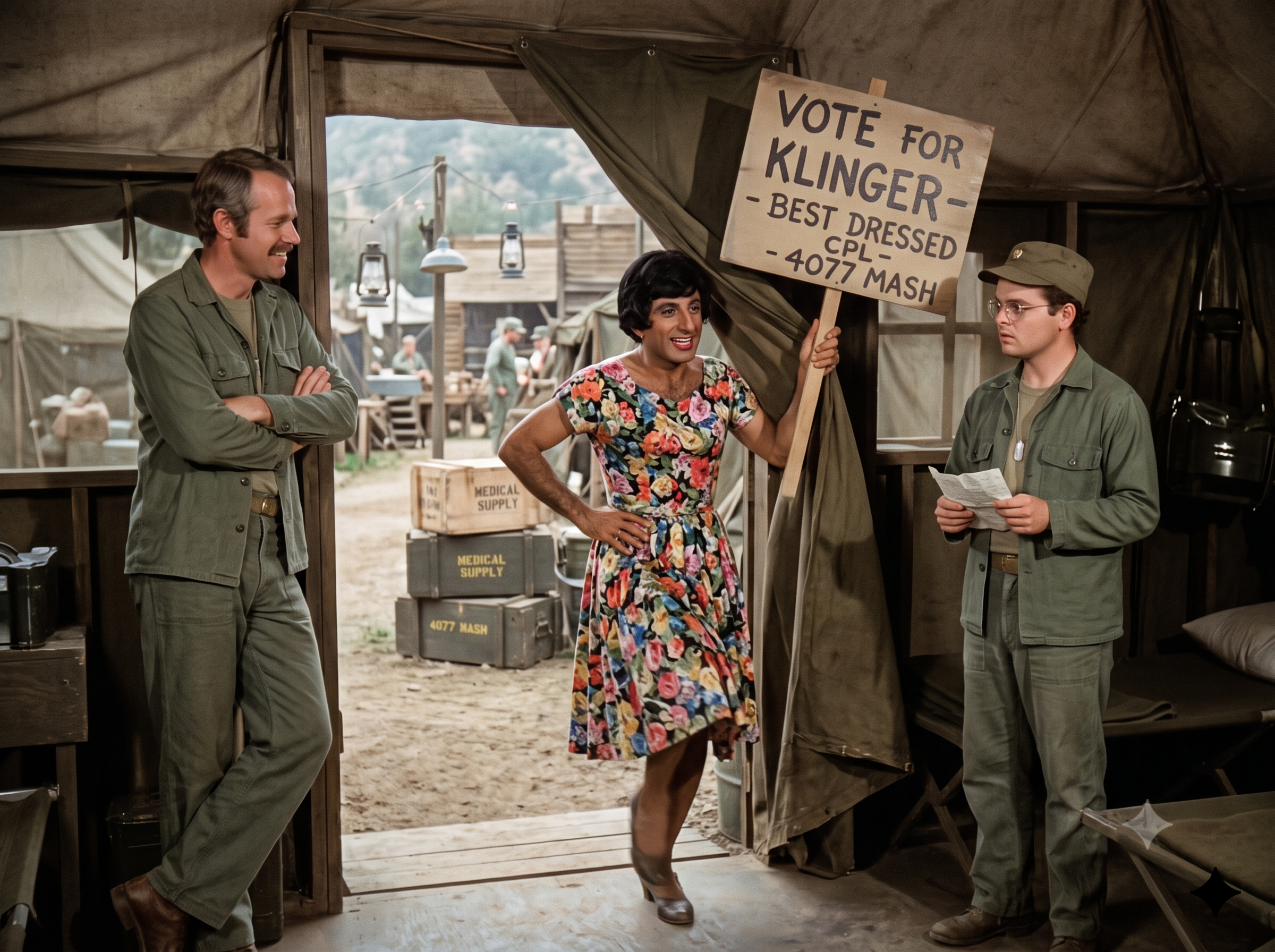
In a place painted entirely in relentless shades of dust, mud, and olive drab, survival sometimes required an unexpected splash of color.
It was a quiet afternoon at the 4077th, a rare and fragile window of peace between the chaotic storms of incoming casualties. The summer heat hung heavy in the air, smelling faintly of exhaust fumes, stale coffee, and the ever-present dry Korean dirt.
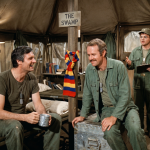
B.J. Hunnicutt stood leaning comfortably against the wooden frame of the Swamp’s doorway. He had his arms crossed loosely over his chest, his shoulders relaxed, just trying to soak in five minutes of absolute normalcy. He watched the slow, tired movement of the camp outside, where a few enlisted men were dragging their feet past the hanging lanterns and medical supply crates.
Then, Radar O’Reilly materialized.
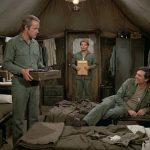
The young corporal was walking briskly toward the Swamp, clutching a piece of paper in his hands. His brow was furrowed in that familiar expression of earnest, nervous concentration that he wore whenever official business was at hand.
But before Radar could deliver his message, the canvas tent flap was thrust aside with immense theatrical flair.
Maxwell Klinger stood frozen in the doorway, blocking the exit.
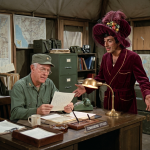
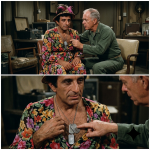
He was a magnificent, absurd vision in a vibrant, shoulder-baring floral dress that looked like it had been repurposed from a Toledo grandmother’s living room curtains. Klinger had accessorized perfectly. He wore sensible brown heels, a dark, neatly styled wig, and a posture that demanded absolute, undivided attention. His right hand was planted firmly on his hip, projecting a profound, dramatic confidence.
But it was the prop in his left hand that really sold the performance.
It was a large, hand-painted wooden sign, nailed somewhat crookedly to a sturdy post. In bold, unmistakable black lettering, it proudly declared: VOTE FOR KLINGER – BEST DRESSED CPL – 4077 MASH.
B.J. felt the heavy exhaustion instantly lift from his chest.
A gentle, dry smile spread across his face, creeping up into his eyes. He didn’t move from his spot against the doorframe. He just settled in deeper, perfectly content to enjoy the sudden matinee performance.
Radar, however, stopped dead in his tracks just inside the doorway.
He looked at Klinger’s floral print, then up at the wooden campaign sign, and then down at the official military paper in his own hands. The young clerk’s face was a portrait of sweet, innocent derailment.
“Gentlemen,” Klinger announced, his voice carrying the polished, projected cadence of a seasoned politician addressing his constituents. “The polls are officially open.”
Radar adjusted his glasses, blinking rapidly as his brain tried to process the surreal interruption.
“But… Klinger,” Radar stammered, holding up the paper. “I have an incoming message from I Corps.”
B.J.’s warm smile faltered just a fraction.
The mention of I Corps usually meant the illusion of peace was about to shatter. It meant a new offensive, a shift in the lines, or the distant, dreaded sound of chopper blades beating against the sky.
B.J. pushed himself slightly off the doorframe, his posture tightening. “Hold the presses, Radar,” he said softly, his voice dropping its humorous tone. “Is it wounded?”
Radar looked down at the crumpled paper, his eyes scanning the typewritten words again, just to be absolutely sure.
“Uh, no, Captain,” Radar said, his shoulders dropping with relief, though his face remained terribly confused. “It’s a memorandum about… proper requisition forms for standard-issue boot polish. They say we’re using too much.”
B.J. exhaled a long, quiet breath that he hadn’t realized he was holding.
The tension left his body as quickly as it had arrived. The smile returned to his face, warmer and wider this time. The war was still out there, grinding away in the hills, but for this exact minute, it was staying away from their doorstep.
“Well then,” B.J. said smoothly, crossing his arms again and turning his attention back to the colorful vision blocking the doorway. “I believe the candidate was speaking.”
Klinger gave Radar a look of profound, dramatic pity.
“Boot polish, O’Reilly?” Klinger sighed, shaking his head so the wig bounced slightly. “Have you no sense of civic duty? Look around you! We are living in a fashion wasteland. A tragic sea of identical green.”
Klinger stepped fully into the light of the doorway. He shifted his weight to pop his hip even further, letting the skirt of his dress swish softly against the heavy canvas tent flap.
“I am offering the voters of this unit a choice,” Klinger declared proudly, gesturing broadly with his free hand. “A choice for elegance. A choice for spring florals in the face of relentless khaki. I ask you, Captain Hunnicutt, as an officer and a gentleman, can you truly look me in the eye and say I don’t deserve the title?”
B.J. stroked his mustache, pretending to consider the political proposition with absolute, solemn gravity.
“It’s a tough race, Max,” B.J. mused, his eyes dancing with quiet amusement. “Corporal Judson in the motor pool wears his dog tags with a certain rugged, greasy flair. And Igor has that soup-stained apron that really brings out the despair in his eyes.”
Radar finally stepped forward, holding the radio message tightly against his chest like a protective shield against the sheer absurdity of the moment.
“But Klinger,” Radar said, his voice squeaking slightly with flawless, innocent logic. “You’re the only corporal in the whole camp who wears dresses. It’s not a fair election if you’re the only one running.”
Klinger lowered the heavy wooden sign just an inch, leaning his head toward the earnest young clerk.
“Radar, my boy,” Klinger said smoothly, tapping the side of his nose. “That is the brilliant, unbreakable cornerstone of my entire political platform. Why risk losing?”
B.J. chuckled softly, the sound rumbling quietly in his chest.
It was in these bizarre, unscripted moments—these tiny pockets of air between the blood and the mud—that B.J. felt the deepest, most aching affection for the people in this camp.
He looked at Klinger, standing there in a dress and heels, proudly holding a handmade sign in the middle of a war zone. Klinger wasn’t just trying to get a Section 8 anymore. B.J. had long suspected that the dresses, the elaborate stunts, and the sheer theatricality of Maxwell Klinger had evolved into something else entirely.
It was a public service.
Klinger was taking the grim, terrifying reality of the 4077th and reflecting it back to them as pure, unfiltered comedy. He was willingly playing the fool, giving them something to smile about when the world gave them absolutely nothing but grief.
“You know, Klinger,” B.J. said, his voice dropping its sarcastic edge, softening with genuine, quiet affection. “I think you’ve got my vote. In fact, I’d be honored to manage your campaign.”
Klinger beamed, his chest puffing out with immense pride beneath the floral fabric.
“Thank you, Captain,” Klinger said sincerely. “Your support is a testament to your refined taste and excellent breeding.”
He turned his attention back to Radar, wiggling his eyebrows expectantly. “Well, O’Reilly? Can I count on the crucial administrative vote?”
Radar looked at Klinger’s hairy chest, the delicate floral pattern of the dress, and the ridiculous, hand-painted wooden sign. A small, shy smile finally broke through his confusion.
“I guess so, Klinger,” Radar said softly, shrugging his shoulders. “You definitely dress a lot better than Igor.”
“Victory is in the air!” Klinger announced to the empty compound, his voice ringing out past the hanging lanterns and supply crates.
With a surprisingly graceful pivot on his sensible heels, Klinger marched off toward the mess tent, holding his wooden sign high above his head for the entire camp to see.
B.J. watched him go, leaning comfortably back against the doorframe, letting the warmth of the sun wash over him.
Radar stepped up beside him, still holding the completely useless message about boot polish. The two of them stood there together in comfortable silence for a long moment, listening to the muffled sounds of Klinger making his grand political pitch to a passing nurse.
“He’s crazy, isn’t he, Captain?” Radar asked quietly, though there was a deep, undeniable fondness in his tone.
B.J. kept his eyes on the retreating figure in the floral dress, the bright colors standing out defiantly against the dull Korean dirt.
“No, Radar,” B.J. said gently, a bittersweet smile playing on his lips. “I think he might be the most sane one here.”
In a place where everything was painted olive drab, true friendship was the only thing that kept their true colors from fading away.