The Catch-22 on Canvas
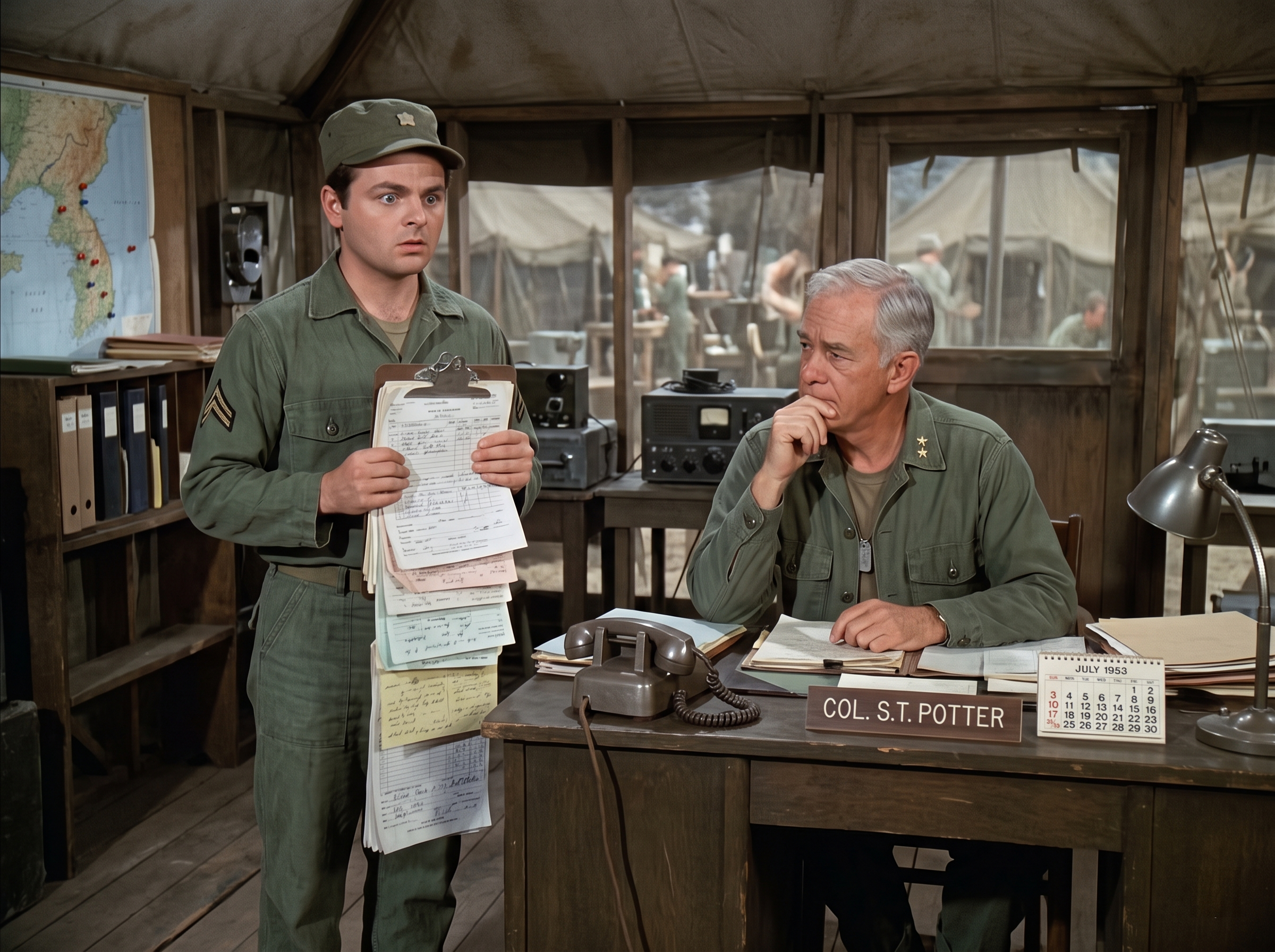
Colonel Sherman T. Potter had survived two World Wars, a horse that liked to bite, and a lifetime of army food.
But as he sat in his canvas-walled office on a quiet Tuesday afternoon, he felt entirely defeated by a piece of paper.
Actually, it was far more than a single piece of paper.
The afternoon sun was filtering through the mesh screens of the 4077th, casting warm, muted light across his practical wooden desk.
It highlighted the worn edges of his scattered folders and the heavy black plastic of the landline field phone.
It was a rare moment of peace in the Mobile Army Surgical Hospital.
There were no choppers in the sky.
There were no wounded in the OR.
There was only the soft, ambient hum of a distant generator and the settling dust of the Korean peninsula.
Potter had been enjoying the quiet, attempting to catch up on the endless mountain of routine paperwork that kept the army running.
Then, the screen door squeaked.
It didn’t open with a bang. It opened with the hesitant, careful squeak that could only belong to one person in the entire camp.
Corporal Walter “Radar” O’Reilly stood at attention before the desk.
He didn’t say a word at first. He didn’t have to.
The expression on the young man’s face spoke volumes.
Radar’s eyes were wide behind his round spectacles, swimming with a mixture of earnest concern and outright terror.
He looked like a small boy who had just accidentally broken the neighbor’s living room window.
But it wasn’t his face that caught Potter’s immediate attention.
It was the object Radar was clutching to his chest like a shield.
It was a clipboard.
But it was not a standard-issue clipboard.
Attached to the wooden board was a cascading waterfall of carbon-copied forms, taped end-to-end, trailing down past Radar’s knees and nearly brushing the dusty floorboards.
It looked less like an army requisition and more like an ancient, cursed scroll.
Potter stopped writing.
He slowly capped his fountain pen, placed it deliberately beside his leather blotter, and folded his hands.
He leaned slightly forward, his weary eyes fixing on the young corporal.
“Radar,” Potter said, his voice a low, gravelly rumble of dry amusement and fatherly exasperation. “What in the name of Marco Polo’s travel agent is that?”
Radar swallowed hard. His Adam’s apple bobbed nervously above his olive-drab collar.
“It’s Form 114-J, sir,” Radar squeaked, his voice pitching up half an octave.
“Form 114-J,” Potter repeated slowly. “And what, pray tell, does the United States Army require us to document on a form long enough to wallpaper the mess tent?”
“It’s an inventory addendum, sir. From I-Corps,” Radar explained, shifting his weight from one scuffed boot to the other.
“They’re doing a theater-wide audit of non-essential administrative office supplies.”
Potter stared at him. “Paperclips, Radar?”
“Yes, sir. And rubber bands. And thumbtacks. And…” Radar lifted the heavy clipboard, struggling to read the fine print halfway down the paper waterfall. “…and typewriter ribbons, black, standard, spool-type.”
Potter sighed, rubbing the bridge of his nose. “Fine. Count the paperclips. Fill it out. Send it off to the brass so they can sleep at night.”
“I did, sir,” Radar said, his voice trembling slightly. “I counted them all. Twice. I even checked under Klinger’s cot for stray thumbtacks.”
“Then what is the problem, son?”
Radar took a shallow, nervous breath.
“Well, sir… the form requires a stamp of authentication at the bottom of page twelve.”
“So stamp it,” Potter said gently, trying to maintain his calm control.
“I can’t, sir,” Radar whispered, his eyes widening in pure panic.
“Why not?”
Radar looked down at the sprawling mess of paperwork, completely overwhelmed by the crushing weight of military bureaucracy.
“Because, Colonel… the stamp of authentication they require… is the precise item that I have to report as missing.”
Silence fell over the small, modest military tent.
The heavy, warm air seemed to stand entirely still.
Colonel Potter remained perfectly frozen behind his wooden desk, absorbing the absolute, staggering absurdity of the situation.
He looked at the boy. He looked at the clipboard.
Then he looked at the heavy black field phone, half-tempted to crank it, call General Headquarters in Seoul, and resign his commission on the spot.
“Let me make sure I am fully digesting this horse pill,” Potter said quietly, his voice dangerously even.
“Yes, sir,” Radar squeaked.
“You have a form,” Potter began, raising one weathered finger.
“Yes, sir.”
“A form that is currently longer than a tall man’s shadow.”
“Yes, sir.”
“To report that we have lost a rubber stamp.”
Radar nodded miserably.
“And the only way they will accept this form, acknowledging that we do not have the stamp…” Potter paused, closing his eyes as a dull ache began to form behind his temples.
“…is if you stamp the form with the missing stamp.”
Radar gripped the edges of the oversized clipboard so tightly his knuckles turned white.
“That is the exact situation, Colonel,” Radar said, his voice dripping with earnest misery.
“I tried calling I-Corps supply, sir. I spoke to a Sergeant Zale in logistics. I explained the paradox to him.”
“And what did the good sergeant say?” Potter asked dryly.
“He said if the form isn’t submitted with the proper authentication by 0800 tomorrow, we are in violation of a Class-3 administrative directive.”
Radar’s lip gave a slight, barely perceptible quiver.
“Colonel, they’ll freeze our outgoing mail. No letters home. No Sears Roebuck catalogs. Just because I lost a little piece of rubber with the word ‘VERIFIED’ on it.”
Potter looked at the young man standing before him.
Underneath the oversized helmet of paperwork and the ridiculous army regulations, Potter saw exactly who Radar was.
He wasn’t just a soldier. He was a kid from Iowa, thousands of miles from home, terrified that his small mistake was going to hurt the people he loved.
Radar cared about this camp. He cared about the doctors, the nurses, and the mail that kept their spirits alive.
He carried the weight of the 4077th on his narrow shoulders every single day.
The weary exasperation in Potter’s chest instantly melted into a deep, paternal warmth.
He had seen a lot of brave men in his time, but there was a specific, quiet kind of bravery in a boy who stayed up all night counting paperclips just to keep his camp safe from the brass.
Potter let out a long, slow breath.
He opened his eyes, projecting the grounded, fatherly authority that had anchored this unit through so many dark days.
“Stand at ease, son,” Potter said gently.
Radar blinked, his rigid posture relaxing just a fraction. The long tail of the forms rustled softly against the floor.
“Radar, how long have you been in this man’s army?” Potter asked.
“Almost two years, sir.”
“And in that time, have you ever known the United States Military to make perfect, logical sense?”
Radar thought about it for a moment. He thought about Hawkeye in a Hawaiian shirt. He thought about Klinger in a floral print dress.
“No, sir. I guess not.”
“Exactly,” Potter smiled, a small, wry grin appearing beneath his gray mustache.
Potter pushed his chair back and stood up.
He walked around the sturdy wooden desk, closing the distance between the commander and his clerk.
He reached out and gently took the absurdly long clipboard from Radar’s trembling hands.
It was surprisingly heavy.
Potter walked back behind his desk and laid the endless scroll of paper flat across his blotter.
He opened his top desk drawer and rummaged around for a moment.
He pulled out a small, worn wooden stamp and a black ink pad.
“Colonel,” Radar warned nervously. “That’s the ‘REJECTED’ stamp. If you stamp it rejected, they’ll make us fill it out all over again.”
“I am well aware of what stamp this is, Walter,” Potter said calmly.
He pressed the rubber firmly into the black ink.
Then, with a swift, decisive motion, Potter slammed the stamp down onto the bottom of page twelve.
THWACK.
He lifted the stamp. There, in bold black letters, was the word REJECTED.
Radar gasped softly. “But sir…”
Potter held up a hand. He picked up his fountain pen, uncapped it, and leaned over the paper.
With quick, fluid strokes, Potter drew a single, thick line directly through the word REJECTED.
Right next to it, in his sharp, commanding cursive, Potter wrote the word: VERIFIED.
He then signed his name, Sherman T. Potter, Col. USA, with a sweeping flourish that took up half the page.
He capped the pen and handed the clipboard back to a completely stunned Radar.
“There,” Potter said, his eyes twinkling with dry defiance.
“It is officially verified by the commanding officer of this unit.”
Radar stared at the makeshift authentication. His mouth hung open slightly.
“Will… will they accept this at I-Corps, sir?”
Potter sat back down in his chair, folding his hands comfortably over his stomach.
“Son, if there is one thing I have learned in thirty-five years of military service, it is this.”
Potter offered a warm, reassuring smile.
“Bureaucrats don’t actually read the forms. They just count the signatures. You send that monster to Seoul, and I guarantee you, nobody will look at it twice.”
Radar stared at the paperwork, then looked up at his commanding officer.
The deep lines of worry that had been etched into the boy’s face completely vanished.
A slow, bright, earnest smile spread across Radar’s face.
The heavy, invisible weight he had been carrying all morning simply evaporated in the warmth of Potter’s office.
“Thank you, sir,” Radar said softly, his voice full of genuine gratitude. “Thank you very much.”
“Don’t mention it, Radar,” Potter replied quietly. “Now, get that monstrosity out of my sight before it reproduces.”
“Yes, sir!” Radar beamed.
He awkwardly gathered the trailing tail of the forms into a messy bundle, hugging them to his chest.
He threw a crisp, happy salute, which Potter casually returned.
As Radar hurried out the screen door, his boots stepping lightly on the dirt, Potter watched him go.
The office returned to its quiet, dusty stillness.
The distant chopper blades remained silent. The afternoon sun continued to paint warm, golden squares across the wooden floor.
Potter picked up his pen, pulled a standard, single-page medical report toward him, and shook his head with a soft, affectionate chuckle.
He was technically a commanding officer, a surgeon, and a career military man.
But most days, in the heart of the 4077th, he was just a father trying to keep his very large, very strange family from falling apart.
And as long as he had his ink pen, he figured they were going to be just fine.
Some battles are won with a scalpel, some with a rifle, and some with a single stroke of a fountain pen.