The Silence between the Rafters
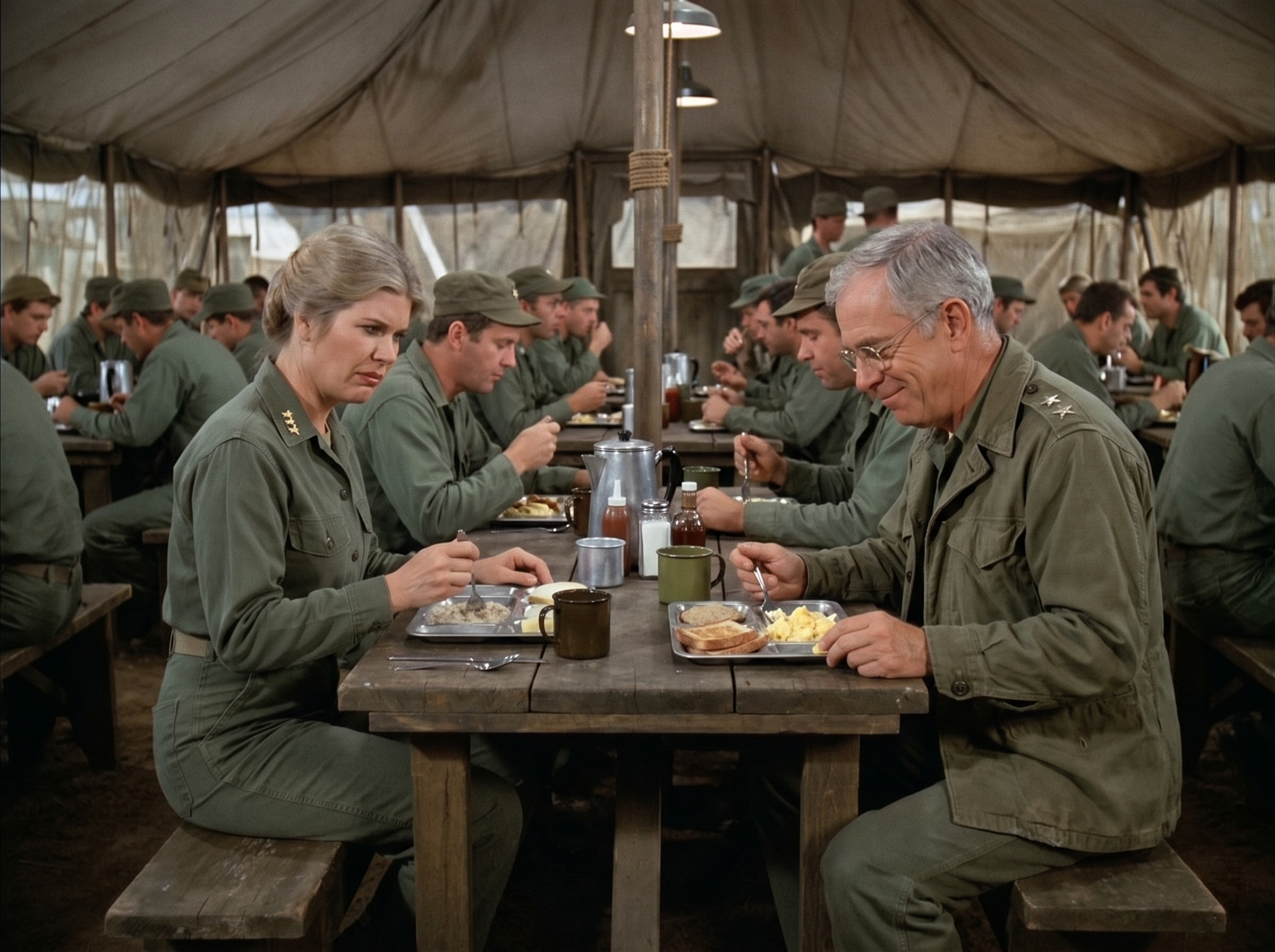
The mess tent always smelled the same: a stale cocktail of spilled gravy, powdered eggs, diesel fuel from the generator, and old, tired sweat.
Some days, you just learned to ignore it; other days, it hit you the moment you walked through the canvas flap, like a physical barrier you had to push through.
Today was one of those second days.
It was morning—or at least, the clock claimed it was morning—and the tent was packed with the usual sea of olive drab, the tired cacophony of a hundred men who hadn’t slept.
They were all the same, yet each completely different: faces masked in the same grey glaze of exhaustion, every shoulder slumped under the invisible weight of the 4077th.
Through the chaos, two people were sharing a simple wooden picnic table, a quiet island in the bustling storm.
Colonel Sherman Potter sat on one side, his glasses perched precisely, his grey hair a contrasting crown among the endless young faces.
He was wearing his M-65 jacket, zipped almost to the top, hands resting near a metal, compartmentalized tray.
Across from him sat Major Margaret Houlihan, her uniform crisp despite the wear, gold oak leaves gleaming on her collar, her posture impeccable even when she was bone-deep tired.
Her expression was professional, attentive, but perhaps a few degrees softer than her usual ‘Major’ demeanor.
He looked down at his breakfast tray, a small, weary smile playing on his face, while she watched him intently.
He wasn’t really seeing the scrambled eggs and dry toast.
He was looking at something much, much further away than the mess tent walls.
He was looking through the fog of Korea.
He was seeing Mildred.
It had been one of those nights, the kind that lasted forty hours, where the triage bell rang so many times it started to sound like a death toll.
Potter had operated standing up, and when he finally stopped, his old legs were shaking.
Margaret, too, had been a rock, her hands steady, her voice directing the nurses, refusing to crack.
They were both just… emptied.
So when they met by chance at the breakfast line, no words were spoken, just a tired nod that understood everything.
“Another Sunday morning,” Potter began softly, his voice low enough that it barely carried to Margaret.
He reached for a small shaker and carefully added a shake of pepper to his eggs.
“Yes, Colonel,” she replied, her own fork poised but motionless.
She wasn’t used to this version of the Colonel; usually, he was the rock, the voice of authority, or a man telling a quick, witty anecdote about his old horse, Sophie.
This version was… vulnerable.
“Do you know what Mildred always used to do on Sunday mornings?” he asked, a twinkle finally returning to his eyes.
He didn’t wait for her to answer.
“She’d make pancakes—real buttermilk ones, with fresh blueberries from the bush right outside our window—and then we’d take Sophie out. Just a gentle walk. The air in Hannibal always smelled sweeter on Sundays.”
Margaret’s eyes softened, a distant look mirroring his own.
She could picture it: a peaceful Missouri farmhouse, a man and his wife, a horse, a moment of simple, predictable quiet.
“That sounds… perfect, Colonel,” she whispered, her voice tightening slightly.
“It was,” he agreed, picking up his ceramic mug.
“The best part wasn’t the food, or the horse, or even the air.“
He looked at her then, his eyes a direct conduit of thirty years of shared love and deep longing.
“The best part,” he said, his smile wavering just for a second, “was that we never spoke a word.“
“Because the silence was enough.”
Margaret’s professional mask cracked, just for a moment, the emotional high point hitting her like a silent ache, and she could feel the stinging threat of tears behind her eyes.
The surrounding mess tent suddenly seemed to fall away, the clatter of silverware and the buzz of conversation becoming a muffled, background hum.
For a heartbeat, they were the only two people in the world.
A profound, bittersweet ache settled into the small space between them, heavier than the canvas rafters.
They were bound by this shared, silent understanding of what they had lost, and what they was desperately fighting to get back.
Margaret swallowed hard, fighting down the lump in her throat, refusing to let the emotion break her entirely.
She was the Head Nurse; she couldn’t afford a moment of weakness, not in front of him, and certainly not in front of the troops.
Instead, she took a slow, deep breath, stabilizing herself, focused purely on the strength that was expected of her.
“The best kind of silence,” she finally said, her voice steady now, but lacking its usual command, sounding simply… human.
Potter smiled back, not a tired or weary smile, but one of genuine understanding, a quiet acknowledgement of her struggle and her strength.
He had seen everything, from two world wars to the darkest hours of this current conflict, and he knew a fighter when he saw one.
“Precisely, Major,” he replied, his fatherly tone returning, a subtle signal that the moment of vulnerability was over.
He lifted his metal spoon, the small, reflective surface briefly catching the dim mess tent light.
“Well,” he added, his voice regaining its familiar, authoritative resonance.
“We may not have buttermilk pancakes, blueberries, or even particularly good coffee, but we have this.”
He gestured with his spoon towards the metal tray and the surrounding chaos.
“It ain’t Hannibal, but for right now, it’s ours.”
Margaret offered a small smile, not her usual brittle one, but one that was genuine and soft, acknowledging his resilience.
“Indeed, Colonel,” she said, finally bringing her own fork to her mouth.
“And I suppose powdered eggs are… sustenance.“
They both chuckled, a low, quiet sound that was intimate and private in the middle of the crowded tent.
It was a shared, dry joke, a tiny moment of normalcy and shared humanity that gave them both the strength to continue.
The tension evaporated, replaced by a deep, comfortable companionable quiet.
They ate in that same comfortable silence that Potter had spoken of, a silence that needed no words, no explanation, no comfort.
It was enough.
They were two soldiers, two survivors, two people who had seen too much and fought too hard, sharing a simple moment of peace.
The fatigue remained, a constant ache in their bones and a shadow behind their eyes, but it didn’t feel so heavy anymore.
The mess tent was still filled with the noise and the chaos of war, but their small corner was calm, a little oasis of shared memory and profound, silent friendship.
And in that quiet moment, surrounded by the ghosts of what they had lost and the hope of what they would return to, they knew they would be alright.
They would be alright, because they had each other.
Because the silence was indeed, enough.
They had little, but in the end, it was always the silent moments that kept them whole.