A Toledo Soliloquy at the Crossroads
The afternoon sun over the 4077th was unforgiving, baking the dirt compound into a fine, choking dust. It was one of those rare, agonizingly quiet lulls between the choppers.
It was the kind of quiet that made the mind wander, usually to places it had no business going.
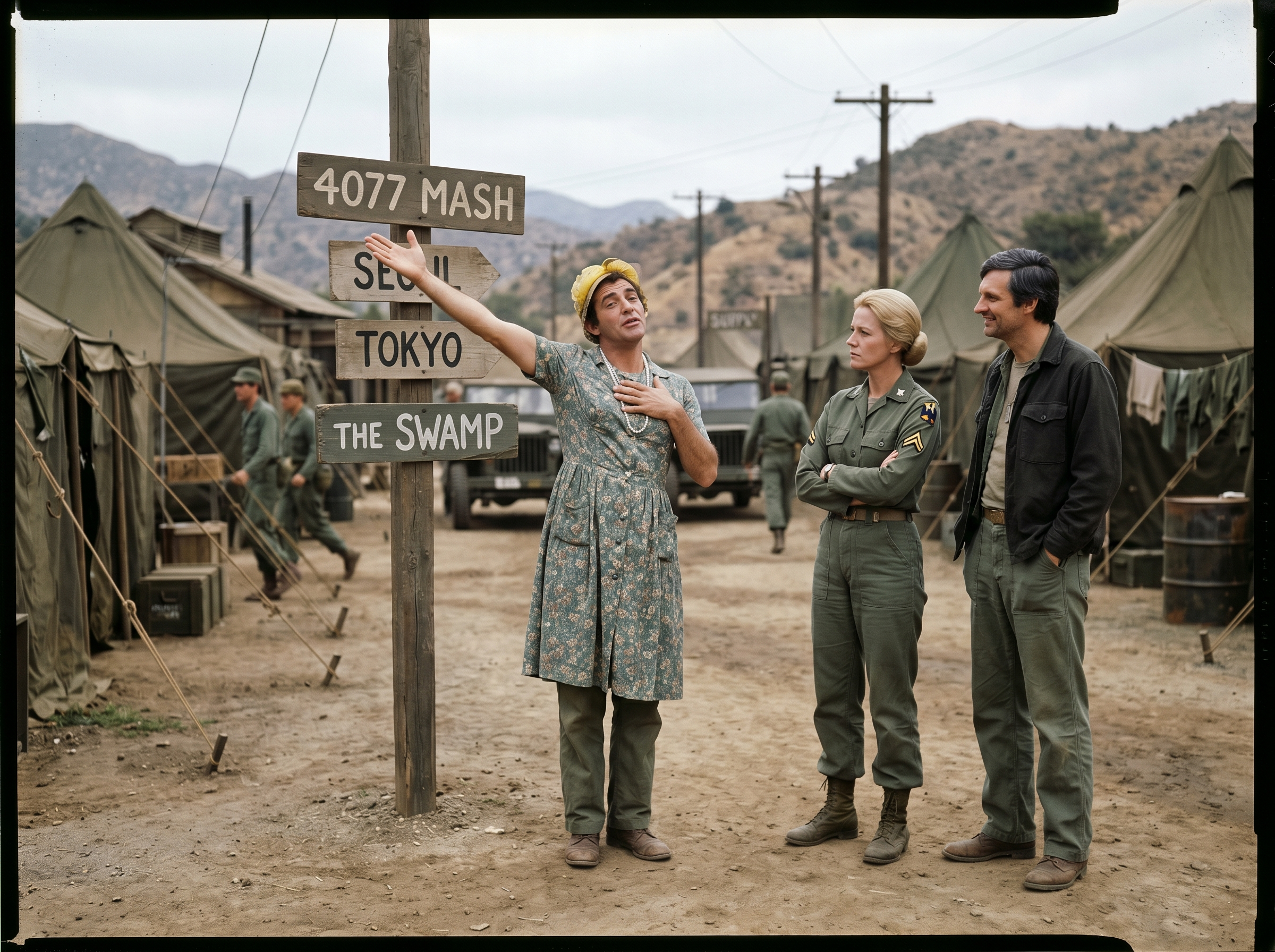
Major Margaret Houlihan and Captain B.J. Hunnicutt were walking across the compound, both thoroughly exhausted and running on stale mess tent coffee.
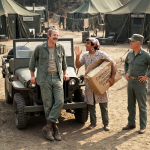
They didn’t have to look hard to find the day’s entertainment. Standing dead center at the camp crossroads, right beneath the wooden signpost that pointed to cities thousands of miles away, was Corporal Maxwell Klinger.
He was a vision in faded, clashing patterns, striking a pose so intensely theatrical it belonged on a Broadway stage rather than a Korean dirt patch.
Klinger had one hand dramatically pressed to his chest, making a grand, sweeping gesture. He was wearing an unseasonably warm, brightly patterned shirt, projecting a magnificent, comic pride.
“I tell you, Captain! Major!” Klinger bellowed, his voice echoing off the canvas tents. “The spirit is broken! The mind has completely and utterly shattered into a thousand tiny pieces of Toledo glass!”
Margaret stopped in her tracks. She folded her arms tightly across her crisp military shirt. Her expression was a masterclass in skeptical, dignified restraint.
She had seen a hundred Klinger performances, but this one had a particularly relentless flair. She narrowed her eyes, maintaining her composure under the comic pressure, waiting for the punchline or the inevitable request for a Section 8 discharge.
Beside her, B.J. simply stood with his hands resting easily, offering a gentle, ironic smile. He was the grounded, steady counterweight to Klinger’s soaring theatrics.
“It’s a tragic sight,” B.J. murmured softly, addressing Klinger with quiet amusement. “What’s the diagnosis today, Max? Demonic possession? An allergy to khaki?”
“Worse, Captain!” Klinger gestured wildly at the wooden arrows above his head. “I am suffering from acute, terminal displacement! My soul is currently standing outside Tony Packo’s eating a hot dog, while my body is trapped in this olive-drab purgatory!”
He pointed an accusing finger at the signpost. “Look at it! ‘Toledo, 8,724 miles.’ It’s mocking me, Major. It’s actively mocking a dying man!”
Margaret let out a sharp, exasperated sigh. “Corporal, the only thing dying around here is my patience. Put your arm down before you dislocate your shoulder.”
But Klinger didn’t drop the pose. Instead, he took a step closer, his dark eyes wide and suddenly very tired. He reached out, his voice dropping an octave from its usual comedic pitch.
“But that’s just it, Major,” Klinger said, the theatrical bravado abruptly wavering. “I can’t put it down. I close my eyes, and I can hear the streetcars. I can smell the river.”
He looked around the barren, dusty camp, his hands falling slowly to his sides. The sudden silence in the compound was heavy, thick with something painfully real.
“…and when I open them, I’m just here,” Klinger whispered, staring at the dirt. “And I don’t think I can do ‘here’ today.”
Margaret’s rigid posture stiffened even further, but her sharp gaze faltered. She opened her mouth to issue a reprimand, but the words caught in her throat. The joke was suddenly gone, leaving only the raw, unmistakable ache of a man who was quietly breaking.
For a long moment, nobody moved. The dusty wind swept through the camp, flapping the loose canvas of the tents in the distance.
Margaret’s arms remained crossed, but the severe, commanding tension in her shoulders melted away. The skeptical set of her jaw softened into something that looked dangerously close to sympathy.
She knew the unwritten rules of the 4077th. You joked, you drank, you yelled, but you never, ever let the homesickness drag you all the way under. If one person went under, they all did.
B.J. shifted his weight, his gentle smile fading into a look of quiet, profound understanding. He stepped forward, bridging the small gap between the officers and the heartbroken corporal.
“It’s a long way, Max,” B.J. said softly, his voice a steady anchor in the swirling dust. “Eight thousand miles is a lot of dirt and water. It’s enough to make anyone feel a little lost.”
Klinger looked up, blinking rapidly. He wiped a hand quickly across his face, trying to resurrect the comedic dignity he had just abandoned.
“I had a whole speech planned, Captain,” Klinger muttered, giving a weak, self-deprecating chuckle. “I was gonna threaten to tie myself to the signpost until Colonel Potter called General MacArthur personally. It was gold. Pure Klinger gold.”
“I’m sure it would have won an Academy Award,” B.J. said warmly, offering a comforting, relaxed presence. “But you don’t need a script today. We all hear the streetcars sometimes.”
Margaret slowly uncrossed her arms. She took a deliberate step forward, her boots crunching softly on the gravel. She didn’t offer a hug or a soft touch—that wasn’t Margaret. But her presence was steady, offering a quiet, fiercely protective strength.
“Corporal,” Margaret said, her voice completely stripped of its usual military bark. It was low, clear, and unexpectedly tender.
Klinger stood a little straighter out of habit. “Yes, Major?”
“Do you know how many bases I’ve lived on since I was a little girl?” Margaret asked, looking up at the signpost. Her eyes drifted over the names of places she had never called home.
Klinger shook his head slowly.
“Dozens,” Margaret continued, a bittersweet edge to her tone. “I grew up packing bags. I never had a Toledo. I never had a hometown with a favorite hot dog stand or a streetcar I knew by heart.”
She turned her gaze back to Klinger, offering him a rare, genuine expression of understanding.
“It is a terrible thing to miss a place so much it hurts,” Margaret said quietly. “But it is a beautiful thing to have a place worth missing.”
Klinger stared at her, genuinely stunned by the admission. The theatrical survivor, always ready with a scam or a joke, was completely disarmed by the regular army major’s vulnerability.
B.J. smiled, a quiet pride shining in his eyes as he looked at Margaret. He knew how much it cost her to lower her armor, even for a second.
“The Major is right, Max,” B.J. added. “Toledo is waiting for you. It’s not going anywhere. The streetcars are still running. You just have to hold on a little longer so you can get back to them.”
Klinger let out a long, shuddering breath. The heavy, suffocating weight of the afternoon seemed to lift just a fraction. He looked at B.J., then at Margaret, seeing not his commanding officers, but two utterly exhausted people who were standing in the dust right beside him.
“It’s the smell of the garlic, mostly,” Klinger said, his voice finally finding a bit of its old, dramatic bounce. “You can’t find decent garlic in this whole country. It’s a culinary tragedy.”
Margaret sighed, her professional mask slipping back into place, though the warmth remained in her eyes. “If you start complaining about the food again, Corporal, I will personally assign you to peel onions for a week.”
“Onions! A delicacy!” Klinger declared, stepping back and striking a new, slightly less frantic pose. “Why, back in Toledo, a good onion is treated with the respect it deserves!”
B.J. chuckled, the sound rich and grounding. The crisis had passed. The fragile thread that held them all together had stretched, but it hadn’t snapped.
“Come on, Max,” B.J. said, turning toward the tents. “Let’s go see if Hawkeye has managed to distill anything that tastes remotely like an Ohio beverage. It’s doubtful, but we can dream.”
“Captain, you are a saint,” Klinger said, giving a sweeping, theatrical bow.
He turned to walk away with B.J., but paused. He looked back at Margaret, who was still standing by the signpost, her arms folded once again, her posture perfectly straight.
“Thank you, Major,” Klinger said, perfectly serious for one fleeting second.
Margaret gave a brief, imperceptible nod. “Carry on, Corporal.”
Klinger bounded off after B.J., his faded shirt bright against the drab canvas background. Margaret stood alone for a moment longer, looking up at the wooden arrows pointing to nowhere in particular.
She took a deep breath of the dusty air, adjusted her collar, and turned back toward the hospital. It was a long way home for all of them, but as long as they were standing together in the dirt, the distance didn’t feel quite so impossible.
In a place where tomorrow was never promised, the greatest comfort they had was simply each other.