The Toast in the Officers’ Club
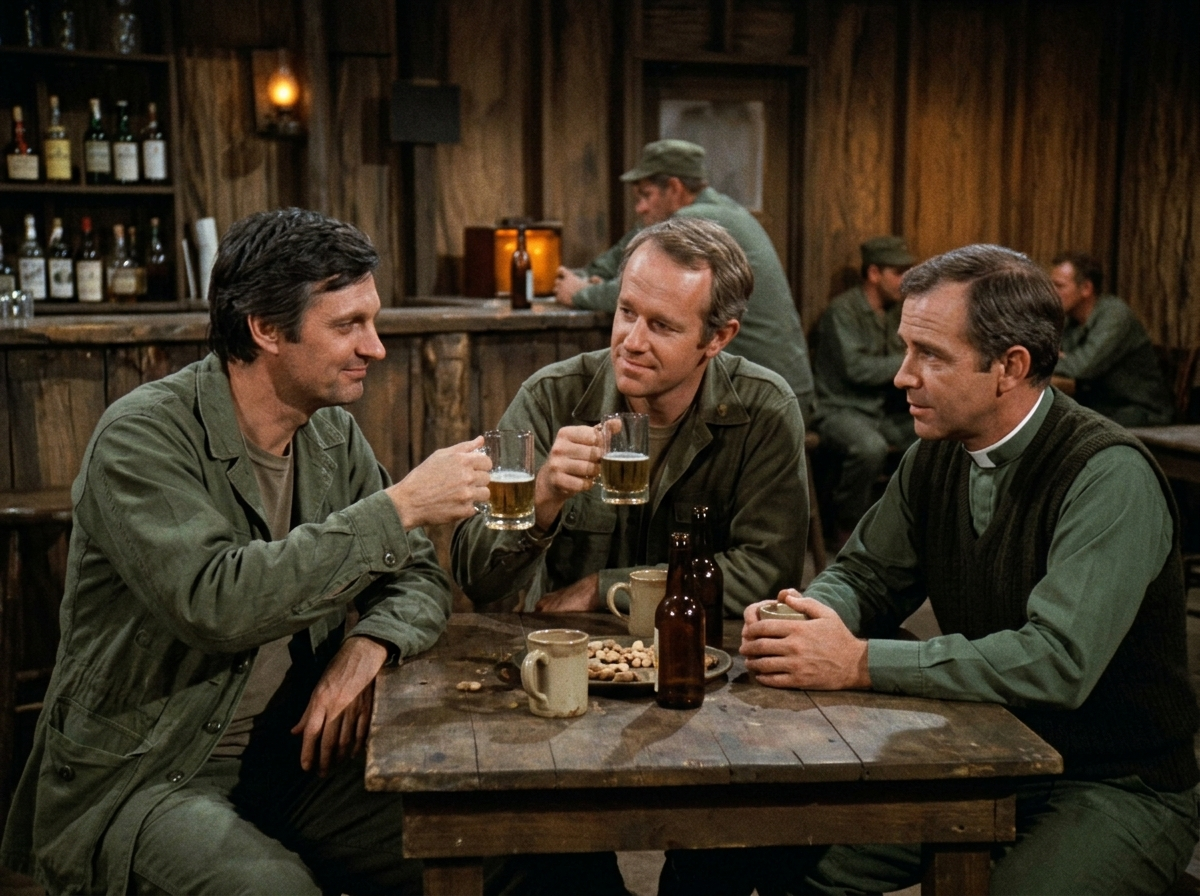
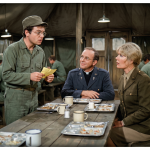
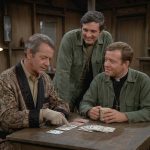
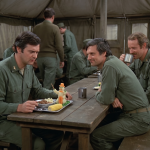
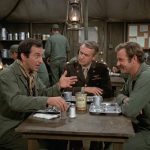
The lighting in the Officers’ Club was dim, but the expressions around the rustic wooden table were bright. It was a rare, quiet moment between long OR shifts and relentless shellfire. The three officers in the center of the image looked remarkably composed, as if the madness of Korea was just a distant hum.
Captain Hawkeye Pierce had a look on his face that mixed mischief with unusual contentment. His arm was extended, glass raised, seemingly making a dramatic point, or perhaps just enjoying the chance to not be operating for an hour. Captain B.J. Hunnicutt, looking equally comfortable, met his gaze with a warm smile, raising his own mug. His face was a mirror of simple human warmth, the kind he worked so hard to find in this gray landscape.
And then there was Father Mulcahy, positioned quietly to the side. He wasn’t clinking a beer mug. He had his hands clasped, resting on the worn table, looking past the toast to a deeper thought. His quiet, focused stare suggested he was seeing something more than just friends sharing a drink. His green vest and dark collar marked him, yet his expression belonged entirely to the brotherhood of those three men, sharing a space where rank and duty dissolved into shared humanity.
“Here’s to the longest hour in history,” Hawkeye said, his voice unusually soft. “The hour we get to keep our sanity.”
B.J. smiled, a genuine smile that started in his eyes. “And to the finest neighbors the 4077th ever housed.” He gave a slight nod.
The third person in the image, Father Mulcahy, didn’t raise a glass, but his heart was present. He lowered his eyes, and said, barely above a whisper, “To the hope that this hour… and this peace… may one day become a lifetime.”
The small, quiet space seemed to shrink as their focus locked onto his whispered hope. It wasn’t just a toast. It was a plea, and in that fragile, fleeting second, the laughter from other tables seemed to fade away, leaving only the sound of three men holding their breath, waiting for a reality that felt painfully distant, and desperately needed.
The simple statement from the priest, so earnest it felt like it had weighted the very air, held them for a long moment. It was the absolute, unshakeable truth, and it always landed heavily in a room built on manufactured distractions.
B.J. shifted slightly, his mug pausing in its descent. He didn’t want to break the spell Mulcahy had cast, but he also needed to move the conversation away from the heartbreaking reality that always tried to creep in. He knew if they stayed focused on ‘the long view’ too long, the short-term reality would crush them.
Hawkeye felt it too. The tenderness in the image—of him holding his mug high, looking at his friends—was precisely why he knew he had to crack a joke, or let the joke crack him. He was the pressure valve.
He cleared his throat, but instead of a punchline, he simply locked eyes with B.J., a deep, shared understanding passing between them, the kind that replaces words. The smile that had softened his features remained, but a shadow of profound fatigue seemed to touch his brow. He didn’t drop the mug.
“The hope is always the hardest part, Father,” B.J. finally said, lowering his eyes to the small bowl of peanuts on the table.
Hawkeye raised his glass again, higher this time, an defiant arc of glass against the dark wooden beams of the bar in the background of the image. “Here’s to never giving it up, especially when it feels impossible.”
B.J. then clinked his mug firmly against Hawkeye’s, and the sound resonated with a singular clarity. It was a promise, as solid and sturdy as the pine wood beneath their elbows.
Father Mulcahy, seeing this simple exchange, smiled a quiet, warm smile, not needing a drink to partake. The image captures the tender truth of their friendship: the silent agreement to be each other’s strength, and when necessary, each other’s sanity. In that worn room, with the blurry shapes of other officers drinking at the bar and other tables, these three men created a sanctuary.
They shared a small communion of friendship and shared hope, a fragile peace that was sometimes all that kept the war at bay.