The Potato Snowman that Saved the World
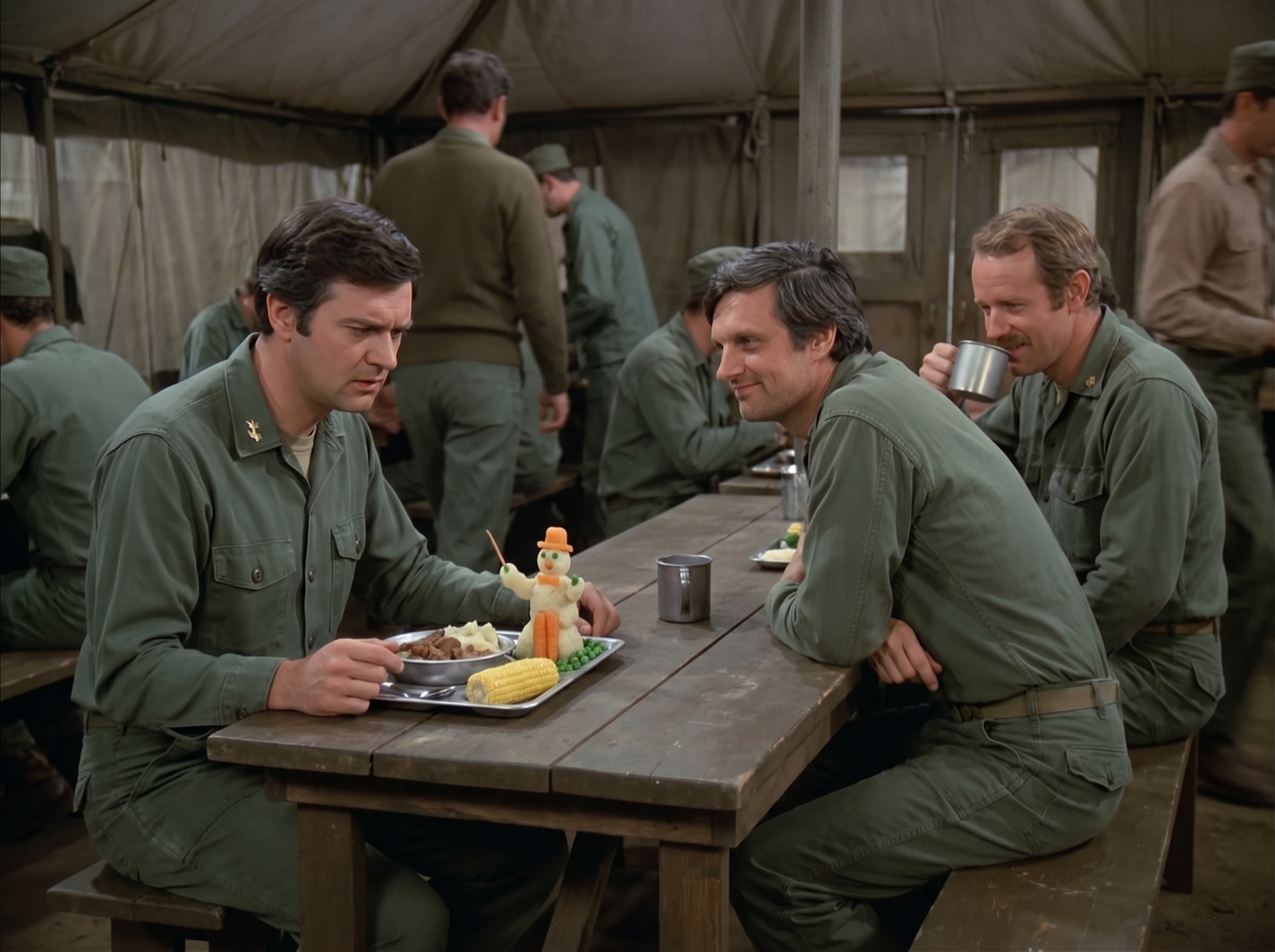
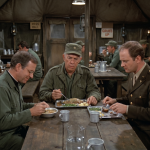
The Mess Tent at the 4077th was usually a battleground in itself, a sensory assault of clanging metal, tired arguments, and the smell of whatever culinary atrocity Igor had cooked up from the weekly rations. On this particular Tuesday, though, things were different. The atmosphere was unusually quiet, thick not with the usual chaotic energy, but with a palpable, draining weariness. A recent, brutal O.R. session had left everyone hollowed out, their faces etched with fatigue and a quiet, shared grief for those they couldn’t save.
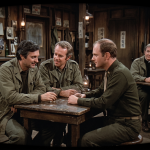
At one corner table, the two roommates and constant companions, doctors Hawkeye Pierce and B.J. Hunnicutt, sat nursing their lukewarm coffee and even more lukewarm enthusiasm for the day. Hawkeye, always the manic wire-puller, was unusually subdued, his eyes distant as he stared into his cup. B.J., usually the steady emotional anchor, was slumped over, the slight mustache a little more drooping than usual. Across from them sat Major Charles Emerson Winchester III, a man of refined tastes hopelessly trapped in a world of industrial-strength stew and olive drab everything.
Their conversation was non-existent. The usual banter, the dry humor, the shared complaints—it was all gone, swallowed by the oppressive silence. Hawkeye finally sighed, a sound that seemed to carry the weight of the entire camp. “If only,” he mumbled, “there was some way to… I don’t know… inject a little… life into this place. A little joy. A little… something.”
Just then, the mess tent door creaked open, and a diminutive figure scurried in, carrying a small, precarious-looking wooden crate. It was Corporal Radar O’Reilly, the camp’s unassuming quartermaster, a beacon of naive hope in a landscape often devoid of it. He navigated the crowded room with practiced ease, heading straight for the doctors’ table.
“Sirs! Sirs!” he announced, his voice a quiet, eager squeak, “Look what the supply truck dropped off this morning! They said it was… *unconventional*.”
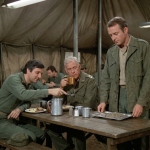
Radar carefully placed the crate on the table, right next to Winchester’s impeccably arranged (and largely untouched) tray of whatever passed for dinner. Inside the crate was a strange and wonderful assortment of vegetables: bright orange carrots, fresh-looking celery stalks, several large potatoes, and even a handful of radishes.
Hawkeye looked up, a glimmer of interest cutting through his fatigue. “Radar, you beautiful soul. A supply drop that isn’t just tinned beef and powdered eggs? Miracles do happen!” He reached in and examined a particularly smooth potato.
Winchester, ever the critic, adjusted his glasses. “Yes, well, it’s… fresh. A rare commodity indeed. But hardly a substitute for proper sustenance.”
Radar, however, had a mischievous glint in his eye. “Oh, it’s not just food, Major. Not just at all.” He glanced nervous, then grinned. “Look what I made you.”
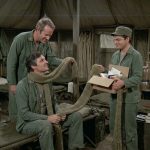
Radar slowly pulled a second, smaller, and highly irregular creation from behind his back. It was a snowman. But not made of snow. It was built from the very fresh vegetables he had just delivered.
The body was a lumpy, expertly carved potato. The head, a smaller potato. The arms? Thin, spindly carrots. The nose, of course, was a tiny piece of carrot sticking straight out. But the masterpiece was the hat: a tiny, orange carrot stump, perfectly sliced and placed on top.
“Look!” Hawkeye chuckled, the first genuine smile breaking through his face in hours. “A snowman in Korea! And it doesn’t even melt! It’s… a work of art, Radar.”
B.J. smiled too, his own tired face softening. “It’s… well, it’s very creative, Radar. A nice touch.”
Winchester just stared, his mouth a slightly wider than usual ‘O’. “A snowman,” he said, flatly, “made of… potato.”
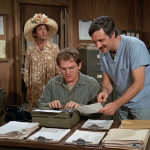
Suddenly, the silence in the mess tent shattered. A large group of soldiers, led by a surprisingly ebullient Corporal Klinger (dressed, for reasons known only to him, in a feather boa and a very loud skirt), burst in, all eyes drawn to the object on the doctors’ table. Laughter, genuine, loud laughter, echoed through the once-subdued tent.
In that small, vegetable-based miracle, a shift had begun. But it wasn’t just laughter. A silent challenge hung in the air. This was the 4077th, after all. A moment of joy could be fleeting, but it could also be the spark for something more… competitive. The eyes of every soldier, tired though they were, fixed upon the potato snowman, and then, slowly, toward each other. A ripple of unexpected competition was beginning to take hold of the tent.
The tension in the mess tent shifted from the oppressive silence of exhaustion to something else entirely. It was a kinetic, almost physical shift. The sight of the tiny potato snowman hadn’t just amused the weary inhabitants of the 4077th; it had awakened a sleeping, competitive spirit that only this group of people, trapped in their surreal reality, could possess.
Klinger, in his full feather boa glory, leaned in close to the table, eyes narrow and calculating. He didn’t see a silly potato snowman; he saw an opportunity. “You know, Radar,” he drawled, his voice a mix of theatrical gravel and low-rent swindle, “it’s charming. Really. Very… rustic. But it lacks… panache. *Elegance*.”
Hawkeye, sensing a performance, leaned back in his seat, a wide, tired grin spreading across his face. “Panache, Klinger? In a *mess tent* in *Korea*? What would that even look like?”
“What *would* it look like?” Klinger retorted, gesturing wildly with his feather boa, which only succeeded in getting caught on his own shoulder pad. “It would look like *this*.”
And before anyone could stop him, Klinger whipped off his elaborate, sparkly high-heeled shoe—the same one he claimed had belonged to Ava Gardner’s second cousin—and smashed it onto the table. “Gentlemen,” he declared with all the gravitas of a Shakespearian actor, “I present: The First Annual 4077th Great Potato-Sculpting Competition! To the victor goes… well, my other shoe. But more importantly: **Glory**!”
The tent, for a split second, went silent. A collective pause, as everyone absorbed the ridiculousness of the proposal. Then, a roar of approval. Soldiers immediately scrambled to grab the freshest, biggest potatoes from the crate that Radar had brought, and soon, the mess tent table was transformed from a site of indifferent dining into a frantic, low-stakes artist’s studio.
Hawkeye and B.J. exchanged a look of pure, delighted chaos. Their exhaustion was forgotten, replaced by a surge of childish energy. Hawkeye, eyes twinkling with a manic glee, began frantically carving, his medical scalpel proving to be a highly effective sculpting tool. He was muttering to himself, deep in concentration, something about a “Cubist approach to carbohydrate anatomy.”
B.J., true to his steady nature, took a more measured approach. He sat quietly, eyes focused, carefully peeling a potato with meticulous detail. “I’m going for realism, Pierce,” he murmured, never looking up from his work. “A tribute to the noble spud. A ‘Potato Pieta’, if you will.”
Winchester, of course, refused to participate directly. Instead, he took on the role of arbiter of taste. He stood above the table, monocle firmly in place (which he only used for important evaluations, and also when he was really annoyed), judging each entry with a critical eye.
“This one here,” he said, dismissively pointing to a soldier’s lumpy attempt that bore a striking resemblance to a badly injured turnip, “lacks artistic vision. It’s a tragedy. A blight upon the agricultural community.”
He moved to another soldier’s creation, a surprisingly detailed, three-headed Cerberus-like potato. Winchester paused, his monocle gleaming. “Interesting. The symmetry is compelling, and the texture… well, it’s undeniably potato-like. A passable effort.”
The noise level in the tent grew and grew. Laughter, playful arguments over who had the best carving technique (“It’s all in the wrist, Igor, the *wrist*!”), and the genuine cheer of shared, utterly meaningless activity. For twenty minutes, the 4077th wasn’t a MASH unit in a war zone; it was a bizarre art class full of people desperate for an escape.
And for twenty glorious minutes, the original potato snowman that had started it all—the small, modest, vegetable miracle—stood watch. It sat slightly to the side on B.J.’s tray, overlooked by most in the frantic rush to create something bigger, bolder, and more competitive. It was the humble catalyst that had unleashed a wave of unexpected joy and community.
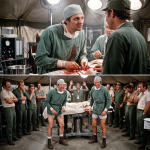
Then, just as the competition was reaching its peak of frenzied, carbohydrate-based creativity, the familiar, awful sound of the PA system crackled to life. It was Colonel Potter’s voice, steady and fatherly, but this time, it carried a familiar urgency. “All personnel, all personnel! We’ve got incoming choppers. Multiple wounded. O.R. personnel to the operating room. **This is not a drill.**”
The effect was instantaneous. It was as if someone had sucked all the oxygen and color out of the room. The laughter died, the arguments ceased, and the playful energy evaporated, replaced by the grim, familiar reality of their mission. Carving tools were dropped, potatoes were abandoned, and the mess tent emptied in seconds. Soldiers, surgeons, nurses, all filed out with grim efficiency, their moments of respite, of shared joy, over just as quickly as they had begun.
In the sudden, heavy silence, the table was a chaotic landscape of unfinished potato masterpieces. Half-carved heads, poorly defined limbs, and the very elaborate three-headed Cerberus stared back, reminders of a brief, beautiful detour into silliness.
Hawkeye and B.J., their scalpel-wielding hands now needed for a very different kind of carving, took one last look. They didn’t say anything. They didn’t need to. They shared a tired, meaningful look, the kind you can only share with someone you’ve been through a war with. The memory of the brief, absurd joy, the shared laughter, the moment of pure human connection, remained, a fragile, important counterpoint to the impending storm.
They turned and walked out, their footsteps heavy. And on the table, alone and untouched, the humble, original potato snowman stood watch, the last, silent witness to the fleeting moment of grace, a quiet, vegetable-based beacon of humanity in a place that desperately needed it.
They went back to saving lives, but for twenty minutes, they had saved each other.