A Shelter and A Symphony in the Mud
Sometimes the hardest thing to find in a war is just one moment of ordinary peace.
The Swamp was quieter than usual, though it was still a damp canvas box filled with weary men, but it held a strange, fragile balance this evening. For one short hour, the sounds of mortars and medical jargon were outside. Inside, it was just home.
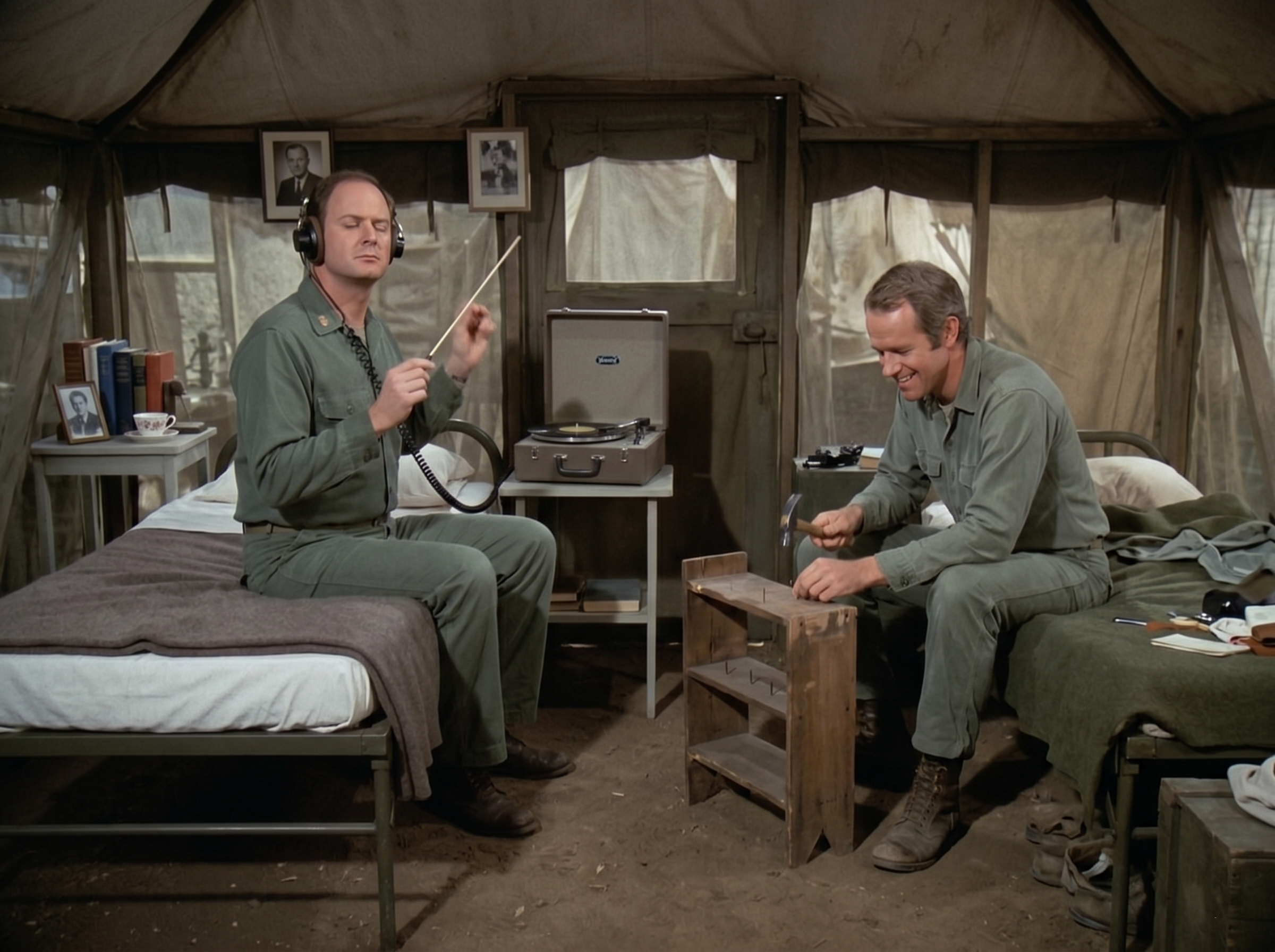
Charles Emerson Winchester III had built a fortress. He sat straight-backed on his bunk, the brown blanket stretched tightly beneath him. On his head were the large, black padded headphones, his only protection from the mundane realities surrounding him. His eyes were tightly closed, a look of sublime concentration smoothing the usual tension lines on his face. In one hand, held aloft and moving with exquisite precision, was his conductor’s baton, guiding an invisible Boston Symphony Orchestra. The tiny portable record player behind him spun silently, radiating a sound only he could hear. It was his sanctuary, and he was fiercely defending it with silence.
Opposite him, on the next cot over, B.J. Hunnicutt was also deep in construction. B.J. wasn’t building symphonies; he was building order. He was carefully assembling a small wooden shelving unit, using a hammer to tap small brass screws precisely into place. It was a sturdy, simple project, a piece of home he could physically assemble in this godforsaken mud pit. Every tap of the hammer on metal was a distinct *ting-ting-ting* that reverberated through the canvas.
For the last ten minutes, they had co-existed in this delicate stalemate. B.J. was fully engrossed in his manual labor, grinning slightly as the wood joined together. He tried to keep his taps rhythmic, almost as if he were trying to match the *silent* symphony Charles was conducting. He peeked over at Charles, a slight smile on his face, observing the other man’s total immersion. He knew Charles despised ‘clattering,’ and he was trying to work as quietly as possible, but the very nature of a hammer made it difficult. He hoped Charles wouldn’t notice.
Charles, for his part, felt every vibration of the tiny hammer *through* his headphones and his spine. Each subtle *ting* B.J. made was like a jagged needleprick in the perfect velvet soundscape he was creating in his mind. He didn’t want to break the spell. He was conducting Beethoven’s Sixth—The Pastoral—and he was just entering the storm. The mental sound of strings and brass was swelling. And then, he felt B.J.’s hammer hit again. *Ting.*
His eye twitched, though his eyes remained closed. He could feel B.J. looking at him. Charles raised the baton slightly higher, gesturing a louder crescendo to drown out the noise in his soul. *Ting.* The real battle was about to begin.
B.J. finally made a mistake. His hammer slipped ever so slightly, hitting the wood frame next to the screw head with a definitive, clunky *THWACK*.
It was the tipping point. The silence in The Swamp was instantly shattered.
Winchester froze, the baton stopping mid-air. He opened one eye slowly, leveling a glare at B.J. that could freeze water in a desert. B.J. dropped the hammer onto the dirt floor and immediately looked like a schoolboy caught passing notes.
“I heard that, Hunnicutt,” Charles said, his voice dropping into that refined, low bass rumble.
“Heard what, Charles?” B.J. asked, trying for innocent and failing miserably, still suppressing his smile.
“That… that uncultured *clattering*!” Charles exclaimed, removing the headphones. “You are systematically disassembling my sanctuary, Hunnicutt! I am trying to conduct a delicate and emotional pastoral symphony, and you are… are… *carpentry-ing* it to death with your clumsy little hammer!”
“I was just assembling a simple spice rack, Charles,” B.J. offered, standing up and holding the unfinished project toward him. “It’s very sturdy. No nails, just screws.”
“I do not care if it is a mahogany cabinet for the King of England!” Charles snapped. “It is interfering with the arts! Is there no place in this entire camp for aesthetic peace?”
“I know a place,” came a tired voice from the doorway. Hawkeye Pierce stepped in, his boots caked with mud, dropping his medical bag. “It’s called The O.R. If you guys can manage to keep this up, I’m sure Colonel Potter would be happy to assign you both to double-shifts and get some of that *artistic energy* out of your systems on something useful.”
Charles scoffed. “Typical. Artistry is always dismissed by the pedestrian mind.”
“Speaking of pedestrians,” Hawkeye continued, sitting heavily on his bunk and pulling off a boot, “if B.J. finishes that rack, and you, Maestro, finish your imaginary concert, maybe we can actually have dinner tonight without using the floor.” He eyed the shelf B.J. was working on. “Which, by the way, looks surprisingly square, BJ. Well done.”
B.J. grinned again. “It’s coming along.” He looked back at Charles, his expression softening from amusement to genuine regard. “I was trying to keep it down, Charles. I know you like your music. It helps you keep that… other part of yourself, you know?”
Charles sighed, a long, tired sound that seemed to deflate him slightly. The arrogance was momentarily gone. He looked at B.J., and then down at the headphones in his lap. “You know, Hunnicutt,” he began, his voice surprisingly quiet and without its usual edge, “this… war… it takes so much. It takes our sleep, our peace, our friends. It chips away at you.” He looked back at B.J.’s simple wooden frame. “It is good that you build things. You take raw materials and create order. You are anchored.”
He picked up the headphones and gently set them back on his head. “I have to build my own order, too. Mine just consists of invisible strings and woodwinds. I need it, Hunnicutt. Just as you need that shelf. We both just need to feel… civilized.”
B.J. nodded slowly, his smile soft and understanding. He saw the genuine vulnerability Charles rarely showed, especially in The Swamp. “I get it, Charles. I really do. How about this?” He picked up the hammer again and carefully placed it *on* his mattress, out of reach. “No more *THWACK*s for tonight. I’ll just sort the screws by size and finish the assembly tomorrow while you’re at the hospital. Deal?”
Winchester nodded, a simple gesture, but one that was full of acknowledgement. He carefully adjusted the headphones over his ears and picked up the baton. He paused, looking over at B.J. one more time.
“And Hunnicutt?”
“Yes, Charles?”
“That is a remarkably straight spice rack. For a man who thinks hammer-and-nail counts as high engineering.”
B.J. just chuckled as Charles closed his eyes, took a breath, and raised the baton once more. He wasn’t conducting a full orchestra anymore. He was just a tired man in a tent, finding the only piece of home he could grasp in the mud. For a few more minutes, the delicate balance held, and the quiet music was everything they had.
They built their walls against the war using whatever they could find—music for the soul, or a simple spice rack for the mess.