A Petition for Sanity in an Insane Place
It was a slow, suffocating Tuesday afternoon at the 4077th. The kind of day where the Korean heat settled over the camp like a thick, wet wool blanket, making every movement feel like a chore.
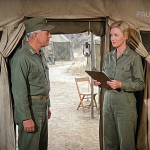
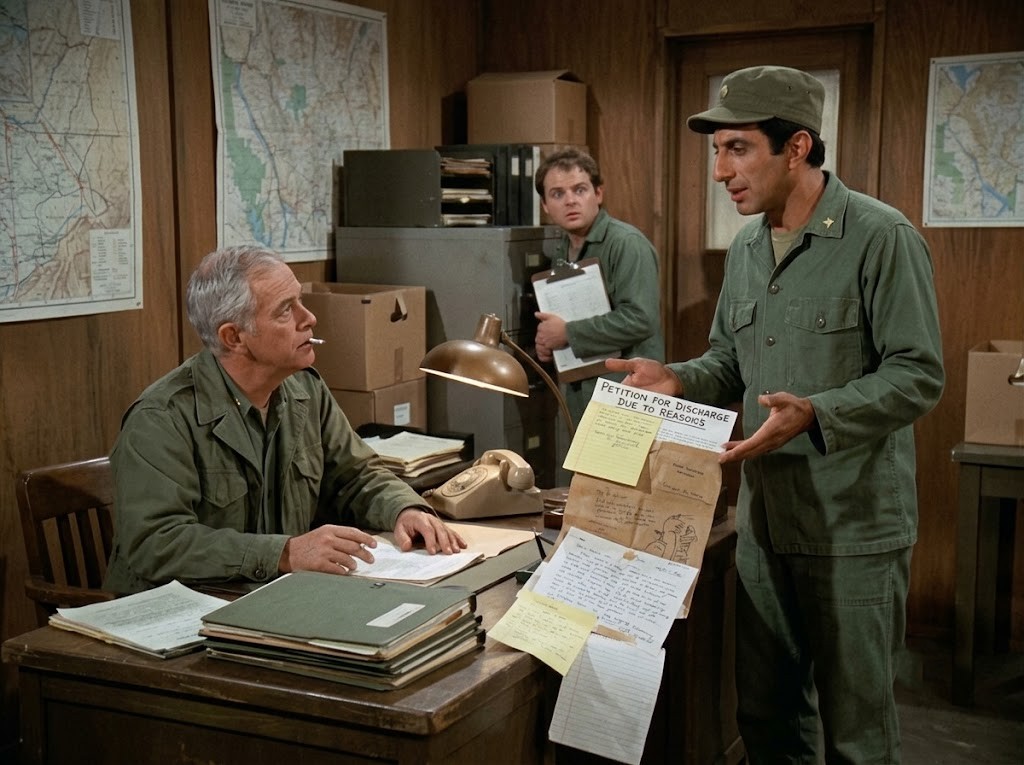
In the Commanding Officer’s office, the only sound was the lazy, rhythmic buzzing of a horsefly bouncing against the screen door. Colonel Sherman T. Potter sat at his desk, perfectly still. He had a cigarette pinched between his lips, a pen in his right hand, and the exhausted posture of a man who had already reviewed three dozen requisitions for toilet paper that morning.
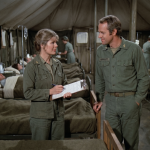
Behind him, near the tall gray filing cabinets, stood Corporal Walter “Radar” O’Reilly. Radar clutched his trusty wooden clipboard to his chest like a medieval shield. His round, innocent eyes were wide behind his glasses, darting nervously toward the doorway.
Radar knew what was coming. He could always sense a storm, or a helicopter, or in this case, an incoming wave of Toledo-born absurdity.
The door swung open, and in marched Corporal Maxwell Q. Klinger.
But something was immediately, startlingly wrong. Klinger was not wearing a floral print dress. He wasn’t wearing a velvet evening gown, a fruit-covered hat, or a feather boa.
For the first time in weeks, Klinger was dressed in standard-issue, olive-drab Army fatigues. He even wore a regulation green cap.
Potter didn’t move. He simply shifted his eyes upward, keeping his chin resting near the collar of his shirt. He took a slow, deliberate drag of his cigarette, waiting for the circus to begin.
“Colonel,” Klinger announced, his voice vibrating with theatrical dignity. “I stand before you today not as a woman trapped in a man’s army, but as a broken vessel of shattered nerves.”
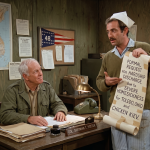
Klinger stepped forward, extending his hands. In them, he held what looked like the wreckage of a recycling bin.
It was a massive, cobbled-together scroll of desperation. It was held together by yellowed cellophane tape, featuring lined legal paper, crumpled typed sheets, and a large piece of brown butcher paper.
At the very top, printed in bold, slightly uneven black marker, were the words: *PETITION FOR DISCHARGE DUE TO REASOICS*.
“I have spent seventy-two consecutive hours compiling this legally binding, airtight, medically indisputable dossier,” Klinger proclaimed. He gestured passionately to the dangling sheets. “It is a complete catalog of my crumbling psyche. Exhibit A, the yellow sheet, details my recurring nightmares about giant, man-eating swabs.”
Radar swallowed hard, taking a tiny step backward into the safety of the filing cabinets.
Potter remained perfectly frozen. The smoke from his cigarette curled upward into the dim light of his desk lamp. He looked at the document. He looked at the misspelled header. He looked at a strange, childish drawing of a head and a jagged line scrawled on the brown paper bag.
“And Exhibit B,” Klinger continued, pointing dramatically to the brown paper. “Is a psychic manifestation of my inner trauma, drawn by my own trembling hand during a fit of sheer, unadulterated madness.”
Klinger finished his grand presentation and stood at attention, waiting for the inevitable victory. He had laid it all out. The ultimate, undeniable proof for a Section 8.
The silence in the office stretched out, pulling tighter and tighter like a rubber band about to snap.
Potter slowly reached forward, resting his forearms on the piles of manila folders covering his desk. He squinted at the massive, taped-together monstrosity hovering inches from his face.
He didn’t yell. He didn’t turn red. Instead, Potter’s eyes narrowed into a terrifyingly calm, steely gaze.
“Corporal,” Potter said, his voice dropping to a low, dangerous gravel. “Before I have you digging latrines until the next ice age… I need you to answer me one very specific question.”
Potter tapped the top of the paper with the end of his pen.
“What in the name of sweet, suffering saddle soap is a ‘Reasoic’?”
Klinger blinked. The grand, theatrical confidence evaporated from his face for a split second, replaced by genuine confusion.
“A what, sir?” Klinger asked, leaning forward to look at his own masterpiece.
“Right there. In big, bold letters,” Potter said, his face deadpan. “Petition for Discharge Due to Reasoics. Is that a new tropical disease? A condition of the liver? Or did you just forget how to spell the word ‘Reasons’ when you were rushing to glue this trash pile together?”
Klinger swallowed, quickly recovering his dramatic flair. “It is a highly technical psychiatric term, Colonel! Originated by a brilliant doctor in downtown Toledo. It means… a profound and irreversible allergy to incoming artillery!”
From the back of the room, Radar couldn’t help himself. “Actually, Colonel,” Radar squeaked, adjusting his glasses. “He just ran out of room on the paper and had to squish the N and the S together. And he used a bad marker.”
Klinger shot Radar a look of pure, venomous betrayal. “Thank you, Walter. Your assistance to the medical community is noted.”
Potter sighed. It was a long, heavy sigh that seemed to carry the weight of the entire Korean peninsula. He plucked the cigarette from his mouth and crushed it out in the metal ashtray on his desk.
The humor of the moment slowly faded, replaced by the quiet, settling exhaustion that defined every afternoon at the 4077th.
Potter leaned back in his wooden chair, the springs creaking loudly in the quiet room. He looked at Klinger. He really looked at him.
Without the makeup, without the cheap earrings and the colorful scarves, Klinger just looked like a tired young man. There were deep, dark bags under his eyes. His green uniform hung a little loosely on his frame. The manic energy of his presentation was just a thin shell over a profound, aching homesickness.
“Put it down, son,” Potter said softly. The gravel in his voice was gone, replaced by a gentle, fatherly warmth.
Klinger hesitated, the fight draining out of him. He slowly lowered the ridiculous petition, letting the brown paper bag rustle against the desk.
“You know, Klinger,” Potter said, folding his hands on his desk. “I’ve seen a lot of men try to fake their way out of a war. I’ve seen guys pretend they were deaf. I’ve seen guys pretend they couldn’t remember their own names. But you…”
Potter offered a small, sad smile.
“You put actual elbow grease into it. You build entire worlds just to prove you don’t belong in this one.”
“I don’t belong here, Colonel,” Klinger said, his voice dropping its theatrical pitch. For a moment, he wasn’t scheming. He was just pleading. “I miss the smell of hot dogs. I miss concrete. I miss looking up at the sky without wondering if something is going to fall out of it.”
Radar looked down at his clipboard, his own heart aching with the exact same sentiment. He scuffed his boot softly against the wooden floorboards.
“We all do, Max,” Potter said gently. It was rare for the Colonel to use a first name, and the sound of it made Klinger stand a little straighter.
“But here’s the cold, hard truth,” Potter continued, leaning forward again. “You’re not crazy. In fact, standing here in that green uniform, holding a taped-up piece of garbage to try and escape a warzone? That might be the most rational, sane thing a man could do in this miserable place.”
Potter reached out and tapped the crumpled brown paper bag.
“You’re sane, Klinger. And because you’re sane, I need you here. I need you answering that phone, scrounging up supplies, and keeping this camp running while the surgeons are up to their elbows in the OR. If I send the sane ones home, there’d be nobody left to take care of the rest of us lunatics.”
Klinger looked at the petition in his hands. The yellow paper, the misspelled header, the ridiculous drawing. It suddenly looked very small and very foolish.
He didn’t get his Section 8. He knew he wasn’t going to. But as he looked at Colonel Potter, he felt something else settle in his chest. A strange, reluctant sense of pride. He was needed.
“So,” Potter said, picking up his pen and pulling a fresh manila folder toward him. “I am denying your petition due to… Reasoics. But I am granting you a three-day pass to Seoul starting Friday. Go eat something that doesn’t come out of a tin can. Buy a cheap suit. Remind yourself what civilization looks like.”
Klinger’s eyes lit up, the familiar spark returning. A three-day pass wasn’t Toledo, but it was a lifeline.
“Thank you, Colonel,” Klinger said softly. He began carefully folding his massive petition, treating it with a strange sort of reverence, before tucking it under his arm.
“Dismissed, Corporal,” Potter murmured, already looking down at his paperwork.
Klinger turned and walked toward the door. As he passed Radar, he gave the young clerk a small, forgiving wink. Radar smiled back, visibly relaxing as his grip on his clipboard loosened.
The door clicked shut, leaving the office in quiet stillness once again.
Potter didn’t look up from his desk. He just reached into his pocket, pulled out another cigarette, and struck a match. The flame flared, illuminating the tired lines around his eyes. He shook the match out, the scent of sulfur mixing with the stale air of the office.
It was just another Tuesday, holding onto sanity by a thread of yellow tape.
In a place built on madness, the most comforting thing of all was knowing you never had to be crazy alone.