Dust, Letters, and the Fine Art of Enduring Together.
If there was a smell unique to this corner of Korea, it was the dust.
The dust got into everything: your coffee, your bunk, your boots, and eventually, right under your skin.
It coated every surface of the 4077th, a fine silt that never let you forget where you were.
Even when the operating room was quiet and the choppers weren’t flying, the dust was always moving.
Always reminding you that you were far, far away from home.
One afternoon, during one of those brief, fragile pauses, it felt like the entire camp was breathing a sigh.
The heat was heavy, the air thick, and the endless work of the war was briefly on standby.
But the dust didn’t pause.
It just settled.
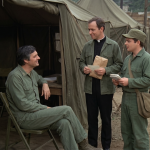
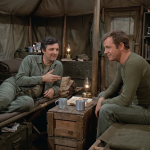
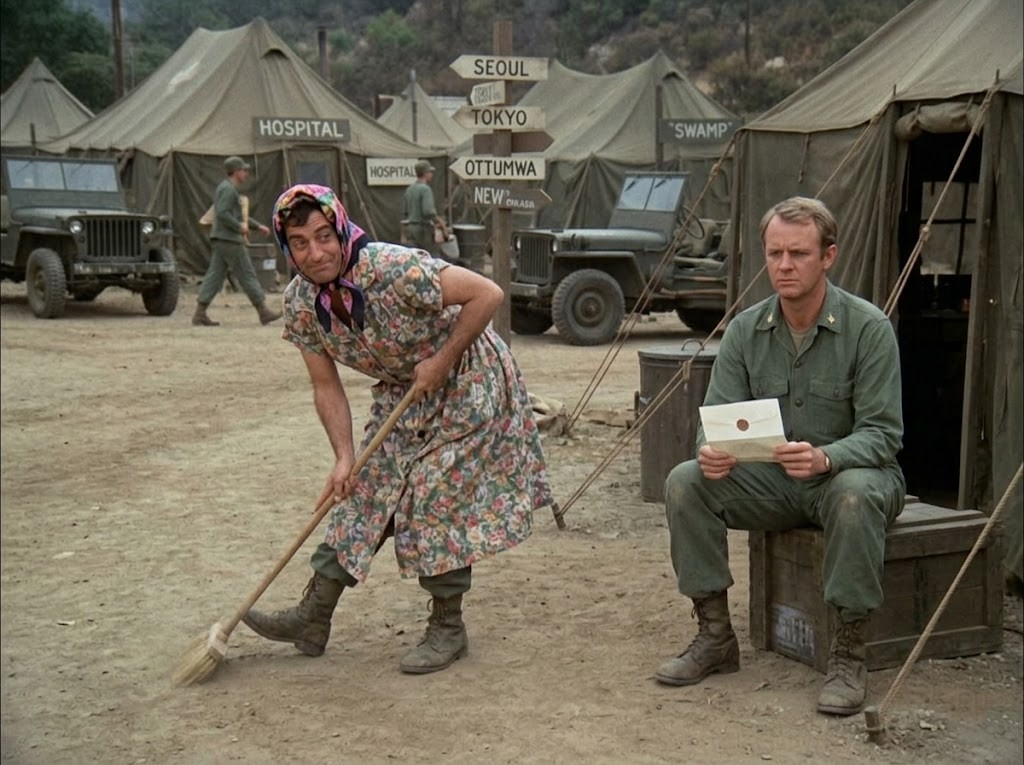
Sitting on a rough wooden crate outside “The Swamp” was Captain B.J. Hunnicutt.
He’d finally managed to shower off the sweat of the day, changing into his clean, olive-drab work shirt.
But he was already losing the battle.
The dust was settling right back onto him.
It didn’t seem to bother him much right now.
His focus was entirely elsewhere.
In his tired hands, he held a single, slightly crinkled white envelope.
It hadn’t been in the O.R. with him, so it was the cleanest thing he possessed.
He held it like it was spun from glass, examining the handwriting.
His expression was complicated—a mix of relief, exhaustion, and a deep, aching homesickness.
He was waiting.
He knew if he opened it now, the spell would break. He’d be pulled across the ocean, away from his boots and the smell of diesel.
So he just sat. Resting his hands on the envelope, trying to decide when he was brave enough to open it.
Just a few feet away, Captain Klinger was performing a delicate operation of his own.
He wasn’t wearing his usual green uniform.
Klinger had decided that a particularly dusty day required a particularly vibrant response.
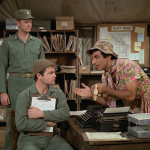
He was dressed in a full-skirted, short-sleeved cotton house dress, patterned with loud, overlapping floral prints in reds, greens, and creams.
A matching kerchief was tied expertly around his head.
He was, as always, the brightest target for miles around.
And he was sweeping.
With focused determination, he was using a wide straw push broom to clear a precise square of ground in front of B.J.
Sweep. Step. Sweep.
A cloud of fine, grey dust immediately rose up, swirling in the hot air.
Klinger ignored it. He was focused on the line he was pushing.
He looked over at B.J., an encouraging, if tired, smile on his face.
“Getting the ‘Swamp’ welcome mat ready for you, B.J.,” he said, his voice unusually quiet for him.
“You have to look respectable when you open that.”
B.J. didn’t even look up from the letter.
He just sighed, the sound barely audible over the broom.
Behind them, the camp continued to buzz.
A jeep sat parked nearby, caked in mud. Another one was parked closer to the signpost.
Orderlies were walking by, their shirts dark with sweat.
Colonel Potter’s tent was visible, a distant figure moving near the door.
Even with everything else moving around them, the world seemed to narrow down to this one spot.
One man, motionless on a crate, looking at a memory.
Another man, dancing with a broom, trying to sweep away the reality.
B.J. ran his thumb one last time over the postmark.
It was from San Francisco.
His wife.
His baby daughter.
He could feel the ache in his chest tightening.
“You think you’re helping, Klinger?” B.J. asked, his voice rough.
Klinger stopped mid-sweep. “Just keeping the dust out of your important business, Captain.”
He started up again, and the new cloud he raised landed right on B.J.’s freshly cleaned shirt.
B.J. finally looked up.
His eyes were watery, the tiredness from the long shift finally catching up.
He closed his eyes, gripping the letter until his knuckles were white.
Klinger saw it.
He stopped again.
“You can’t just keep staring at it, B.J.,” Klinger said softly. “You got to open it eventually.”
B.J. opened his eyes. He looked over at the camp signpost.
‘SEOUL,’ it said. ‘OTUMWA.’ ‘TOKYO.’
Every direction pointed somewhere that wasn’t home.
He looked back at the small, perfect white rectangle in his hands.
“I don’t think I can,” B.J. whispered, his voice cracking for the first time.
“Not today.”
Klinger just stood there.
The dust cloud he had just kicked up had already settled, painting a grey ghost over B.J.’s shoulders and boots.
His push broom remained frozen, the straw resting against the cracked earth.
For a moment, all the theatricality was gone.
Underneath the loud house dress and the matching kerchief, Maxwell Klinger was just another exhausted GI who hadn’t seen a real porcelain bathtub in months.
He saw the lines etched deep around B.J.’s eyes.
He saw how B.J.’s hands, which were steady as a rock when holding a scalpel, were shaking now as he gripped the letter.
B.J. looked down again, the weight of the moment pressing him even further into the wooden crate.
It was too much. The heat, the sleep deprivation, the endless river of wounded boys… and now, this perfectly clean reminder of the life that was moving on without him.
Klinger didn’t say anything witty.
He didn’t try to lighten the mood with a joke.
He slowly set the broom aside, leaning it carefully against the rough canvas wall of the “Swamp.”
Then, he walked over and sat down right next to B.J. on the small crate.
It was a tight squeeze. The frilly skirt of Klinger’s dress bunched up around them, a surreal floral island in a sea of olive green.
Klinger just sat. He didn’t put a hand on B.J.’s shoulder. He didn’t try to look at the letter.
He just shared the silence.
They sat that way for what felt like a long time. The sound of the camp faded into background noise: a distant engine, the quiet clatter of the mess tent, the rhythmic thump of someone chopping wood.
Inside the nearby tent, Hawkeye was probably making a joke to an imaginary bartender. Radar was probably hearing a helicopter no one else could. But out here, for these two, the world had truly stopped.
The silence wasn’t awkward; it was respectful.
Klinger had letters of his own, tucked away in his wallet. He knew the feeling.
He knew that some days, hope was just too damn painful to touch.
B.J. finally took a long, shaky breath, letting it out with a quiet whistling sound.
“How do you do it, Klinger?” B.J. asked, his voice steadier than before, but still quiet.
“The clothes, the gags, the whole… show.”
Klinger didn’t answer right away. He ran a finger along the seam of his skirt.
“Because it’s not real,” he said softly. “When I put this on, for an hour or two, I can be crazy. And if I’m crazy, then all of *this* makes sense. It’s a performance, B.J.”
He turned to look at the letter.
“That,” Klinger said, gesturing to the envelope, “is real. And the real is what will kill you here. The real is the sound of the choppers coming over the hill at 3 AM. The real is the smell of the blood that you just can’t get out of your nose.”
He looked back at B.J., his gaze serious.
“Some days, you got to protect the real.”
B.J. looked at him, truly looked at him, seeing the intelligence and weary kindness that was too often hidden.
“It’s from Peg,” B.J. admitted. “Her first letter in two weeks.”
Klinger nodded. “A good woman, Peg. Keeps a clean house, probably.”
B.J. actually smiled. A small, real smile. “She does. She also sings to the radio when she irons. God, I forgot that until just now.”
A tear finally escaped B.J.’s eye, but it wasn’t a desperate one. It was just a tear.
“I just wanted… I just needed it to stay perfect for a little longer. Before I open it and the dust gets it.”
Klinger looked at B.J., then at his clean shirt, now thoroughly dusted.
“Captain,” Klinger said, his voice rising, regaining its usual performative twang, “You have been operating for twenty hours straight. You have not slept. You are covered in half of Korea. Perfect is for movies. Perfect is for generals.”
Klinger stood up, dramatically smoothing the skirt of his house dress.
“And besides,” he declared, reaching back for his broom. “If dust gets in that letter, it only means the dust knows where home is. It means home is real enough that even the dirt wants to be part of it.”
He grabbed the broom and deliberately kicked it against the ground, raising a small, fresh cloud.
“Don’t worry, Captain. I will protect you from the worst of it. The ‘Swamp’ deserves a professional.”
B.J. looked from the dancing cloud of dust to Klinger, who was already back to his meticulous sweeping, humming a tune that was definitely *not* from Korea.
B.J. looked back at the letter.
His hands were no longer shaking.
The ache in his chest was still there, but it was warmer now, less like a knife.
He had been holding onto it, afraid that reading it would break him.
Klinger had just shown him that sometimes, the breaking was the whole point.
And that even in the dustiest, saddest place on Earth, you weren’t alone.
B.J. took a slow breath, his tired eyes gazing toward the signpost that marked how many thousands of miles he was from San Francisco.
Then, with fingers that were once again surgeon-steady, he slowly ripped open the top of the envelope.
Out here, the real things were the only things that kept you whole.