The Small Mercy of the Mess Tent
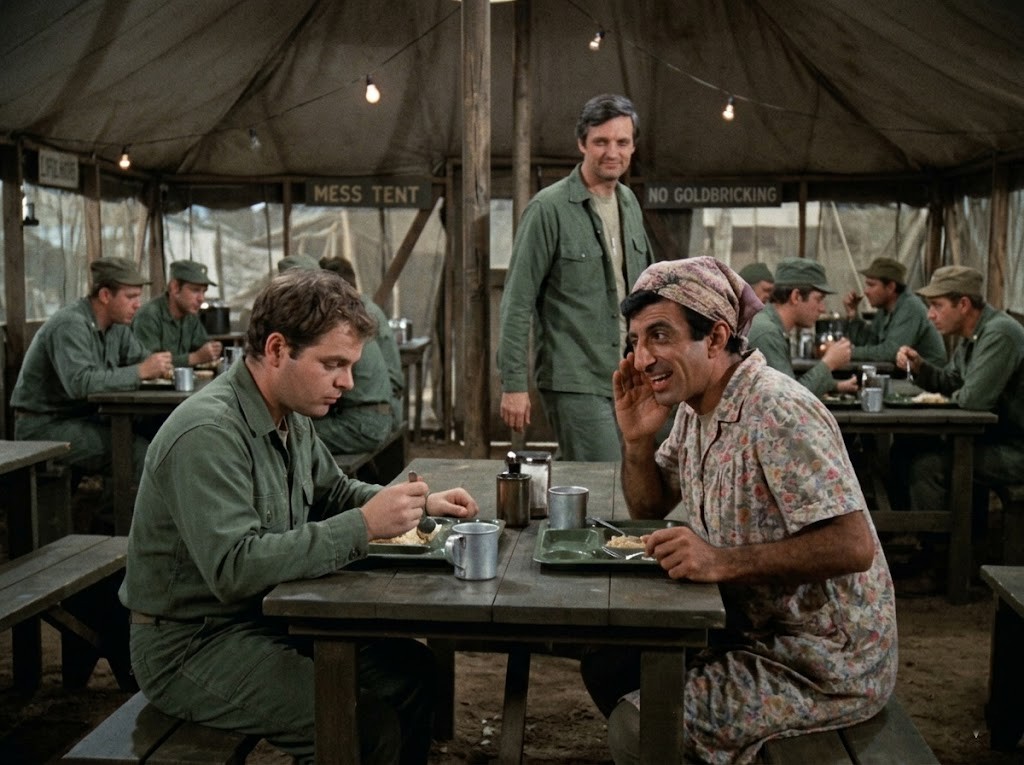
If there was one thing that unified the 4077th, more than the incoming choppers and the smell of anesthesia, it was the collective sigh when the mess tent flap opened.
It was just another Thursday.
Or maybe a Tuesday.
In the 4077th, time didn’t tick; it pooled.
The standard scene played out under the low-hanging bulbs, casting a sickly yellow glow over standard-issue trays. Soldiers in faded fatigues huddled over food that was, if not actively trying to escape, certainly resisting consumption. They ate with the grim focus of men who understood that food was fuel, not pleasure.
Corporal Radar O’Reilly was not eating.
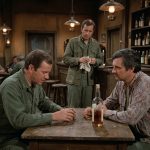
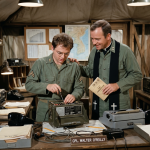
He sat at one of the rough-hewn wooden tables, staring into his tray of mystery meat and mashed potatoes that had given up the ghost hours ago. He was wearing his usual fatigues, but his expression was far from the usual efficient calm. His gaze was locked on the food with an intensity that suggested he was waiting for it to reveal a state secret.
Opposite him, Corporal Klinger was an island of unauthorized color in the drab olive sea.
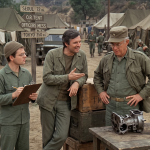
Klinger was wearing a dress that can only be described as aggressively floral—a loose-fitting garment covered in pink and yellow blossoms. A matching headscarf was tied bandana-style around his head. If any regular army officer had walked in, the “NO GOLDBRICKING” sign hanging nearby would have seemed a sick joke, but here, it was just Klinger.
But right now, Klinger wasn’t thinking about a Section 8. He was leaning so far across the table his nose was almost in Radar’s water cup. He had one hand cupped conspiratorially to his ear, listening.
Actually, he wasn’t listening. He was communicating. He was whispering.
It was the kind of dramatic, theatrical whisper that carried over the clatter of metal trays. It was the whisper of a man possessing a delicious secret that was burning a hole in his chest.
And whatever the secret was, it had completely paralyzed Radar.
Standing in the aisle between the tables, observing this tableau, was Captain Benjamin Franklin “Hawkeye” Pierce.
He looked exhausted. Dark circles were visible beneath his eyes, matching the fatigue of his uniform. He wasn’t sitting, just standing, a metal cup of coffee in hand, watching.
Hawkeye watched the interaction with the faint, knowing smile of someone who had seen it all. He was too tired to initiate a joke, but still alive enough to appreciate one.
Klinger’s expression, with that hand cupped to his ear, was a masterpiece of gossipy, urgent importance.
“Sparky said…” Klinger’s whisper was a coiled spring.
Radar didn’t move. He didn’t blink. He just sat still, looking down, but listening with every fiber of his being.
“…and here’s the best part,” Klinger continued, leaning in even further. “He said the shipment *didn’t just get delayed*. It got *misrouted*.”
Radar slowly lifted his gaze from his tray. The glasses perched on his nose magnified the rising panic in his eyes. He looked up at Klinger, his face a perfect mask of bewildered, fragile hope that was ready to be shattered.
At the table behind them, another soldier looked up, a spoon frozen halfway to his mouth, drawn by the sudden, sharp focus in Radar’s usually calm face.
“Wait,” Radar’s voice was a soft croak, barely audible over the general mess hall buzz. “Sparky said *my* shipment? The *one* thing I’ve been waiting for?”
Klinger’s dramatic posture softened for just a split second, replaced by a genuine, earnest nod. “Yeah, Radar. The only thing with ‘O’Reilly’ on the manifest for the last two weeks. It was put on the supply train to Seoul by mistake.”
Hawkeye, standing behind them, stopped smiling. He watched the light of absolute devastation slowly extinguish the tiny speck of hope in Radar’s eyes. This wasn’t just a funny story anymore.
Radar didn’t say a word. He just lowered his eyes back to his metal tray. But he wasn’t looking at the mystery meat this time. He was looking through it, seeing a completely different reality thousands of miles away.
He reached out, his hand trembling slightly, and wrapped his fingers around his metal cup. It was cold. Everything here felt cold.
Klinger dropped his hand from his ear. The high-tension energy he always carried suddenly drained away. The flowered dress and the scarf, usually a punchline, felt heavy. He reached across the table and covered Radar’s hand with his own hairy, tattooed one.
The comedy was gone.
“Radar,” Klinger said softly. “I didn’t say it was *gone*. It’s just… taking the scenic route.”
Hawkeye Pierce had treated hundreds of patients today. He had repaired arteries, patched intestines, and seen more pain than any human should be required to process. But nothing in the O.R. prepared him for the quiet, understated tragedy of Radar O’Reilly being homesick.
He understood. They all did.
For Radar, this unit was a job he excelled at. But the small, fragile connection to the farm—a specific part for his tractor, or perhaps just a letter from his mom containing a photo of a new calf—was the rope that kept him anchored.
When that connection was severed, even for a few extra days, the anchor was gone.
Hawkeye pushed off from where he had been standing and walked to the table. He didn’t sit. He didn’t say a witty, deflectionary joke to break the mood. He simply placed a tired, steady hand on Radar’s shoulder. It was a gesture that needed no words. It said: *We are here. We know.*
The background noise of the mess tent—the clinking of spoons, the murmuring of tired men—continued. Life went on. But at this one table, time had truly stopped.
Radar sat still, his hand under Klinger’s. He didn’t look up, but his grip on the metal cup tightened. He swallowed, hard.
“It was…” Radar’s voice was barely a whisper. “It was just a new headlight glass. For the ’39 Ford tractor. The old one got broken by a loose rock. It’s hard for my uncle to see the fields in the evening without it.”
Klinger didn’t laugh. Hawkeye didn’t make a joke about nighttime driving.
In the 4077th, a small thing like a headlight glass for a tractor in Ottumwa, Iowa, was everything. It represented order. It represented peace. It represented a world that wasn’t this one.
They all understood that if that tractor didn’t work, Radar O’Reilly might be a thousands miles away, but part of him would stop working, too.
Klinger squeezed Radar’s hand, then slowly removed his own. He was the unit’s supply-scrounger. He could find anything—silk stockings, genuine French wine, or a section 8. Finding a headlight glass for a 1939 Ford tractor in the middle of a war zone was impossible.
But it was what Radar needed.
Hawkeye’s hand remained on Radar’s shoulder. He felt the tension slowly leave the corporal’s frame. Radar let out a long, slow breath. He still didn’t look up, but he picked up his fork.
“I guess the old man will just have to drive in the daytime for a little while longer,” Radar said.
He didn’t sound happy. He didn’t sound hopeful. But he was coping. He was back in the 池.
Hawkeye gave a small, approving nod, his hand lingering for another second on Radar’s fatigues before he gently let go. The humor, the fatigue, and the quiet, fierce care for each other—it was all here, contained within this drab canvas tent.
They weren’t family by choice, but they were family by necessity.
Klinger went back to his exaggerated posture, but his face remained soft. He started telling Radar about another rumor Sparky had shared, about a shipment of *actual* oranges that had been spotted in Pyongyang, which was even less useful, but far more entertaining.
Hawkeye turned and slowly walked back out into the aisle. He needed that coffee. And maybe, just maybe, he would write a letter home himself.
As he walked away, a new soldier in the line behind him whispered, “Hey, was that *him*? Radar? Is he okay?”
The soldier in front, a veteran of two years, shrugged and went back to his tray. “He’s fine. Klinger just told him some gossip. Pierce is Pierce. This is the 4077th. Nobody’s ever ‘fine.’ But we all keep moving.”
The camera—if there were one—might pull back now, capturing the full width of the mess tent: the tired men eating in low light, the “NO GOLDBRICKING” sign hanging mockingly, and at one table, a soldier in full floral regalia, a boy with a breaking heart, and a doctor trying to heal things that stitches couldn’t fix, all trying to survive one more Tuesday. Or Thursday.
In the 4077th, the greatest battles were often fought not in the O.R., but in the quiet, fragile spaces between the tired heart and the endless wait.