A Frequency of Faith and Static
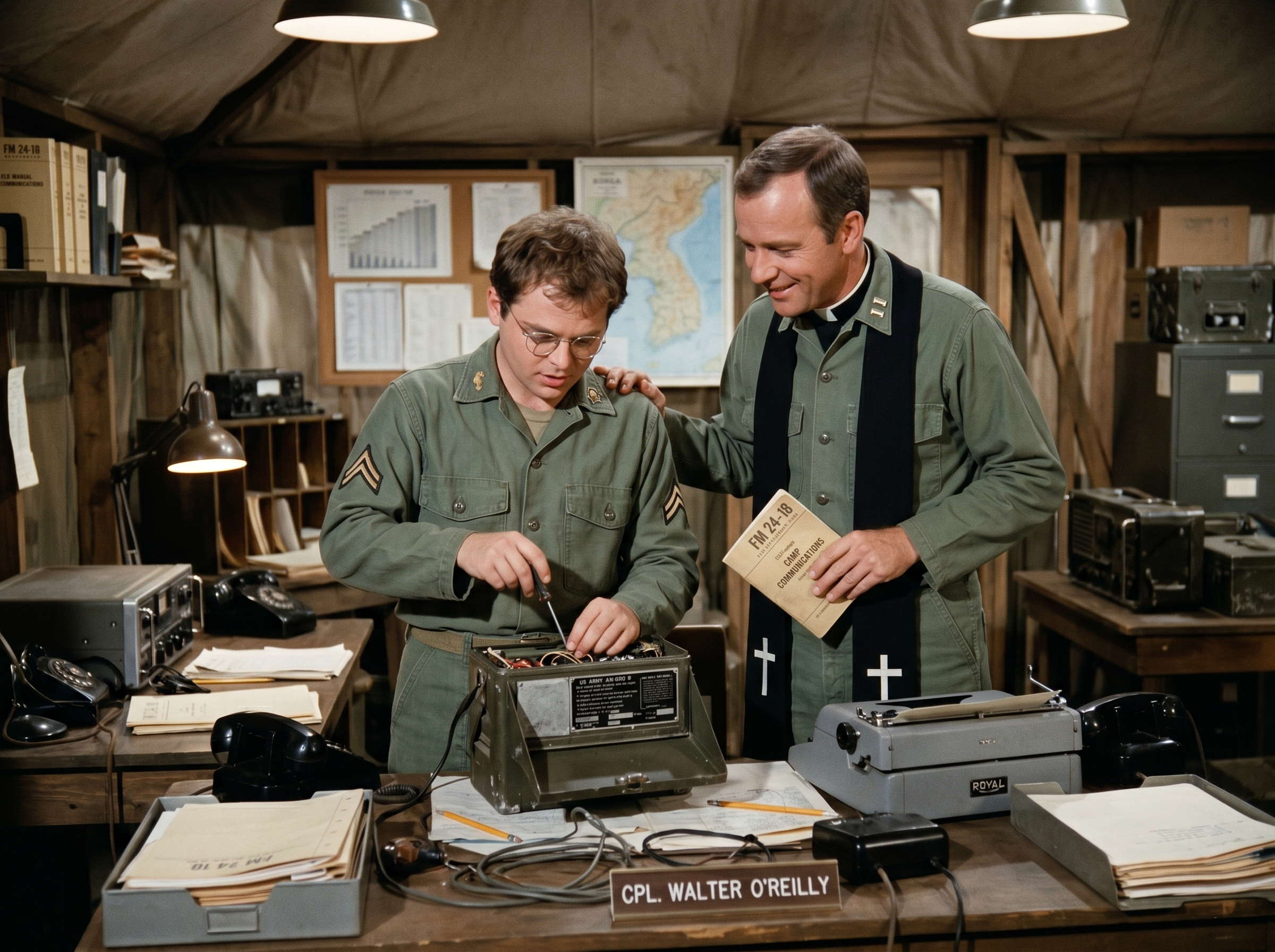
The silence in the camp was heavier than the humid Korean night pressing against the canvas walls of the clerk’s office.
Normally, the 4077th hummed with a chaotic, nervous energy, but tonight, an eerie quiet had settled over the compound. The main receiver—the camp’s only reliable tether to the world outside the war—had sputtered, hissed, and died right after dinner. Without the crackle of Armed Forces Radio or the comforting static of a distant broadcast, the camp felt dangerously isolated, adrift in a sea of olive drab.
Inside the office, Corporal Walter “Radar” O’Reilly was sweating.
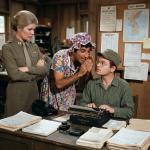
The small clerk’s station was a modest sanctuary of beige paper, tan canvas, and muted gray equipment. Under the warm, even glow of a practical desk lamp, Radar stood behind his cluttered desk, his shoulders tense beneath his worn green fatigues. He had pushed his gray “Royill” typewriter aside, clearing a space next to his wooden nameplate to operate on the open chest of the olive-drab communications box.
Radar peered earnestly into the tangle of exposed wires, tubes, and resistors, his face a picture of sincere, nervous focus. He held a small, red-handled tool delicately between his fingers, treating the military hardware with the same gentle caution he used when splinting a stray rabbit’s leg.
Leaning in next to him, a steady and compassionate presence in the tense room, was Father Francis Mulcahy.
The chaplain wore his black stole with white crosses draped over his own faded fatigues, his silver captain’s bars catching the dim light. Father Mulcahy didn’t know the first thing about vacuum tubes or radio frequencies, but he knew when one of his flock was in distress. He held a small, tan field manual—FM 24-18—in his hands, his expression showing a gentle concern and a soft, encouraging smile.
“According to the book, Corporal,” Father Mulcahy said, his voice a soothing, quiet murmur, “the primary oscillator should be… well, it says here it should be calibrated to the secondary grid. Does that sound right?”
“It sounds like Latin to me, Father,” Radar muttered, not taking his eyes off the radio’s innards. “And usually I don’t mind Latin, seeing as it’s your department, but this radio doesn’t speak by the book. It’s got a sensitive stomach, sir. You gotta talk to it right.”
“I suppose every creation requires a unique sort of understanding,” Mulcahy replied gently, adjusting his grip on the manual. “Even the mechanical ones.”
Radar wiped a bead of sweat from his forehead with the back of his wrist, his round glasses slipping slightly down his nose. Outside, he knew Hawkeye and B.J. were sitting in the Swamp, staring at the ceiling, waiting for a distraction. Colonel Potter was likely at his desk, missing his wife’s voice. Margaret was probably brushing her hair in her tent, needing a song to drown out the distant rumble of artillery.
The whole camp was counting on this little box, and by extension, they were counting on Radar.
“Okay, buddy,” Radar whispered to the radio, leaning in closer. “Just a little turn of the spark gap. Don’t bite me now.”
Radar inserted the small tool, holding his breath as he made a microscopic adjustment to the wiring. For a second, a low, promising hum began to vibrate from the speaker. Mulcahy’s smile widened, and Radar’s tense shoulders dropped a fraction of an inch.
Then, a sharp, angry spark arced across the chassis.
A loud POP echoed in the quiet tent, followed by a thin, bitter wisp of gray smoke that curled up toward the canvas ceiling. The faint hum died instantly, leaving behind a silence that felt twice as heavy as before.
Radar froze, his hand trembling slightly around the tool. He stared into the darkened machine, the devastation clear on his young face.
“Oh, no,” Radar whispered, his voice cracking. “I killed it, Father. I really killed it this time.”
The smell of ozone and burnt dust lingered in the warm air of the office.
Radar slowly pulled his tool away from the radio, his shoulders slumping in defeat. He looked down at his wooden nameplate—CPL. WALTER O’REILLY—feeling entirely unworthy of the official title. He was supposed to be the guy who could hear choppers before they arrived, the guy who could source ice cream in a war zone, the guy who kept the heart of the 4077th beating.
Right now, he just felt like a tired kid from Iowa who had broken the only toy in the sandbox.
“I let everybody down,” Radar said softly, refusing to look up from the desk. “They’re all out there waiting for a song, or a baseball score, or just a voice that doesn’t sound like… like Korea. And I ruined it.”
Father Mulcahy closed the tan field manual, the soft thud of the paper breaking the silence. He didn’t offer a hollow platitude or tell Radar that it was just a machine. He knew better. He knew how fragile the human spirit was in this place, and how tightly it clung to small comforts.
Instead, Mulcahy moved just a fraction closer, his presence a quiet anchor in the cluttered room.
“Walter,” Father Mulcahy said gently, using the boy’s given name. “Look at me.”
Radar reluctantly raised his head. He expected to see disappointment, or at least a polite, priestly pity. Instead, he saw the same warm, unwavering encouragement that Mulcahy offered to wounded soldiers in post-op and homesick kids in the mess tent.
“You haven’t let anyone down,” Mulcahy told him, his voice steady and kind. “You care for this camp more than anyone I know. You carry the weight of all our worries, and you do it with a willing heart. That is a far greater comfort to us than any radio broadcast.”
“But the radio is dead, Father,” Radar said, his voice thick with frustration. “And I don’t know how to resurrect it. That’s your department, not mine.”
Mulcahy let out a soft, dry chuckle. “If I had the power to resurrect electronics, Corporal, I would have fixed the camp generator months ago. No, this isn’t a matter for miracles. It’s a matter of patience.”
The chaplain tapped the closed cover of the field manual against the desk.
“This book tells you the rules of the machine,” Mulcahy explained, his eyes crinkling warmly at the corners. “But you’ve never been a boy who operates strictly by the book, have you? You operate by feel. By intuition. By a kind of grace that simply can’t be diagrammed on beige paper.”
Radar looked from the manual to the priest, absorbing the quiet wisdom.
“You told me this machine has a personality,” Mulcahy continued, gesturing gracefully toward the open chassis. “You said it has a sensitive stomach. Well, when a person is hurting, we don’t just read them a medical text. We listen to them. We find the source of the pain, and we treat it with a gentle hand.”
Radar blinked, processing the words. He turned his gaze back to the exposed wires, the scattered paperwork, the black rotary phones waiting silently for a connection. He thought about the animals he had cared for back home, and the terrified soldiers he checked in every week.
He didn’t need to be an engineer. He just needed to be Radar.
“A gentle hand,” Radar muttered, nodding slowly to himself. “Yeah. Okay. Let me try something else.”
He set the red-handled tool down on the desk beside the ‘Royill’ typewriter. He wiped his palms on his green canvas trousers. Then, leaning in close until his nose was just inches from the metal casing, Radar closed his eyes.
He didn’t look at the complicated schematics or worry about the primary oscillators. He just listened. He listened past the hum of the distant camp generator, past the wind hitting the tent flaps, searching for the tiny, almost imperceptible pulse of the machine’s electrical current.
He reached his bare fingers into the back of the radio, bypassing the heavy wiring. He found a small, neglected connection near the power source—a delicate little fuse that had been jarred loose by the vibrations of the war.
With a touch as light as a feather, Radar nudged the connection back into place.
He held his breath. Father Mulcahy held his breath.
For a long moment, the silence persisted. Then, a low, crackling static began to build. It grew louder, rising from a whisper to a steady hiss. The amber dial light flickered, caught, and glowed steadily in the dim office.
Suddenly, the static parted like a curtain, and the smooth, brassy sound of a distant big band swung right into the middle of the room. It was faint, surrounded by the ghosts of atmospheric interference, but it was there. It was music. It was home.
Radar’s eyes flew open, a brilliant, relieved grin breaking across his face.
“I got it!” Radar beamed, his entire posture transforming from defeat to pure, youthful joy. “Listen to that, Father! It’s Tommy Dorsey! We’re picking up Tokyo!”
Father Mulcahy smiled broadly, his eyes shining with shared delight. He didn’t understand the mechanics of what had just happened, but he understood the magic of it perfectly.
“A marvelous sound, Corporal,” Mulcahy said softly, placing a warm hand lightly on Radar’s shoulder. “Simply marvelous.”
Outside in the compound, a cheer went up from the Swamp. Someone in the mess tent began to clap along to the beat. The heavy, oppressive silence of the 4077th had been broken, chased away by a swinging trumpet and the stubborn dedication of a clerk from Iowa.
Radar quickly began to screw the casing back on, treating the machine with newfound respect. He was still tired, the war was still waiting outside the door, and the paperwork on his desk hadn’t gotten any smaller. But right now, the music was playing, and the family was whole again.
He looked up at the chaplain, his sincere eyes full of gratitude.
“Thanks for the help, Father,” Radar said quietly. “I guess sometimes you just gotta throw away the manual.”
Father Mulcahy chuckled warmly, tucking the tan book under his arm. “Indeed, Walter. Sometimes, you just have to operate on faith.”
In a place surrounded by broken things, the greatest comfort was always the people who knew exactly how to put you back together.