The Geometry of a Quiet Night
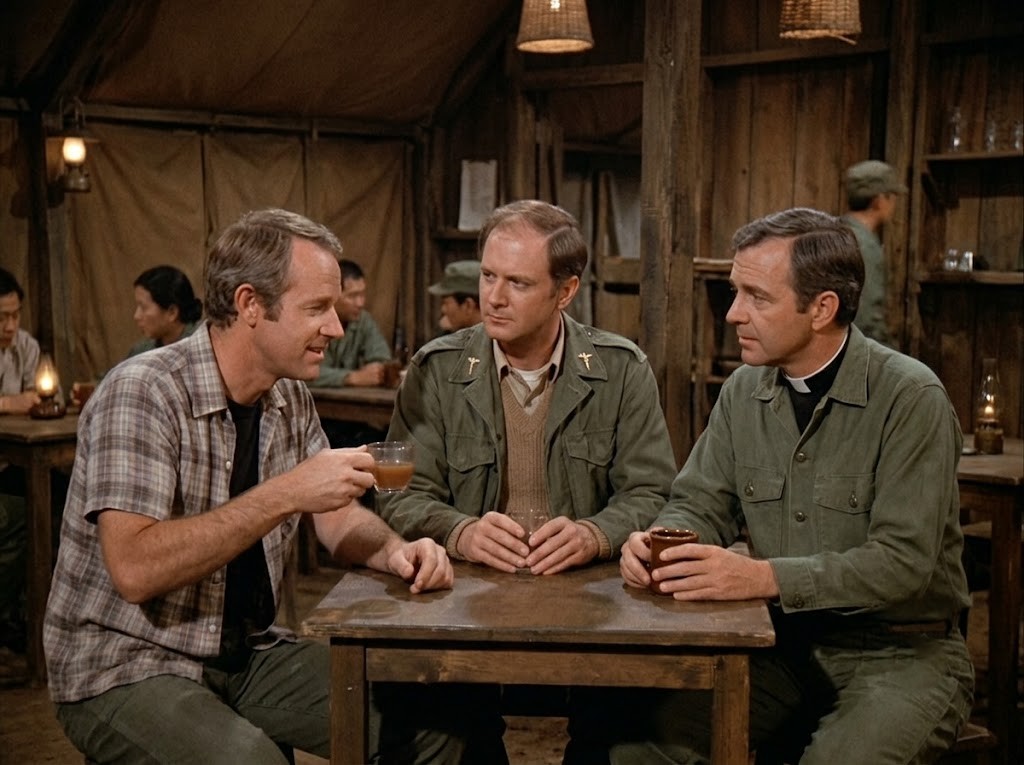
The Mess Tent always smelled of damp canvas, old cabbage, and the specific brand of exhaustion that only forty-eight straight hours in surgery could produce.
It was past midnight, the kind of hour where the war outside seemed to pause, catching its breath in the cold Korean mud. Inside, the generator hummed its familiar, erratic song, keeping the shadows flickering against the wooden ribs of the tent.
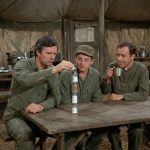
B.J. Hunnicutt stared down at the glass cup in his hand, his thumb tracing the smooth rim. The tea inside was lukewarm and weak, a poor substitute for anything resembling a home-cooked comfort, but it was wet and it was warm.
Across from him sat Charles Emerson Winchester III, looking as out of place as a grand piano in a stable, yet entirely anchored by his own stubborn dignity. Even with his olive-drab jacket zipped tight against the draft and a civilian sweater vest peeking through, Charles held himself with the posture of a man waiting for a curtain call at the Boston Symphony.
Beside Charles, Father Mulcahy kept his hands wrapped around a heavy ceramic mug, his clerical collar a stark white band against the drab utility of his uniform. His face carried the deep, pale lines of a man who had spent the last two days absorbing the confessions and final thoughts of boys half his age.
“You know, Charles,” B.J. said, breaking a silence that had stretched for nearly twenty minutes, “if you stare at that table any harder, you’re going to bore a hole straight through to Iowa.”
Charles didn’t move his head, merely shifting his prominent, critical gaze toward B.J. with an expression of profound, weary tolerance. “I am not staring, Hunnicutt. I am composing a mental missive to my sister, Honoria, explaining the precise anatomical impossibility of surviving on whatever substance the cooks have masqueraded as dinner this evening.”
“It’s meatloaf, Charles,” B.J. offered, a faint, tired grin tugging at the corner of his mustache. “Or at least, it shared a jeep with something that used to be meatloaf.”
“It is a culinary atrocity,” Charles sniffed, though he didn’t pull his hands away from his glass. “A crime against the digestive tract.”
Father Mulcahy offered a small, apologetic smile, his gentle voice cutting through the dry banter like a soft light. “Now, Charles, we must be thankful for the sustenance we have. Cook Igor did mention he tried a new seasoning technique today.”
“If by seasoning, Father, you mean he exposed it to the exhaust pipe of a Deuce-and-a-half, then yes, he succeeded remarkably,” Charles countered, his voice dripping with its trademark Brahmin frost, though there was no real venom in it.
They were too tired for venom. The operating room had been a conveyor belt of broken bodies, a red blur of clamps, sutures, and the rhythmic, terrifying sound of suction. Every one of them had blood under their fingernails that wouldn’t wash out until morning.
B.J. took a slow sip of his tea, looking at the way the light caught the amber liquid. He thought of Peg, back in San Francisco, probably putting Erin to bed right about now, or waking up to a clean, bright California morning. The distance between the Mess Tent and home felt like something that couldn’t be measured in miles, only in heartaches.
“What I wouldn’t give for a real glass of fresh cider,” B.J. murmured, his eyes drifting toward the canvas ceiling. “The kind from the orchard just outside of town. Crisp, cold, makes your teeth ache a little.”
Charles closed his eyes for a brief second, his face softening in a way he rarely permitted in public. “A vintage Bordeaux,” he whispered, almost to himself. “Properly decanted. Not this… this battery acid we are forced to imbibe.”
“I think,” Mulcahy said softly, looking between the two men, “I would just like a quiet Sunday afternoon where the bell rings for church, and not for incoming wounded.”
The three of them sat in the stillness, each trapped in their own private geography of longing, bound together by the shared weight of the uniform.
Then, the sudden, sharp sound of a heavy metal tray crashing to the floor in the kitchen area shattered the quiet, causing all three men to flinch simultaneously.
From the back, the unmistakable, booming voice of Colonel Potter echoed through the screen door. “What in the name of Douglas MacArthur is going on out there? Radar! Get in here!”
B.J. exchanged a glance with Charles, the humor fading from his eyes as a familiar tightness crept back into his chest. The camp was waking up again, and in the 4077th, a sudden noise at midnight usually meant only one thing.
The bell outside began to swing, its iron tongue striking the metal casing with a cold, rhythmic clang that echoed across the hills.
The sound of the siren didn’t follow the bell, which was the only saving grace of the moment. Instead, the screen door banged open, and Radar O’Reilly scrambled into the Mess Tent, his oversized fatigue cap tilted precariously on his head, clutching a clipboard to his chest like a shield.
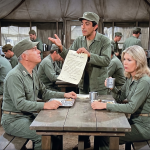
“Sirs! Oh, sorry, Father,” Radar gasped, sliding slightly on the damp floor before catching his balance against the edge of a nearby table. “Colonel wants everyone in the office. We’ve got a situation.”
Charles groaned, a deep, operatic sound of pure physical protest as he leaned back slightly, his hands still resting on the table. “O’Reilly, if the North Koreans have decided to launch an offensive at this ungodly hour, kindly inform them that the Captain from Boston is currently indisposed.”
“It’s not an attack, Captain Winchester,” Radar said, his breath coming in short, anxious puffs. “It’s… well, it’s a truck. From the supply depot at Uijeongbu. It broke an axle about a half-mile down the road, right by the old creek bed.”
B.J. sat up, his interest piqued despite his exhaustion. “A supply truck? Radar, don’t tell me they finally found our missing shipment of penicillin.”
“No, sir,” Radar said, looking nervously toward the kitchen where Potter’s boots could be heard stomping closer. “It’s worse. It’s the Thanksgiving turkeys. The ones that were supposed to get here three weeks ago. They’ve been sitting in a refrigerated compartment that isn’t refrigerating anymore.”
Charles stared at Radar, his eyebrows knitting together in a look of absolute horror. “Are you implying, Corporal, that we are about to be inundated with several hundred pounds of decomposing poultry?”
“The driver says they’re still good, but they’re thawing fast!” Radar squeaked. “And the Colonel says if we don’t get them into our icebox within the hour, the whole camp is going to smell like a biological hazard by sunrise!”
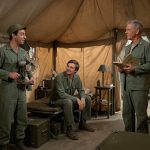
Before Charles could launch into a full-scale oratorical defense of his right to sleep, Colonel Potter marched into the main area of the tent, his bathrobe tied tightly around his waist, his face a map of stern determination.
“Alright, gentlemen, you heard the boy,” Potter barked, pointing a finger at B.J. and Charles. “I need every able-bodied man who isn’t currently holding a scalpel to get down to that creek. We’re forming a bucket brigade, except instead of water, we’re passing twenty-pound birds.”
“Colonel, really,” Charles protested, rising slowly from his chair with the reluctance of a man ascending the scaffold. “I am a thoracic surgeon, not a stevedore for salvaged poultry.”
“Winchester, right now you’re a soldier with two working arms,” Potter said, his tone softening just enough to show the underlying warmth of a father who knew exactly how tired his boys were. “Move it, Captain. Before those turkeys become a tactical weapon.”
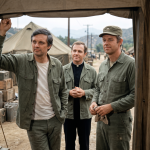
Ten minutes later, the three men were standing in the chilly, damp air just outside the Mess Tent, waiting for the first jeep to bring the cargo up from the broken truck. The night air was sharp, biting at their faces, a stark contrast to the stifling heat of the operating room.
B.J. looked over at Charles, who was currently trying to wrap his woolen scarf around his neck with an expression of profound martyrdom.
“Look on the bright side, Charles,” B.J. chuckled, shoving his hands into his pockets to keep them warm. “This is the closest you’ve gotten to a real Thanksgiving dinner since we crossed the ocean.”
“Hunnicutt, I assure you, back in Beacon Hill, the turkey does not arrive via a mud-splattered vehicle after midnight, nor is it handled by individuals who smell faintly of ether,” Charles replied, though he adjusted his grip on his jacket, preparing to work.
Father Mulcahy stepped up beside them, having rolled up his sleeves despite the cold. “You know, Charles, there is a certain spiritual beauty in unexpected labor. It keeps the mind occupied.”
“My mind, Father, was perfectly content being occupied by dreams of a warm bed and a complete lack of military hierarchy,” Charles muttered.
The first jeep rattled into the compound, its headlights cutting through the ground fog. In the back seat, Klinger was sitting atop a mountain of frozen, wrapped turkeys, wearing a velvet toque and a heavy winter coat, looking like a manic king of a very specific, frozen country.
“Hot tamales! Get ’em while they’re cold!” Klinger shouted, tossing the first frozen bird toward B.J., who caught it with a loud *thump* against his chest.
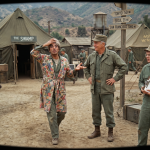
“Good catch, Beej!” Hawkeye’s voice echoed from across the compound as he jogged over, having just woken up, his purple bathrobe trailing in the dirt. “Careful, that one looks like it has a mean disposition.”
For the next forty-five minutes, the exhaustion that had weighed so heavily on the Mess Tent seemed to transform. It didn’t disappear—it never truly disappeared in Korea—but it shifted into something lighter, carried by the rhythm of the work and the absurd camaraderie of the 4077th.
They formed a line stretching from the jeep to the camp’s small walk-in freezer. B.J. passed to Charles, Charles, with an expression of intense distaste, passed to Father Mulcahy, and Mulcahy, with a cheerful “Bless you,” passed to Radar.
“You see, Winchester?” B.J. panted as he handed over another heavy, frozen bundle. “It’s all about the teamwork. The Boston assembly line.”
“If my father could see me now,” Charles muttered, swinging the turkey to Mulcahy with surprisingly efficient form, “he would disinherit me on the spot. I am handling frozen fowl in the middle of a wasteland.”
“And doing a magnificent job of it, Charles,” Father Mulcahy said, his face flushed with the exercise and the crisp night air. “Truly magnificent.”
By the time the final jeep was emptied, the first pale streaks of pink and grey were beginning to show over the tops of the jagged mountains to the east. The camp was quiet again, the frozen cargo safely stored away, and the threat of a poultry disaster successfully averted.
The three men walked back into the Mess Tent, their breath pluming in the early morning chill. They returned to the exact same wooden table, dropping into their seats with a collective, heavy sigh of relief.
The lukewarm tea was gone, but while they were working, Nurse Kelly had left a fresh pot of actual, steaming coffee on the burner. B.J. poured three cups, the rich, dark aroma filling the small space and washing away the lingering smell of damp canvas and cold mud.
Charles picked up his cup, holding it close to his chest to warm his hands. He looked across the table at B.J., then at Father Mulcahy. His hair was slightly disheveled, and there was a smudge of grease on his collar, but the aristocratic stiffness had given way to something much older and much softer.
“Well,” Charles said, lifting his cup an inch into the air, his voice quiet, stripped of its usual defensive pomp. “It was… adequate service, gentlemen. The Boston supply line held.”
B.J. smiled, a genuine, warm expression that crinkled the corners of his eyes. He raised his own glass cup, clinking it gently against Charles’s mug. “To the 4077th Thanksgiving, Charles. Three weeks late, but right on time.”
Father Mulcahy joined his cup to theirs, the ceramic making a soft, solid sound in the quiet morning. “And to the company we keep,” the Father whispered softly.
Outside, the first birds of the Korean morning began to chirp, a fragile, beautiful sound that existed entirely apart from the war. Inside the tent, three tired men drank their coffee in silence, holding onto the warmth of the room, the friendship, and the quiet knowledge that they had made it through one more night together.
Sometimes the best medicine in Korea didn’t come from a bottle, but from a shared cup of coffee and the friends who kept the cold away.