The Tangle of Human Kindness
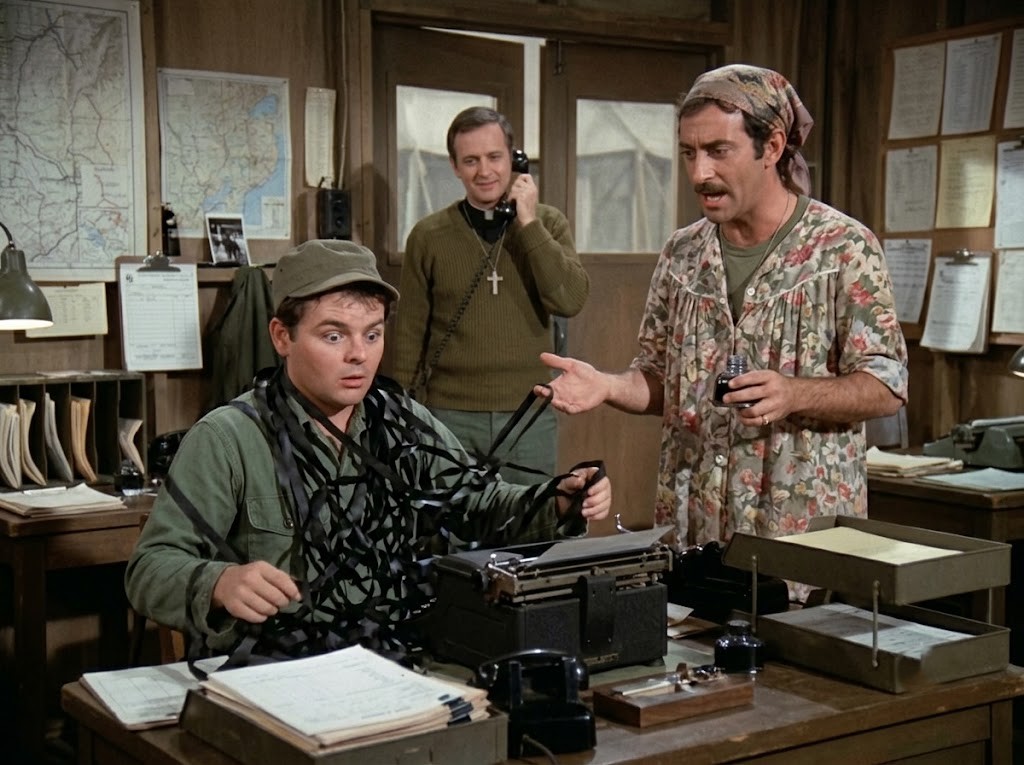
The clerk’s office at the 4077th M*A*S*H was usually a sanctuary of organized chaos, a small wooden room where the war was fought with carbon paper instead of scalpels. But on this particular Tuesday afternoon, Corporal Radar O’Reilly looked like he was losing the battle against his own desk.
A fresh batch of wounded had just passed through the OR, leaving the entire camp physically exhausted and emotionally drained. Among them was a young private from Iowa who had lost his right hand—his writing hand. He had begged Radar to type a letter to his mother back home before the official, cold Army telegram could reach her.
Radar had promised the boy it would go out on the afternoon supply chopper, which was scheduled to depart in less than fifteen minutes. It was a race against the clock, and Radar’s fingers were flying across the keys of his old typewriter like lightning.
Then, disaster struck.
With a loud, metallic snap, the ancient spool jammed. Radar, panicking about the deadline, gave the ribbon a frantic yank.
Instead of loosening, the brittle, ink-soaked ribbon erupted from the machine like an angry, black snake. Within seconds, Radar was completely ensnared, loops of dark fabric wrapping around his neck, his shoulders, and his hands, pinning him to his chair.
Just then, Corporal Maxwell Klinger strode into the office, looking like a tropical garden in a vibrant floral dress and a matching headscarf. He was holding a fresh bottle of ink, ready to complain about his latest supply requisition being denied.
Klinger stopped dead in his tracks, his eyes wide as he took in the spectacle of the company clerk wearing a modern-art costume of typewriter ribbon. “Radar,” Klinger said, gesturing with his free hand in utter disbelief, “I know you like to immerse yourself in your work, but this is ridiculous. Are you trying to mail yourself to Des Moines?”
Radar’s eyes were wide with genuine panic. “Klinger, don’t joke! This is the last ribbon in the supply cabinet, and if I tear it, I can’t finish Billy’s letter! He needs his mom to know he’s okay!”
In the background, the telephone began to ring. Father Mulcahy, who had walked in to check on the mail, picked up the receiver with a gentle, amused smile, watching the comedy unfold before him.
But as Mulcahy listened to the voice on the other end of the line, his smile instantly vanished.
“Radar,” the priest said, his voice dropping its usual warmth and tightening with urgency. “That’s Sparky. The weather is turning bad over the mountains. The chopper isn’t leaving in fifteen minutes—it’s landing on the pad right now, and the pilot is refusing to shut down his engines. They’re leaving in less than two00 seconds.”
Radar froze, staring down at his ink-tangled hands, completely trapped.
—
The distinct, rhythmic *thud-thud-thud* of helicopter blades began to vibrate through the floorboards of the office, rattling the clipboards on the wall. The sound always brought a chill to the camp, but right now, it sounded like a ticking countdown.
“Father, I can’t move!” Radar cried out, his voice cracking with the pure, desperate innocence that made everyone in the unit want to protect him. “If I pull away, the ribbon will snap, and the letter is only half-done! Billy’s mom is going to get that awful government telegram first. She’ll think the worst!”
Klinger looked at Radar, then looked down at his own floral dress, and finally at the bottle of ink in his hand. Beneath the theatrical outfits, the constant schemes for a Section 8 discharge, and the endless grumbling, Maxwell Klinger possessed a heart as big as the city of Toledo.
He set the ink bottle down on the desk with a sharp click.
“Hold your horses, Iowa,” Klinger said, his voice suddenly steady, completely dropping the drama. “Don’t move a single muscle. You just stay as still as a statue.”
With surprising gentleness, Klinger leaned over the desk. His large, calloused hands, usually rough from camp chores, became incredibly delicate as he began to untangle the black web. He treated the cheap, ink-soaked fabric as if it were the finest lace on a wedding gown.
Father Mulcahy spoke rapidly into the telephone receiver, his gentle eyes burning with determination. “Sparky! Listen to me, it’s Father Mulcahy. You tell that pilot he needs to check his oil. Tell him he needs to check his conscience! He cannot leave yet. We have a passenger of the soul that needs to be on that flight. Just give us two minutes!”
Captain Hawkeye Pierce and Captain B.J. Hunnicutt strolled into the office, their scrubs still stained with the exhaustion of the morning’s surgery. They opened their mouths, undoubtedly prepared to deliver a barrage of quick-witted jokes at the sight of Radar wrapped in ribbon and Klinger acting as his stylist.
But Hawkeye caught the look in Radar’s wide, wet eyes, and B.J. noticed the intense focus on Klinger’s face. The jokes died in their throats.
“What do we need?” Hawkeye asked quietly, instantly shifting from a cynical doctor to a supportive brother.
“The carriage is stuck, Hawk,” Radar whispered, afraid that breathing too hard would tear the ribbon. “And I still have two sentences left to type.”
Hawkeye stepped forward, his surgeon’s fingers moving in to hold the paper steady against the roller. B.J. grabbed a wooden pencil from the desk, using the eraser end to manually turn the typewriter spool, easing the tension on the ribbon so Klinger could guide it back into the metal slots.
It was a beautiful, silent choreography of found family. Five men, brought together by a war they didn’t want, standing around a battered desk in the middle of nowhere, working to save a mother’s peace of mind.
“Dictate it to me, Radar,” B.J. whispered, his thumb resting on the spacebar. “Go ahead, buddy.”
Radar closed his eyes, remembering the young soldier’s tearful words in the Post-Op tent. “Write… ‘The doctors here are top-notch, Mom. They fixed me up real good. Don’t you worry about my hand… because I’m still coming home to you.'”
Hawkeye reached over, using his index finger to carefully punch out the final letters on the keys. *T-H-E-E-N-D.*
“It’s clear!” Klinger announced, successfully threading the last loop of ribbon back into the guide.
Hawkeye ripped the paper out of the carriage with a sharp, satisfying snap. Radar didn’t even care about the black ink smudged across his own nose and cheeks; he grabbed a pen, scrawled his signature at the bottom as a witness, and stuffed it into an envelope.
Klinger snatched the envelope out of Radar’s hand before the glue was even dry.
“I’ve got it!” Klinger yelled, turning on his heel. He bolted through the screen door, his floral skirt billowing behind him like a parachute as he sprinted through the mud toward the helicopter pad, yelling at the top of his lungs for the pilot to wait.
The office suddenly fell completely silent, save for the fading roar of the chopper blades as it lifted off into the grey Korean sky.
Hawkeye looked down at his fingers, which were now stained a deep, permanent black from the typewriter ribbon. He wiped his hands on his scrubs and let out a soft, tired laugh. “Well, if anyone asks, I’ve officially been fingerprinted by the United States Army.”
B.J. smiled, clapping a hand on Radar’s shoulder. “Good job, Radar. You look like a raccoon, but you did good.”
Father Mulcahy gently hung up the telephone receiver, a look of profound peace washing over his face. “A cup of water given in His name,” he murmured softly to himself, looking out the window as the helicopter disappeared into the clouds.
Radar sank back into his chair, rubbing his tired eyes, leaving another smudge of black ink across his forehead. He looked at the old typewriter, then at his friends, feeling the incredible warmth of the people who surrounded him.
They were tired, they were cold, and they were thousands of miles away from home. But in that small, cluttered room, they had managed to keep the world just a little bit brighter for one more day.
—
Sometimes, the most important stitches sewn at the 4077th didn’t happen in the Operating Room.