The Floral Defense of Corporal Klinger
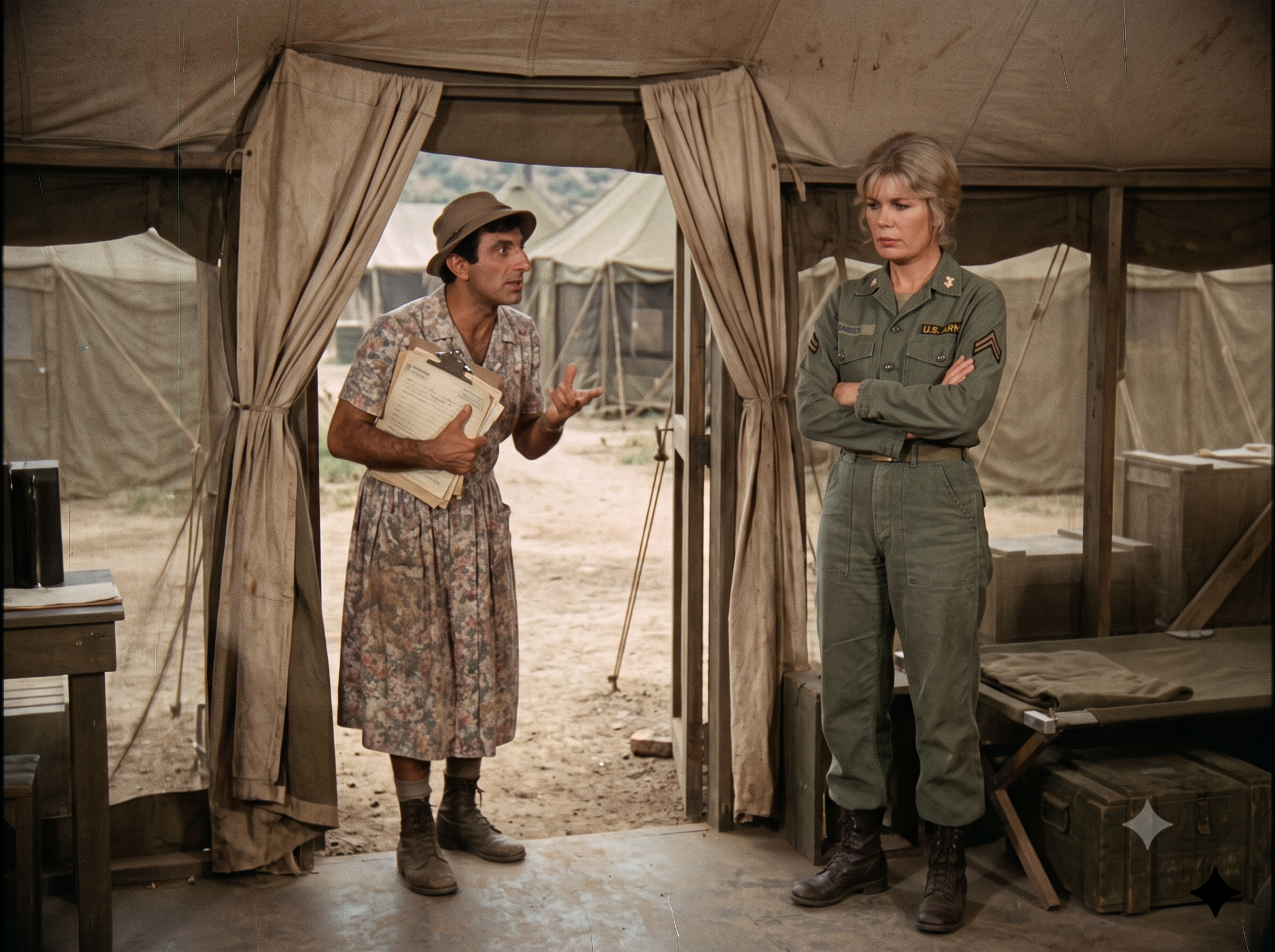
There were very few things in the 4077th that could be called predictable.
The casualties arrived on their own terrible schedule, the mess tent food was consistently unidentifiable, and the heat of the Korean afternoon was a heavy, suffocating blanket of dust and despair.
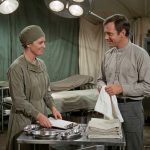
Major Margaret Houlihan was simply trying to find three minutes of order in the relentless chaos.
Standing inside the dim, stifling canvas walls of the supply tent, she was exhausted. Her feet ached, her head throbbed, and her patience had worn entirely thin. Yet, she stood perfectly upright. Her green fatigues were as crisp as a footlocker iron would allow.
She was an island of military discipline in a sea of dusty beige canvas, trying to maintain her dignity in a place that actively worked to strip it away.
Then, the canvas flaps of the tent doorway parted.
Corporal Maxwell Klinger made his entrance, pausing squarely in the wooden doorframe to ensure maximum dramatic effect.
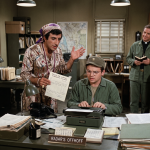
He was a vision of inappropriate spring fashion. He wore a faded, short-sleeved floral dress that looked like it had been stolen from a Toledo thrift store a decade ago. Perched upon his head was a sensible, somewhat crushed beige sun hat.
Beneath the hem of the dress, his dusty, heavy Army-issue combat boots remained firmly planted on the dirt path.
He clutched a wooden clipboard to his chest, his free hand thrown out in a theatrical gesture of deeply wounded dignity. He looked like a tragic heroine who had just been terribly misunderstood.
Margaret didn’t flinch. She didn’t sigh. She simply crossed her arms defensively across her chest.
She fixed him with a look of pure, controlled frustration and profound skepticism. It was a facial expression she had perfected over months of dealing with the absolute madness of this camp.
“Whatever it is, Corporal,” Margaret stated, her voice tight and clipped, “the answer is absolutely, unequivocally no.”
Klinger’s hand fluttered in the air, his face the picture of exaggerated offense. “Major, please! You wound me to my very core. I am not here as a petitioner of insanity. I am here as a victim of the United States military bureaucracy.”
Margaret maintained her rigid, unyielding posture. She was entirely used to his elaborate Section 8 schemes.
She had survived the phantom pregnancies, the imaginary brothers, the sudden bouts of amnesia, and the time he claimed to be a Russian grand duchess. She was not in the mood for amateur theater.
“I am not signing another requisition form for a strapless evening gown, Klinger,” she warned.
But as Klinger stepped fully into the light of the doorway, Margaret noticed something different.
The theatrical flair was certainly there, and the outfit was as ridiculous as ever, but his knuckles were stark white where they gripped the edge of the clipboard.
The usual spark of manic mischief in his dark eyes was gone, replaced by a tight, genuine panic that he was trying very hard to hide behind his feminine persona.
“I’m not kidding this time, Major,” Klinger said, his voice suddenly dropping its dramatic pitch, cracking just a little.
He held out the clipboard, his hand trembling slightly. “Tokyo messed up. They reclassified my MOS by accident. There’s a transport jeep idling out by the motor pool, waiting to take me to the 3rd Infantry at the front line.”
Margaret stared at him, her heart skipping a cold beat.
“And Colonel Potter,” Klinger swallowed hard, his eyes wide with genuine fear, “is scrubbed in for surgery.”
Margaret did not immediately unfold her arms.
She stood frozen in the dusty beige light, staring at the man in the doorway. Maxwell Klinger, dressed in a faded spring floral print, being handed an M1 rifle and sent to a muddy foxhole under heavy artillery fire.
The sheer absurdity of the image would have been hilarious if it wasn’t a sudden, terrifying death sentence.
She dropped her arms and stepped forward, snatching the clipboard from his trembling hands.
Margaret scanned the mimeographed sheet of paper. Her eyes darted across the typewritten lines. It was true. It was a genuine, officially stamped transfer order from I-Corps headquarters.
A faceless clerk at a typewriter in Tokyo had accidentally shuffled Corporal M. Klinger from a mobile hospital clerk to a frontline combat replacement.
The Army was Margaret’s life. She believed in the chain of command, she believed in regulations, and she believed in following orders to the letter.
But looking at Klinger—who was currently trying to adjust his sun hat to look more pathetic, though his hands were shaking too much to do it properly—she felt a familiar, fierce protectiveness flare up in her chest.
These people were a band of insubordinate, maddening lunatics. But they were her lunatics.
“Why didn’t you go to Captain Pierce or Captain Hunnicutt?” she demanded, her tone remaining sharp, though it had lost its punishing edge.
“They’re in the OR with the Colonel, Major,” Klinger pleaded, his voice tinged with desperation. “They’re up to their elbows in a belly wound. You’re the highest-ranking officer available. You gotta do something!”
Klinger gestured wildly to his outfit, his wounded dignity flaring up again as a defense mechanism against his fear. “Look at me! Does this look like a combat soldier? I am wearing a pastel floral! I won’t blend in with the foliage, Major! I’ll be a walking target for anyone who hates spring colors!”
Margaret sighed deeply, pinching the bridge of her nose to stave off an incoming headache.
“I cannot simply sign a fake medical discharge, Klinger,” she explained, trying to keep her voice steady. “If I forge a Section 8, I will be court-martialed, and you will still end up on that transport jeep.”
Klinger’s shoulders slumped in defeat. The theatrical energy vanished completely, leaving only a tired, scared kid from Toledo standing in a dusty dress.
“So that’s it then,” he said quietly. “I go out there… like this?”
Margaret looked out the tent doorway. She could see the dust kicking up near the motor pool. The war was hungry, and it didn’t care about clerical errors.
Her mind, usually a steel trap for enforcing regulations, desperately began searching through the thick manual of Army red tape for a loophole.
Suddenly, her eyes narrowed. She turned on her heel and marched over to the supply desk. She grabbed a red grease pencil and a heavy rubber stamp.
“You are not going to the front lines today, Corporal,” Margaret said firmly, her voice echoing with total authority.
“I’m not?” Klinger asked, blinking in confusion.
“No,” she said, furiously striking out lines on his transfer order with the red pencil. “Because according to Army Medical Regulation 412, subsection C, critical medical personnel cannot be reassigned during an active triage and surgical situation.”
Klinger stepped into the tent, thoroughly confused. “But Major, I’m just a company clerk. I type forms and I wear chiffon.”
“You are currently,” Margaret declared, slamming the heavy rubber stamp down onto the paperwork with a loud, echoing THWACK, “the Acting Assistant to the Head Nurse in charge of critical sterile inventory.”
She looked up at him, her eyes fierce. “Which makes you essential medical personnel. Your transfer is hereby suspended indefinitely, pending a full, in-person review by the commanding officer. And Colonel Potter won’t have time for a review until next Tuesday at the earliest.”
She walked back to the doorway and shoved the clipboard hard into his chest.
Klinger looked down at the red ink crossing out his doom, and then up at Margaret. His dark eyes were wide with shock, and a profound, quiet gratitude.
For a long moment, neither of them spoke. The sounds of the camp—a distant helicopter, the hum of the generator—filled the silence between them.
“Major…” Klinger whispered, his voice thick with emotion. “I… I don’t know what to say. You saved my life.”
Margaret immediately took a step back, putting distance between them. She instantly re-crossed her arms over her chest, her posture rigid once again.
Her face hardened back into that perfect mask of controlled frustration, though her eyes remained unmistakably soft.
“Don’t flatter yourself, Corporal,” she said briskly. “Good company clerks are exceptionally hard to find in this miserable country. I don’t have time to train a replacement.”
She looked him up and down, her lip curling slightly. “And frankly, that dress is entirely inappropriate for a combat zone. The hemline is a disgrace.”
A slow, brilliant smile broke across Klinger’s face, completely shattering his tragic persona. He stood up straight, snapping his worn combat boots together beneath the floral skirt.
“Yes, Major,” Klinger said.
He offered her a surprisingly crisp, perfect military salute. “Thank you, Major.”
Margaret returned the salute with sharp precision. “Dismissed, Corporal. Get back to the office before I put you on latrine duty.”
Klinger turned and walked back out into the bright, dusty camp, his skirt swishing gently with every step. Margaret stood in the doorway, watching him go. A tiny, invisible smile touched the corners of her lips for just a fraction of a second, before she turned back into the shadows of the tent to face the unending work of the 4077th.
In a place where the world felt like it was ending every day, sometimes the bravest thing you could do was protect the family you didn’t ask for.