The Paperwork of Peace in the Middle of Nowhere
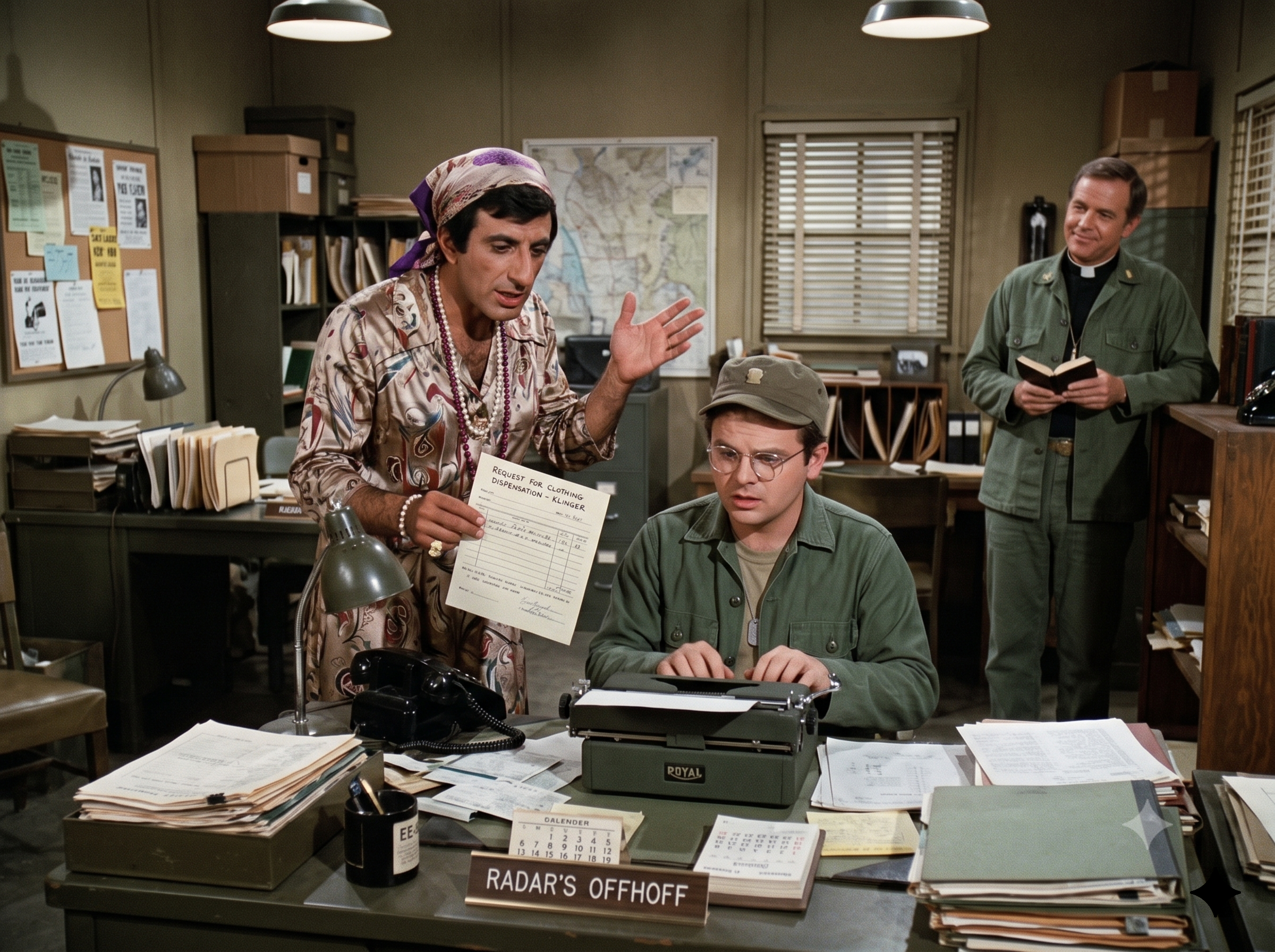
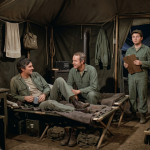
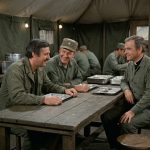
The air in the office was thick with the scent of mimeograph ink, stale coffee, and the unique, dusty smell of a Korean summer that just wouldn’t quit.
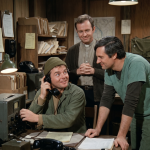
Radar O’Reilly sat at his desk, his fingers hovering over the keys of his Royal typewriter like a concert pianist preparing for a particularly frantic concerto.
He was in his element, surrounded by the organized chaos of the 4077th, but even he looked frazzled.
Then, the door swung open, and the atmosphere shifted instantly.
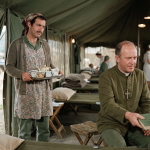
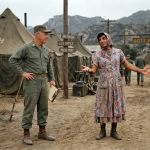
In walked Maxwell Klinger, looking like a silk-clad vision of defiant absurdity in a floral wrap dress and headscarf.
He wasn’t just walking; he was practically conducting an opera of frustration.
He slammed a paper onto Radar’s desk—a formal “Request for Clothing Dispensation.”
“Radar, look at this!” Klinger exclaimed, his voice rising, his hands gesturing wildly as if trying to push away the very walls of the compound.
“I’ve filled this out in triplicate, I’ve had it signed by the supply sergeant, and I even included a personal testimonial from a goat I met near the mess tent!”
Radar looked up, his glasses sliding slightly down his nose, his expression a mix of genuine worry and habitual, polite panic.
“Klinger, I… I really don’t think that’s going to help your case for a section eight,” Radar stammered, looking at the document as if it were a live grenade.
In the corner, Father Mulcahy stood quietly, clutching his small prayer book, his eyes moving back and forth between the two men with a look of helpless, gentle concern.
The tension in the room wasn’t about the war outside, but the exhausting, persistent demand for sanity inside.
Klinger leaned in, his face intense and surprisingly vulnerable under the layers of costume, and his voice dropped to a desperate, shaky whisper.
“Radar, if this doesn’t work, I don’t know what’s left for me to do.”
Radar froze.
The humor that usually surrounded Klinger’s antics evaporated, leaving behind the stark, uncomfortable truth of where they all were.
The office went silent, save for the hum of a ceiling fan that seemed to be struggling as much as they were.
Radar looked at the paper, then back at Klinger, who was holding his breath, waiting for a rejection that felt like it would break him.
Father Mulcahy took a step forward, his voice soft but steady, cutting through the heavy air.
“Maxwell,” the priest said, his eyes kind and tired, “perhaps the dispensation isn’t for the Army to give, but for us to find for each other.”
Klinger blinked, his theatrical posture sagging just an inch, his bravado finally flickering out.
He looked at the document, then down at his floral sleeves, and a long, ragged sigh escaped him.
Radar didn’t say a word, but his hands moved.
He pulled the document closer, straightened it out on the desk, and began to type.
He wasn’t typing a refusal; he was typing a note to Colonel Potter, a recommendation filled with the kind of bureaucratic double-talk that only Radar could craft—a gentle, protective shield for a friend.
As the typewriter clicked rhythmically, the sound became a heartbeat for the room.
Klinger watched, his shoulders dropping, the fierce lines of his face softening into something resembling peace.
He reached out and placed a hand on the desk, not to demand, but to steady himself.
Father Mulcahy moved closer, placing a hand on Klinger’s shoulder, a silent gesture of solidarity that said more than any sermon.
They stood there for a long moment—the harried clerk, the weary soldier in drag, and the gentle priest—anchored together in the middle of a war that seemed determined to tear them apart.
There were no fireworks, no grand speeches, just the quiet realization that they were all they had.
Klinger finally offered a small, crooked smile, the kind that didn’t hide his pain but acknowledged it, and nodded to Radar.
The office was still just an office, the war was still just over the hill, and the paperwork was never-ending.
But for a few seconds, the exhaustion of the 4077th felt a little more bearable, buffered by the simple, stubborn act of caring for one another.
In the end, it was never about the paperwork; it was about who was holding the pen.