The Mess Tent Liturgy
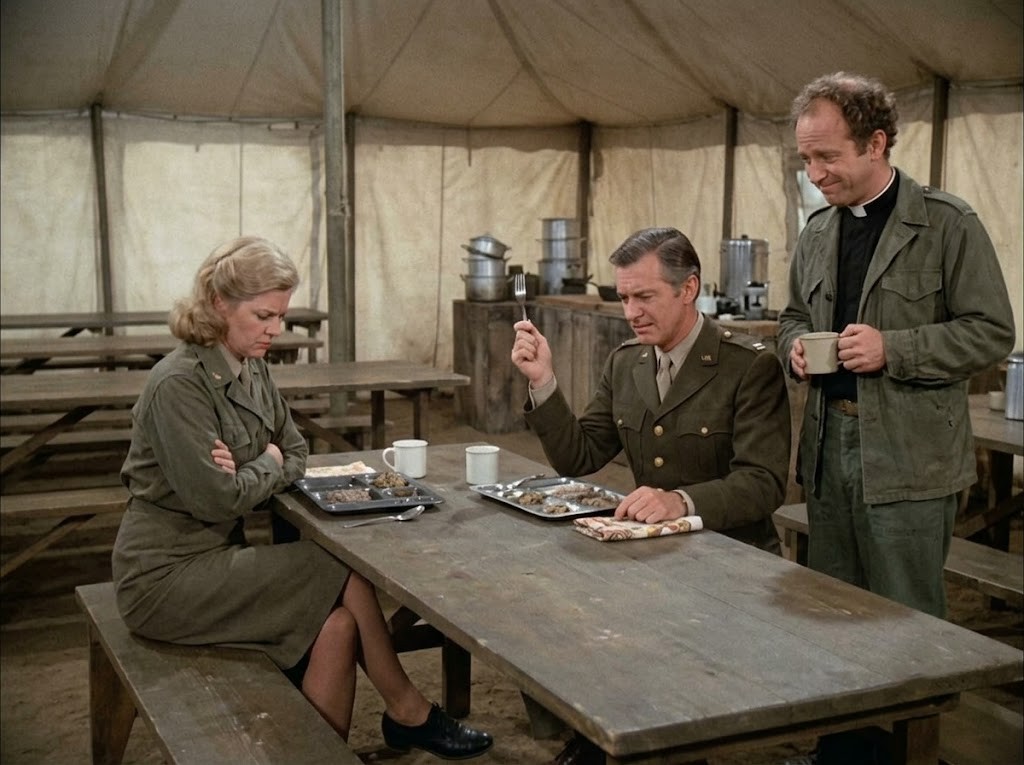
The mess tent of the 4077th was rarely a place of comfort, but it was almost always a stage for the quiet theatre of the exhausted. On this particular Tuesday, the air hung heavy with the smell of creamed chipped beef and the damp canvas of a Korean afternoon.
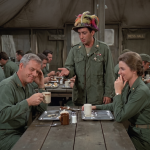
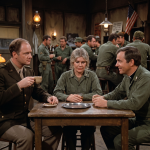
Major Margaret Houlihan sat perfectly still at the long wooden table, her arms crossed so tightly against her chest that her knuckles were entirely white. She was staring a hole directly through the metal compartments of her tray, refusing to engage, refusing to surrender to the headache pulsing relentlessly behind her eyes.
Across the table sat a visiting Lieutenant Colonel from I Corps Headquarters. He looked entirely out of place in his pristine, impeccably tailored Class A uniform, not a single wrinkle betraying the reality of the war raging just miles away. He had arrived an hour ago to conduct a “routine morale and hygiene” inspection, blissfully oblivious to the fact that the surgical staff had just finished an agonizing eighteen-hour marathon in the operating room.
Standing quietly to the right of the table was Father Mulcahy. He clutched his tan ceramic mug of lukewarm coffee with both hands, his gentle eyes crinkling in a mixture of mild amusement and deep pastoral concern. He knew the warning signs of an impending emotional eruption, and Margaret was currently functioning as a highly volatile, dormant volcano.
“It’s really about personal discipline, Major,” the visiting Colonel droned on, oblivious to the absolute frost radiating from the woman across the table.
He raised his fork gracefully into the air, pausing to hold a pale, unidentifiable lump of mess tent food aloft as if he were examining a fine jewel. “Even in adverse combat conditions, a properly maintained diet and a positive, forward-looking outlook are what separate the officers from the enlisted men.”
Margaret’s jaw clenched so hard it was a wonder her teeth didn’t shatter. The muscles in her neck pulled tight beneath the collar of her faded green fatigues. She hadn’t slept since Sunday morning, and her famous military composure was currently being held together by nothing more than bobby pins and pure, unadulterated exhaustion.
Father Mulcahy took a slow, deliberate sip from his mug. He watched the silver fork waver in the air, listening to the Colonel wax poetic about the nutritional benefits of military logistics and rear-echelon planning.
“Why, I venture to say,” the Colonel continued, waving the fork for dramatic emphasis while flashing a bemused smile, “that if one simply approaches this ration with the right attitude, it tastes absolutely no different than a hearty Sunday roast back in the States. Wouldn’t you agree, Major?”
Margaret slowly raised her eyes from her metal tray. The silence in the tent suddenly grew incredibly heavy, thick enough to cut with a scalpel. Father Mulcahy took a small, nervous step forward, bracing himself for the inevitable blast of shrapnel.
The silence stretched out, thin and fragile as a surgical thread. Father Mulcahy knew Margaret better than most; he saw past the brass, the regulations, and the strict exterior to the deeply caring, profoundly exhausted woman underneath. He knew that if she opened her mouth right at this very moment, she might say something that would end her military career, or at the very least, earn her an immediate court-martial.
“I believe,” Father Mulcahy said, his voice cutting through the tension like a soft, cooling breeze, “that the Major is currently engaging in a silent, deeply spiritual reflection on the… unique culinary challenges we face here at the 4077th.”
The visiting Colonel paused, his fork still hovering uselessly in the air. He turned his head to look at the priest, slightly bewildered by the sudden interruption. “Reflection, Father?”
“Oh, indeed,” Mulcahy continued, stepping closer to the table and offering a warm, utterly disarming smile. He looked closely at the sad lump of food resting on the Colonel’s fork. “In fact, Colonel, your observation about discipline is incredibly timely. Brigadier General Hammond was just expressing a similar sentiment during his last visit, and he was particularly interested in how visiting dignitaries evaluate our supply lines.”
The Colonel’s posture straightened immediately at the mere mention of the General’s name. The pompous air of the lecture evaporated in an instant, replaced by the sudden, nervous energy of an ambitious career officer. He lowered his fork, suddenly looking at the grim food on his tray with entirely different, highly scrutinizing eyes.
“General Hammond, you say?” the Colonel murmured, clearing his throat and adjusting his brown tie.
“Yes, indeed,” Mulcahy said brightly, nodding his head. “He usually starts his evaluations over at the motor pool. I believe our company clerk mentioned something about the General’s transport logs needing an urgent, expert review. Perhaps your expertise would be absolutely invaluable over there right now.”
It was a masterful, elegant deflection, delivered with the pure, innocent grace that only Father Mulcahy could naturally muster. The visiting Colonel quickly wiped his mouth with a paper napkin, standing up abruptly from the wooden bench and smoothing down the front of his immaculate jacket.
“Well,” the Colonel said, coughing slightly into his fist. “Duty calls, as they say. A pleasure, Major. Father.”
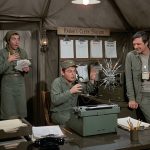
He marched briskly out of the mess tent, leaving a profound wake of silence behind him. Mulcahy waited until the heavy canvas flaps swung shut before he let out a long, quiet exhale. The tension that had filled the space, much like the frozen moment captured perfectly in the file G (3).jpg, finally began to dissipate into the damp Korean air.
Margaret didn’t move for a long moment. Then, very slowly, her crossed arms finally dropped to her sides. Her shoulders slumped forward, losing the rigid, perfect military posture she maintained so fiercely in front of the nurses and the doctors. She let out a breath that sounded suspiciously like a broken sob, though she quickly and expertly swallowed it down.
Father Mulcahy pulled out the bench opposite her and sat down smoothly. He didn’t offer any empty platitudes, nor did he try to make a joke to lighten the mood. He simply sat there, a quiet, steadfast anchor in the drab, canvas room.
“Are you alright, Margaret?” he asked, his voice now barely above a gentle whisper.
Margaret stared at her untouched tray, her eyes glossy with unshed tears. “I lost a boy this morning, Father. Nineteen years old, from somewhere in Ohio. It took us six hours just to try and put him back together.” She closed her eyes tightly, resting her forehead heavily in the palms of her hands. “And then I come in here to sit down, and this… this immaculate, perfectly pressed fool wants to lecture me about the nutritional value of canned meat.”
“The world is full of people who speak the loudest when they have absolutely nothing of substance to say,” Mulcahy said gently, resting his hands on his warm mug. “It is a heavy cross we all must bear in this place. But you bore it with remarkable grace.”
Margaret let out a short, dry laugh, rubbing her tired eyes with the back of her hand. “I was going to stab him with my spoon, Father. I really was.”
“I know,” Mulcahy smiled, his eyes twinkling with a shared, secret understanding. “That is precisely why I mentioned the General. Your spoons are far too valuable for the surgical ward, and we simply cannot afford to lose a good head nurse over a bad plate of powdered eggs.”
Margaret looked up at the priest, a profound sense of gratitude washing over her features. The hardened, unyielding shell of Major Houlihan was completely gone, leaving only Margaret—tired, deeply human, and immensely grateful for the quiet protection of a dear friend. The mess tent was empty save for the two of them, accompanied only by the distant hum of the camp going about its daily survival outside the thin canvas walls.
“Thank you, Father,” she said softly, the genuine emotion clear in her voice.
“You are very welcome, my dear,” Mulcahy replied, tapping his ceramic mug gently against her metal tray in a silent, meaningful toast. “Now, please try to eat something. Even if you just push it around with a fork to maintain discipline.”
Margaret smiled, a genuine, weary smile that finally reached her eyes and softened the harsh lines of exhaustion on her face. In the sheer madness of the war, surrounded by mud, blood, and endless fatigue, it was these small, quiet interventions that kept them all from completely falling apart. They were a makeshift family forged in a terrible crucible, held tightly together by shared exhaustion, quiet dignity, and the unspoken promise to always look out for one another.
In a place where tomorrow was never promised, survival was often found at the bottom of a lukewarm cup of coffee, shared with a friend who simply understood.