The 4077th: Static and Silence.
You didn’t need a calendar to tell time at the 4077th. You just needed to listen. There was the constant, low-level thrum of generators, the rattle of laundry carts, and the occasional, distant *whump* of something that you hoped was just artillery testing.
And then there was the silence. The worst kind of silence was the one that followed a long, exhausted surgical shift. It was the heavy, collective exhale of people who had done everything they could, only to realize the world outside would just ask them to do it all again.
Today, the silence wasn’t in the operating room. It was in the Swamp.
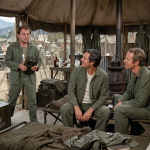
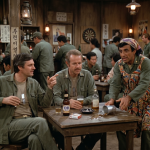
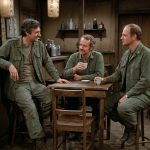
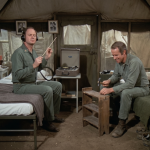
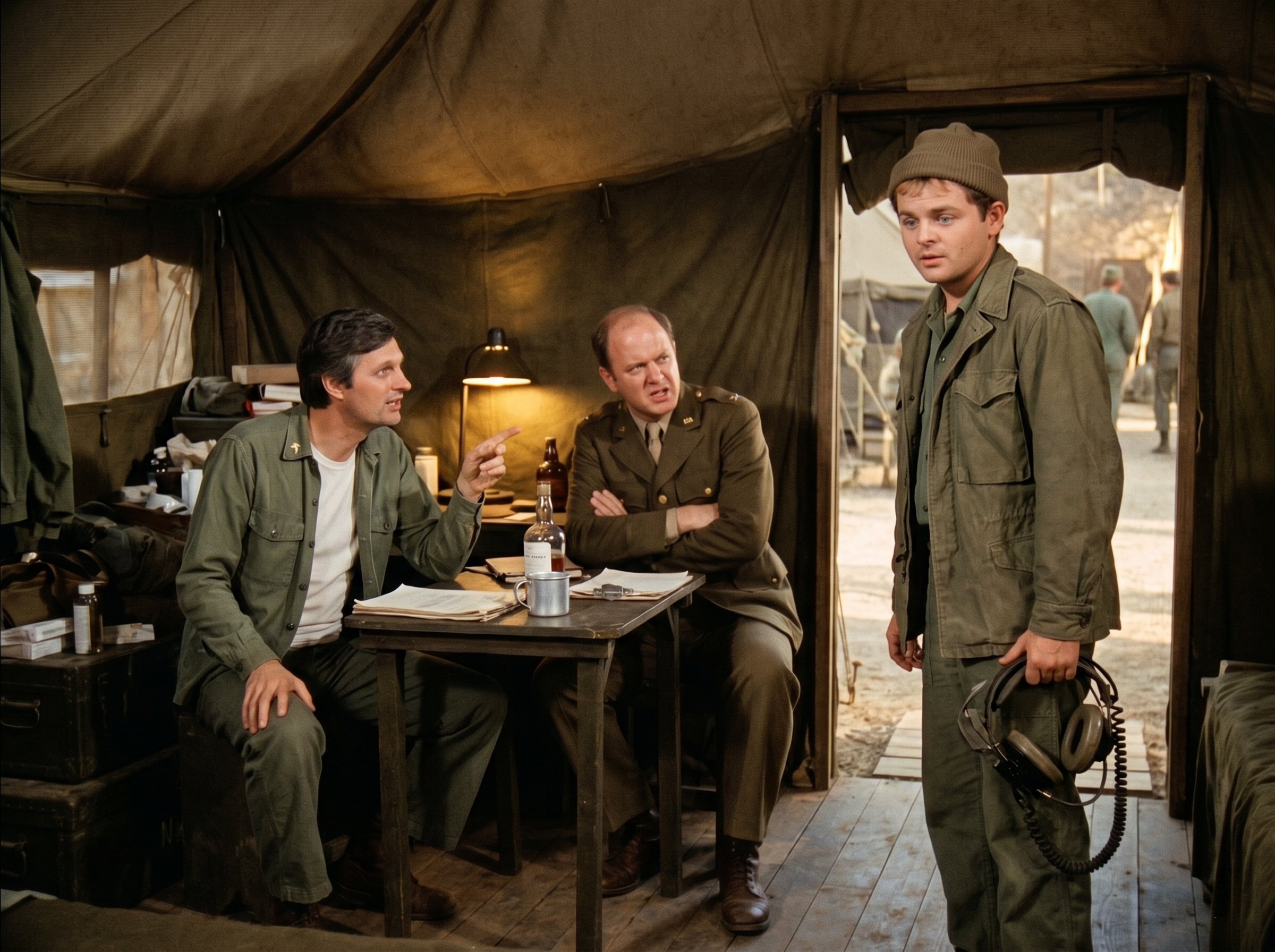
The tent itself felt different, less a sanctuary of dry humor and gin, and more a confined space of held breath. The small lamp was on, a warm but insufficient orb against the invading fatigue. Hawkeye and Charles were seated at the small wooden desk, their usual positions of sparring replaced by something more dangerous: waiting.
Hawkeye wasn’t bouncing a witty retort off of Charles. Charles wasn’t retreating into his high-brow snobbery. Hawkeye just looked exhausted, his right hand tracing patterns on his knee, the index finger of his left pointing, slightly aggressively, at a blank piece of paper, as if he could demand words onto the page by sheer will.
Charles, still in his dress greens and looking remarkably unwrinkled given the hour and the heat, sat with his arms crossed over his chest, his mouth set in a grim line. His default posture of irritation had hardened into genuine, quiet worry. He wasn’t even attempting to be superior.
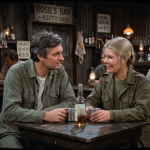
Between them lay a small, tin metal cup, half-full of something amber and antiseptic, and a single, unadorned glass bottle of cheap whiskey, its seal broken. It wasn’t the kind of alcohol you drank for fun.
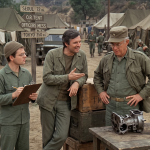
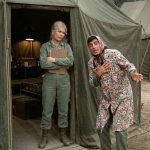
Radar stood in the center, just inside the flap, caught in the doorway’s dusty light. He still held the massive, cumbersome radio headset in his right hand. He was the messenger, but he had no message. His face, visible from the back, was etched in a tension that was painful to watch. The innocent, eager-to-please Radar seemed to have vanished, replaced by a young man who had seen too much waiting.
“It’s just static, sir,” Radar’s small voice cracked, and even without seeing his expression, you knew it.
Hawkeye closed his eyes. The finger stopped pointing. “Static isn’t an answer, Radar. It’s an absence of an answer. Try again.”
Radar shifted. “Colonel, Captain, I’ve tried every frequency. Sparky says the reception is clear for *every* other unit. It’s just… nothing from *them*.”
Charles let out a long, slow breath through his nose. “And what does the… ‘Sparky’ of Seoul suggest, Corporal O’Reilly? Is the atmosphere to blame for an entire platoon being, shall we say, incommunicado?”
“No, sir,” Radar said. His voice was steadying, but only through effort. “The lines are open. But they’re just… not there.”
The implication hung in the air, heavier than the humidity. B.J., who had been quietly tending to a tear in his field jacket near the back of the tent, put down the sewing kit. He walked toward the desk.
“Okay, guys,” B.J. said, voice calm and steady. “Let’s be realistic. No news isn’t bad news. Yet. They could be… maybe they’re radio-silent for tactical reasons. Maybe they had to move positions.”
“Maybe they’re gone,” Hawkeye said, his voice quiet and dangerously flat.
The silence returned, but this time, it felt like it might suffocate them all. B.J. didn’t argue. He just rested a hand on Hawkeye’s shoulder. Radar took a half-step further into the tent, as if looking for cover. And that’s when they heard it. The distinctive, rhythmic *thwup-thwup-thwup* of a helicopter approaching from the north.
The sound of the helicopter cut through the Swamp like a sharp knife. In the 4077th, a incoming chopper was not just transportation; it was a signal, a change in reality.
B.J.’s hand tightened on Hawkeye’s shoulder. Hawkeye’s head snapped up. Charles’s arms uncrossed with a jerk, his hands immediately checking the button of his top pocket, a reflex. Radar didn’t move, but the headset in his hand began to tremble.
“Could be medical?” Charles asked, but nobody believed him. Medical drops were preceded by a radio call.
“It’s them,” Hawkeye said. He didn’t sound relieved. He sounded like a man walking into a room he knew he’d hate.
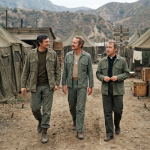
They all filed out, Hawkeye leading, then Charles, and B.J. silently taking up the rear. Radar was left standing just inside the tent flap, holding the headset as the helicopter’s dust wash began to rustle the canvas.
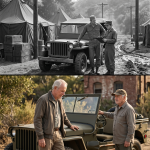
The landing was tense. The red cross was visible, but standard, and didn’t ease the waiting minds. Out stepped a single officer—not a whole platoon, not a wounded casualty list. Just one man.
The waiting felt like an eternity. It was Colonel Potter who spoke first, emerging from his office. “Major? Captain? What news do you bring?”
The Major, looking haggard and dust-covered, removed his helmet. “It was… bad, Colonel. We got hit. Hard. We managed to pull back. Most of us are in one piece. But we lost communication in the chaos.”
“How many?” Hawkeye demanded.
The Major paused, his expression crumpling for just a fraction of a second before he re-found his military bearing. “Six. We found five of them. We’re still looking… looking for one.”
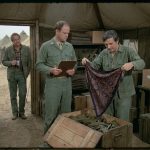
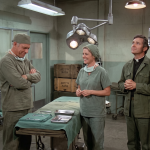
He handed a clipboard with a list of names to Colonel Potter. Potter glanced down, his face a mask of practiced stoicism. He nodded, once, and said, “Alright. The OR is on standby, if needed.”
The tension in the Swamp, back in the tent, hadn’t broken; it had only changed its color. The list was a concrete confirmation of loss, and the ‘one’ still missing hung over everything.
They were back in the same spots, a few hours later, though the lamp was lower, and the shadows longer. Radar was gone, sent to coordinate the actual information. B.J. was back near his cot. Hawkeye and Charles were at the desk. The whiskey bottle was now emptier.
Charles sat, swirling the liquid in his tin cup. “The… Major from the base? He seemed like a reasonable man. Thorough.”
Hawkeye let out a bitter laugh. “Reasonable men do not send platoons into meat grinders, Charles.”
“Don’t start,” B.J. warned from the shadows.
“No, let him,” Charles said, his voice unusually soft. “Let him say it. Reasonable. Inexcusable. It doesn’t matter. We will mend what we can. We will write letters to the mothers of five of them. And we will simply… wait for the sixth.”
This time, Charles did not say it with the air of an upper-class intellectual analyzing a social ill. He said it with the voice of a man who had seen his share of impossible waiting in the operating room. He was validating Hawkeye’s despair without excusing the outcome.
Hawkeye picked up the bottle. He didn’t look at the list, still resting on the table. “They were just kids, B.J. Just… kids with radio headsets and a willingness to be ‘reasonable’.”
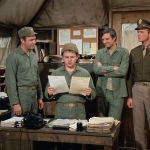
The tent flap rustled again. Radar. He wasn’t holding the big radio headset anymore, but he had a small slip of paper in his hands. His face was different. It wasn’t relief. It was something quieter. Something like found peace.
“Sir,” Radar addressed Colonel Potter, who had followed him in. “They… found him.”
The single word, “found,” made everyone freeze.
“Who, Radar? Which one?” Potter asked, though they all knew.
Radar looked down at the slip of paper. “The… missing one. Corporal Thomas. His ID tags. They… they identified him. He’s… gone, too, sir.”
The news shouldn’t have felt better, but it did. It didn’t fix anything, but it allowed the tension to diffuse. The static of unknown possibility was replaced by the clarity of grief.
Hawkeye didn’t say anything. He just looked at the desk, at the space where the list rested. He reached out and placed the bottle, still unpoured, next to the list. He wasn’t drinking for anger anymore. He was just placing a sentinel.
Charles stood, smoothed his uniform one last time, and picked up his cup. He looked at Hawkeye, then at the list, then at the bottle. He raised the tin cup in a silent toast. It wasn’t to the Major, or the army, or even the memory. It was to the silent truth they all shared.
B.J. finally put down the jacket and walked over. He didn’t speak. He just sat at the edge of the cot and closed his eyes.
They would carry this moment, this day of silence and static and helicopter blades, not as a memory of failure, but as a chapter in the manual of how to endure.
It was just another day at the 4077th. Which meant it was a long, terrible day that they had survived together.
They made it through another night, and for now, that was enough.