The Weight of the World (And a Rubber Chicken)
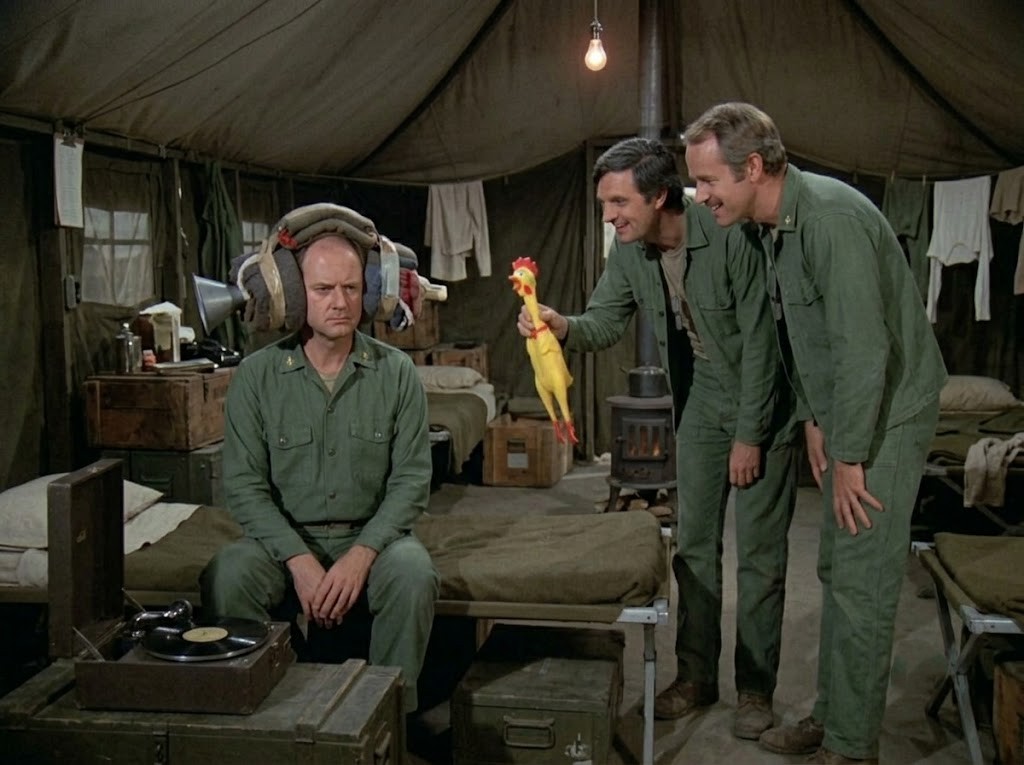
The Swamp always smelled the same after a thirty-hour shift in Post-Op. It was a thick, unmistakable mixture of cheap gin, stale cigar smoke, damp canvas, and the distinct, metallic scent of exhaustion.
Charles Emerson Winchester III sat on the edge of his cot, motionless. He hadn’t unbuttoned his olive-drab fatigue jacket, nor had he removed his boots.
Instead, he sat perfectly rigid under a mountain of improvisational insulation. Two heavy woolen army blankets were wrapped tightly over his head like an oversized, ridiculous turban, secured by a complex web of clothesline and belts.
Wedged firmly against his left ear was a tin funnel, acting as a makeshift horn to catch the faint, scratchy sounds drifting from his portable phonograph. A classical record spun slowly on the turntable, but Charles wasn’t just listening to the music; he was hiding inside it.
Across the tent, Hawkeye Pierce and B.J. Hunnicutt stood shoulder to shoulder, watching their sophisticated tentmate with a mixture of amusement and genuine concern. The contrast was stark—Charles looked like a miserable, aristocratic monument to despair, while Hawkeye held a bright yellow rubber chicken aloft like a sacred peace offering.
“I tell you, Beej, it’s a clinical case of Bostonian sensory overload,” Hawkeye whispered, his voice laced with that familiar, tired humor he used to keep the darkness at bay. “The man has finally realized that the 4077th does not possess an opera box, and his soul is rejecting the reality.”
B.J. leaned forward, resting his hands on his knees, a soft, knowing smile tugging at the corners of his mustache. “Either that, or he’s finally found a way to completely block out your snoring, Hawk. Honestly, I might ask him to borrow the blueprints.”
For the past three days, the shelling in the distance had been relentless. It wasn’t close enough to threaten the camp directly, but the steady, low thudding had vibrated through the floorboards of the O.R., rattling the instruments and everyone’s nerves.
Combined with a massive influx of casualties from the front, nobody had slept more than a handful of broken hours. Charles, usually so quick with a biting insult or a demand for privacy, had simply retreated into absolute, stone-faced silence.
Hawkeye took a step closer, gently squeezing the rubber chicken. It let out a pathetic, high-pitched *squeak* that cut through the scratchy strains of Mozart.
Charles didn’t blink. His eyes remained fixed on the floor, heavy with a fatigue that went far deeper than a lack of sleep. His jaw was set, his expression frozen in a mask of stern, unyielding misery.
“Come on, Charles,” Hawkeye coaxed, waving the chicken slightly closer to the funnel on Winchester’s head. “Look at him. He’s a Harvard graduate. He’s passed the bar. He’s here to offer a second opinion on your neurological state.”
B.J. watched Charles’s hands, which were clasped tightly in his lap. The knuckles were white. “Hawk, lay off a second,” B.J. said softly, his tone shifting from playful to observant. “He’s not ignoring us. He’s somewhere else entirely.”
The record player hissed as the needle hit a scratch in the vinyl, repeating a fractured, broken bar of music over and over again. The small, repetitive sound seemed to echo the endless, repetitive cycle of the war outside their canvas walls.
Suddenly, Charles’s shoulders trembled, just a fraction. He didn’t look up, but a single, sharp breath escaped his lips, sounding dangerously close to a choke.
The playful atmosphere in the tent vanished in an instant, replaced by the heavy, suffocating reality of what they all carried. Hawkeye slowly lowered the rubber chicken, his cynical defense mechanism melting away to reveal the deeply empathetic doctor underneath.
He exchanged a quick, worried glance with B.J., who moved around the crate and knelt down closer to Charles’s level.
“Charles?” B.J. asked, his voice remarkably gentle. “Talk to us, pal. You’ve been in that rig for two hours. It’s okay to take the armor off.”
For a long moment, the only sound was the scratch of the broken record. Then, slowly, Charles reached up with one trembling hand and pulled the tin funnel away from his ear. He didn’t dismantle the blankets wrapped around his head; they remained perched there like a heavy, absurd crown.
“The boy from the morning shift,” Charles said, his voice shockingly raspy, stripped of its usual theatrical grandeur. “The young corporal from Berkshire County. Just a few miles from my family’s summer estate.”
Hawkeye sat down quietly on the edge of his own cot, listening. He knew exactly which patient Charles meant. They had spent four hours trying to repair the boy’s shattered leg.
“He asked me if the snow still fell the same way over the Berkshires in December,” Charles whispered, his gaze still fixed on the dirt floor. “He wanted to know if the frost still painted the windows of the old libraries in Boston. And I… I told him it did. I promised him he would see it again.”
Charles swallowed hard, his throat working. “I lost his pulse three minutes after we moved him to Post-Op. I am a surgeon trained at the finest institutions in the world, Pierce. Yet, I could not preserve a single piece of my own home.”
The silence that followed was profound. It was the kind of silence that visited the 4077th after the helicopters left, when the adrenaline faded and the sheer weight of their helplessness set in.
Hawkeye reached out, his hand resting briefly on Charles’s fatigue-clad shoulder. There were no jokes left, no witty rejoinders to deflect the pain. There was only the shared understanding of three men trapped in a valley of broken things.
“You gave him a piece of home before he went, Charles,” Hawkeye said quietly, his voice steady and devoid of irony. “In a place like this, that’s not nothing. In fact, it might be the only thing that matters.”
B.J. reached over and gently clicked off the phonograph, silencing the repeating scratch of the needle. “We can’t save the world, Charles. We can barely save ourselves. But we keep each other warm.”
Charles sat quietly for a moment, letting the words settle over him. Slowly, the rigid tension in his spine began to thaw. He raised both hands and began to unfasten the clothesline, allowing B.J. to help him slide the heavy blankets off his head.
When the makeshift helmet was gone, Charles looked incredibly small, his thinning hair messy, his eyes red-rimmed and tired. But the frozen, distant look was gone, replaced by the exhausting, healing return to reality.
He looked at Hawkeye, then down at the yellow rubber chicken still held loosely in Hawkeye’s hand. A tiny, microscopic smirk briefly touched the corner of Winchester’s mouth, so fast you would have missed it if you weren’t looking closely.
“If that poultry comes any closer to my person, Pierce, I will personally ensure it is served in the mess tent as the chief ingredient in Father Mulcahy’s Sunday broth,” Charles muttered, though the familiar aristocratic bite lacked any real venom.
Hawkeye let out a soft, relieved laugh, tossing the chicken onto his own cot. “Now that’s the Winchester elegance I know and tolerate. Come on, Charles. Let’s go see if Radar can conjure up some of the Colonel’s private stash. God knows we’ve earned a sip.”
Charles stood up, stretching his stiff back, adjusting his jacket with a lingering, stubborn dignity. He looked around the cramped, messy tent, at the two men who knew his deepest vulnerabilities and still looked at him with nothing but respect.
They weren’t the high-society peers he had grown up with in Boston. They were loud, unrefined, and constantly smelled of low-grade alcohol. But as they walked out into the cool Korean night together, Charles knew they were the closest thing to a family he had ever found.
Sometimes, the only way to survive the madness of the 4077th was to lean on the people who shared the weight.