The Quiet After the Storm
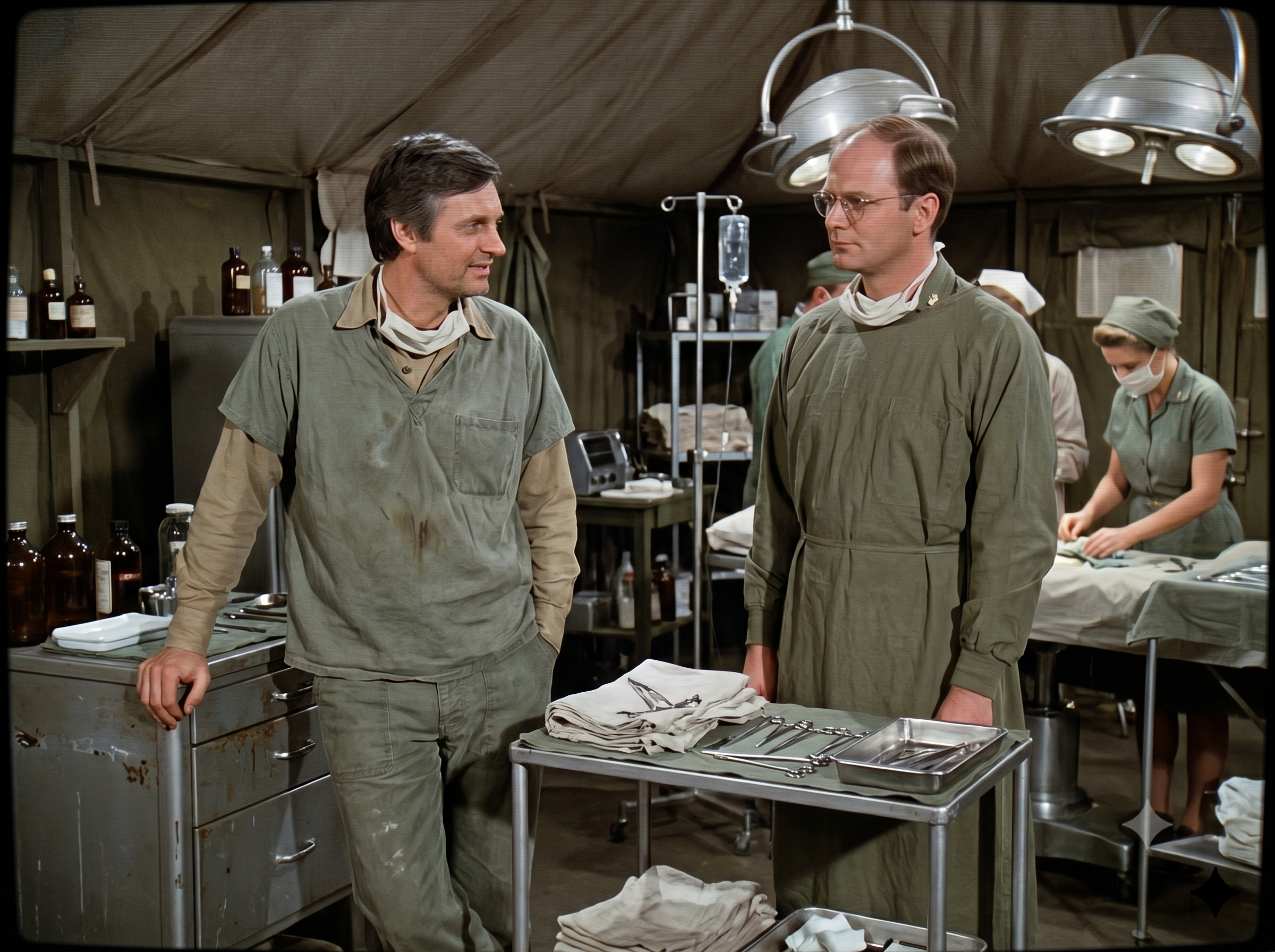
The silence in the Operating Room was always louder than the war.
When the choppers stopped bringing in their tragic cargo and the generators finally stopped humming, the silence dropped over the 4077th like a heavy, suffocating woolen blanket. It was four in the morning. They had been standing over the tables for seventeen straight hours.
Hawkeye Pierce felt as though someone had replaced his bones with crushed glass and lead. He stood near the scrub sinks, leaning heavily against a grey metal supply cabinet. It was the only thing keeping him vertical. His surgical mask was pulled down around his neck, his green scrub shirt hopelessly wrinkled and stained with the day’s grueling work.
A few feet away stood Major Charles Emerson Winchester III.
Charles was still swathed in his oversized, rumpled surgical gown. Unlike Hawkeye, Charles refused to slouch. He stood upright, his posture rigid, fighting a private battle against gravity and exhaustion. His mask was also pulled down, framing a face that looked pale and worn thin.
In the background, a nurse quietly sorted instruments, the metallic clinking the only sound left in the cavernous tent.
Hawkeye let out a long, ragged breath, resting his hands lightly on the cabinet. He looked over at the Boston aristocrat. He was looking for a crack, a joke, a sarcastic jab—anything to push away the ghosts of the young men they had just stitched back together.
“You know, Charles,” Hawkeye said, his voice a dry, gravelly croak. “For a man who claims to abhor manual labor, you certainly know how to sew a fine hem. You could make a fortune doing alterations at a downtown department store.”
Charles did not immediately fire back with a haughty insult.
Instead, he simply stood there, staring straight ahead at nothing in particular. He slowly reached up to adjust his wire-rimmed glasses, and when he did, Hawkeye saw it.
Charles’s hand was trembling.
It wasn’t a small tremor. It was a violent, uncontrollable shaking—the kind of physical betrayal that comes when the adrenaline finally burns out, leaving nothing behind but raw nerves and sheer terror. Charles quickly lowered his hand, gripping the edge of a surgical tray so tightly his knuckles turned entirely white.
Hawkeye stopped smiling. The dry humor vanished from his eyes.
The kid on table three had almost slipped away from them twice. It was a massive chest wound, an impossible jigsaw puzzle of torn arteries and shattered ribs. It had taken both of them, working in a frantic, bloody, synchronized dance, to pull the nineteen-year-old boy back from the absolute brink.
Charles had found the bleeder in the dark. Charles had saved him.
But right now, the great Boston surgeon looked like he was about to shatter into a million pieces right there on the linoleum floor. Charles took a sharp, shallow breath, his eyes squeezed shut tight, fighting desperately to maintain his ironclad composure.
“Winchester,” Hawkeye said softly, taking a half-step forward.
“I am perfectly fine, Pierce,” Charles snapped out, though his voice lacked its usual booming authority. It sounded thin, fragile, and desperate. “It is merely… muscle fatigue. The retractors were incredibly stiff today.”
Hawkeye didn’t push. He knew better than to strip a proud man of his last shred of dignity.
Instead, Hawkeye leaned back against the grey metal cabinet, mirroring Charles’s stance just a little. He crossed his arms loosely and looked softly at his colleague. In the Swamp, they were mortal enemies, separated by class, geography, and completely incompatible taste in music. But in this room, under the harsh glare of the surgical lamps, they were just two tired men holding back the tide.
“Adrenaline is a lousy tipper, Charles,” Hawkeye said gently. “It makes you feel like Superman for ten hours, and then it leaves you with the check.”
Charles kept his grip on the tray, but his shoulders dropped just a fraction of an inch. He opened his eyes and looked at Hawkeye. There was no arrogance in Winchester’s gaze now. There was only the shared, hollow ache of a doctor who had looked death in the face and barely won the argument.
“He was so young, Benjamin,” Charles whispered, the use of Hawkeye’s real name a rare white flag in the O.R. “When his pressure dropped the second time… I truly believed we had lost him.”
“But we didn’t,” Hawkeye said firmly. “We didn’t lose him, Charles. Because you clamped that artery blind. I’ve been doing meatball surgery in this miserable sandbox for two years, and I’ve never seen a faster pair of hands.”
Charles stood in silence, processing the unadulterated praise. From Hawkeye Pierce, a compliment of that magnitude was rarer than fresh eggs in the mess tent.
Slowly, the trembling in Charles’s hands began to subside. He let go of the metal tray and stood fully upright again, pulling his shoulders back into their familiar, aristocratic alignment. The crisis had passed. The heavy, emotional weight in the room began to lighten, replaced by the comfortable, exhausted camaraderie they both desperately needed.
Hawkeye offered a small, weary, completely genuine smile. It was the exact moment caught in the quiet space between them—Hawkeye looking up, his expression thoughtful, emotionally alert, and deeply humane.
“Of course,” Hawkeye added, his dry humor returning to safely cover the vulnerability. “If you ever tell anyone I said that, I’ll swear I was drunk on my own still and deny it to the commanding officer.”
Charles looked back at him. The faintest ghost of a smile tugged at the corner of Winchester’s mouth. He looked slightly out of place, as he always did in this dirty, makeshift hospital, but right now, there was a reluctant, profound warmth in his eyes.
“Do not worry, Pierce,” Charles replied, his voice regaining a touch of its familiar haughty velvet. “I have no intention of ruining my impeccable reputation by letting people know I associate with you.”
“That’s the spirit,” Hawkeye chuckled softly. He pushed himself off the cabinet, his legs finally remembering how to work. “Come on, Charles. Let’s go back to the Swamp. I think I have a tin of smoked oysters from Maine that I’ve been saving for a minor miracle.”
“Oysters?” Charles asked, raising an eyebrow. “With what vintage, I shudder to ask? Your bathtub gin?”
“Only the finest,” Hawkeye said, turning toward the door. “Bottled yesterday.”
Charles sighed heavily, but he followed Hawkeye out of the sterile light and into the dark Korean night. They walked shoulder to shoulder, two wildly different men from two entirely different worlds, united by the blood on their boots and the lives they had saved.
The O.R. was quiet again, waiting for the next wave, but for tonight, the war had lost, and the doctors had won.
Some bonds aren’t made of shared histories or similar backgrounds; they are forged in the silence of an operating room, sewn together by the simple, profound grace of saving a life.