The Unreadable Words of Home
In the 4077th, mail call was the only true medicine that didn’t come in a glass vial. It was a temporary ticket out of the mud, a brief window back to living rooms, front porches, and a world that still made sense.
But sometimes, the war didn’t even let them have that.
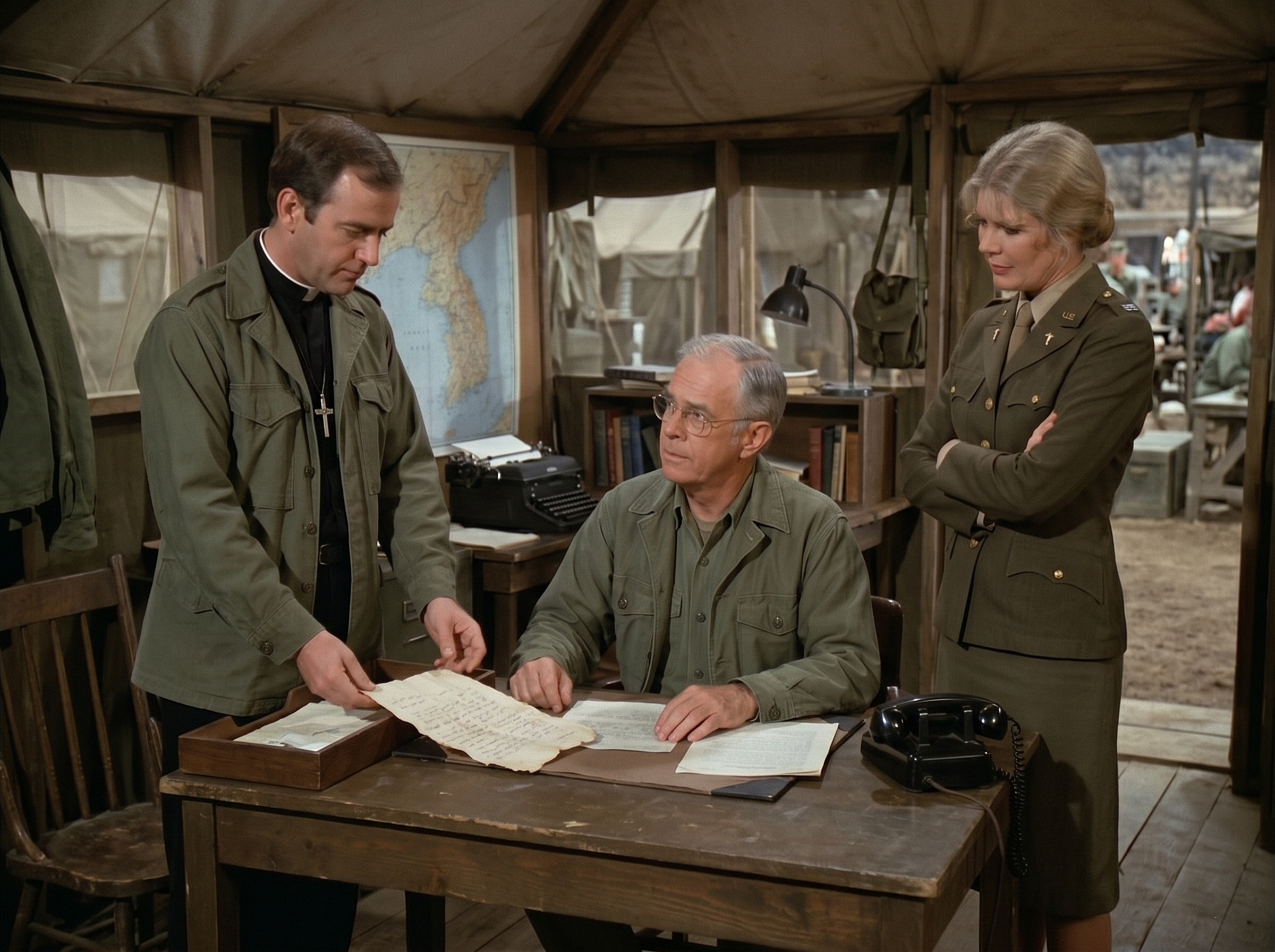
Inside Colonel Potter’s office, the late afternoon sun filtered weakly through the olive-drab canvas. The practical, soft light of the desk lamp cast long, weary shadows across the wooden floorboards. The small tent smelled of old paperwork, stale coffee, and the ever-present dust of Korea.
Colonel Sherman Potter sat behind his heavy wooden desk, leaning slightly forward. He looked every bit the seasoned cavalryman, anchored with a grounded, fatherly presence. But right now, his expression was etched with a weary wisdom, his eyes locked on the tragic little object hovering over his blotter.
Standing beside the desk was Father Francis Mulcahy. The chaplain’s posture was characteristically modest, his shoulders slightly slumped under the weight of an invisible burden. His face held an expression of quiet, profound sadness.
In his gentle hands, Mulcahy was holding up a single, heavily damaged letter.
It was a ruined mess of faded paper. The mail jeep had skidded into a rain-swollen ditch on its way up from Seoul that morning. While most of the canvas sacks had been pulled from the muck in time, one small bundle had soaked in the muddy water and leaking engine oil.
A few feet away, Major Margaret Houlihan stood by the filing cabinets. She had come in to deliver the afternoon duty roster, but she hadn’t moved to leave.
Margaret stood with her arms folded defensively across her chest. Yet, her normally sharp, unyielding professional composure was entirely gone. Her face had softened into a quiet, unexpected compassion. She was staring at the ruined paper in the chaplain’s hands, her eyes betraying the deep tenderness she usually kept hidden beneath her brass and starch.
“I’ve tried everything, Colonel,” Father Mulcahy said, his voice barely above a whisper. “I held it over the stove. I tried to peel the pages with tweezers. But the ink is completely washed away. It’s just… blue smudges.”
Potter let out a heavy, tired sigh. He took off his wire-rimmed glasses and rubbed the bridge of his nose. “Not a single word, Father?”
“Only the address on the envelope, sir,” Mulcahy replied, gently turning the crinkled, stained paper toward the light. “It’s for Private Miller. The young man who came through triage two nights ago with the severe chest wounds.”
Margaret shifted her weight, her voice surprisingly thick with emotion. “He’s barely holding on in Post-Op, Colonel. His fever spiked again an hour ago. He hasn’t stopped asking if the mail arrived.”
The silence in the small office grew heavy. They all knew the reality of a surgical hospital. Sometimes, a boy didn’t survive on plasma and penicillin alone. Sometimes, they survived because they had a reason to go back home.
“He told me this morning,” Margaret continued quietly, “that his mother promised to write and tell him about his little sister’s graduation. He’s been hanging onto the thought of this letter for weeks.”
Mulcahy looked down at the muddy, fused lump of paper in his hands. It was nothing but a casualty of bad roads and bad luck. The words of a loving mother, drowned in a Korean ditch before they could reach her dying boy.
“What do we tell him?” Mulcahy asked, looking between the Colonel and the Major. “To hand him this ruined thing… it might break whatever spirit he has left.”
Just then, the squeak of the office screen door broke the stillness. Corporal Radar O’Reilly peeked his head in, looking nervous and deeply earnest.
“Excuse me, Colonel,” Radar said softly. “But Private Miller is awake. He’s… well, he’s crying, sir. He’s asking for the Father. He wants to know if his letter dried out.”
Potter looked at the ruined envelope. He looked at the anxious clerk in the doorway. Then, he looked up at Margaret and Mulcahy, the weight of command settling heavily on his tired shoulders.
“Tell him the Father will be right there, son,” Potter said, his voice steady and calm.
Radar nodded, quietly closing the door and leaving the three officers alone again in the warm, brown-toned light of the office.
Potter put his glasses back on. He didn’t lean back in his chair. Instead, he reached out and gently took the muddy letter from Mulcahy’s hands, laying it flat on the green blotter of his desk.
“We can’t tell him it’s ruined,” Margaret said, her voice dropping into a fierce, protective whisper. Her arms remained folded, as if she were trying to hold her own heart in place. “If we tell him the war took this too, he’ll stop fighting the infection. I know it.”
“Lying to a dying boy…” Mulcahy murmured, his eyes full of conflict. “It goes against everything I’m supposed to do.”
“Horse hockey,” Potter said softly, though there was no anger in it. “Father, you’re not in the business of delivering mail. You’re in the business of delivering hope.”
Potter reached into his top drawer and pulled out a clean, crisp sheet of official Army stationery. He laid it gently next to the muddy ruin. He clicked his fountain pen open and looked up at the priest.
“Who says we need to see the words to know what a mother says to her son?” Potter asked.
Margaret uncrossed her arms. She stepped closer to the wooden desk, her eyes fixed on the blank sheet of paper. The harsh lines of the military nurse vanished completely, leaving only the woman who had held the hands of a thousand frightened boys in the dark.
“We know exactly what she wrote,” Margaret said softly.
Mulcahy’s troubled expression slowly eased. A gentle, understanding light returned to his eyes. He pulled up a wooden canvas chair and sat beside the desk, pulling his own small notepad from his pocket.
“Alright, Colonel,” Mulcahy said quietly. “Let’s read the letter.”
Potter looked down at the muddy smear. “Well,” he started, his gravelly voice dropping into a warm, paternal cadence. “Right here at the top, it says she misses him terribly. She says the house is far too quiet without him slamming the screen door.”
Mulcahy smiled, jotting a quick note on his pad. “Yes. And here in the second paragraph… she mentions the dog. Old Buster. She says Buster still sleeps at the foot of his bed, waiting for him to come home.”
Margaret stepped right up to the edge of the desk. She placed one hand gently on the worn wood. She looked at the muddy paper, but her eyes were seeing a farmhouse thousands of miles away.
“She tells him about his sister,” Margaret whispered, her voice trembling just a little. “She says Mary wore a beautiful white dress to graduation. And that Mary wished her big brother was there to see it.”
Potter nodded slowly, adding a few lines to his own mental draft. “She also says his father went out to the barn. Fired up that old Ford he’s been working on. Says it runs like a top, and it’s sitting under a tarp waiting for him to take the wheel.”
The room felt incredibly warm. The sounds of the helicopters and the distant artillery seemed to vanish, blocked out by the walls of the small canvas tent. For a few minutes, they weren’t commanding officers or seasoned veterans. They were just family.
“And down here,” Margaret said, pointing to the darkest, most ruined edge of the paper. A single tear escaped her eye, but she didn’t wipe it away. “Down here, she tells him how proud she is. She tells him to be brave, but to be careful. And she tells him that she loves him more than anything in the world.”
Mulcahy finished writing on his notepad. He looked up at Margaret and Potter. The sadness was gone from his face, replaced by a quiet, fierce grace.
“A beautiful letter,” Mulcahy said softly.
“The best I’ve ever read,” Potter agreed.
Mulcahy stood up. He carefully tucked his handwritten notes behind the stiff, ruined envelope. When he held it up this time, he wasn’t holding a piece of trash. He was holding a lifeline.
Potter leaned back in his chair, a weary but genuine smile touching his lips. Margaret stood tall, her military bearing slowly returning, but the incredible softness remained in her eyes.
“Go read him his mail, Father,” Potter said.
Mulcahy nodded gently to them both. He turned and walked out of the office, stepping out into the blinding Korean sun to give a young boy his mother’s love.
Back in the office, the Colonel and the Major remained silent for a long time, standing together in the quiet, faded light, guarding the invisible home they had just built.
The war could destroy the paper, but it could never touch the words.